Get Full Government Meeting Transcripts, Videos, & Alerts Forever!
Get email alerts on the Paid Family Medical Leave topic
No spam. Unsubscribe anytime.
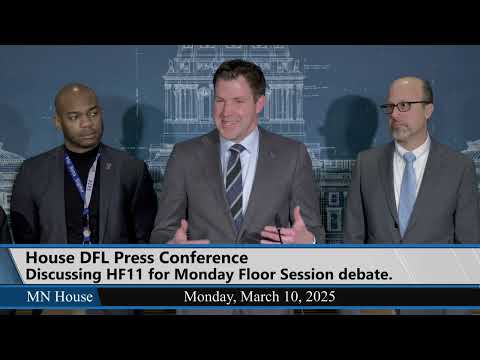
DFL leaders push for paid family and medical leave to take effect Jan. 1, 2026, reject GOP delay efforts
Summary
DFL lawmakers and allies defended Minnesota’s paid family and medical leave program at a Capitol event, detailing rates, small-business supports and the state agency role while warning against Republican attempts to delay or repeal the law.
Representative Dave Pinto, DFL lead on the Workforce, Labor and Economic Development Committee, opened a Capitol event by saying Minnesotans “have been waiting for years for the benefits of paid family and medical leave. Waiting another year is not an option.”
DFL lawmakers and supporters used the event to describe how the statewide paid family and medical leave program will work, press the case that the law should take effect as written and outline features meant to limit costs for small employers. They also criticized Republican lawmakers for pursuing repeal or delay measures and said the Department of Employment and Economic Development (DEED) will run the program.
Why it matters: The program creates a state-administered, premium-funded benefit that the DFL says will expand paid leave access to millions of Minnesotans who do not now have it. Lawmakers at the event repeatedly warned that efforts to postpone or undo the law would leave families without paid leave and urged Republicans to negotiate improvements instead of seeking repeal.
The bill and rollout: Speakers said the law is scheduled to begin paying claims Jan. 1, 2026. Representative Cedric Frazier of District 43A said, “paid family medical leave is not a luxury. It's necessary,” and framed the program as protecting workers from having to choose between income and caregiving.
Administration and timing: DFL lawmakers said DEED, which already runs Minnesota’s unemployment insurance system, will administer the paid-leave program. “We had DEED come to testify in our workforce committee specifically to those points,” Representative Frazier said, and DFL leaders said that testimony supported the program’s readiness to begin next year. DFL members emphasized annual actuarial reviews built into the program to set future premium levels.
Cost and benefit mechanics: Speakers gave several implementation figures during the event: - The announced general premium rate for the program was discussed as 0.88% of wages, with employers responsible for up to 50% of that premium and employees paying the remainder. DFL members said the law requires that split as a minimum. - Small employers were described as having a lower share: the “small employer” rate noted in the discussion was 0.44% (half of 0.88%) with additional discounts that can reduce employer exposure further; under some discounts an employer’s share could be as low as 0.22%. - Lawmakers said the statute sets a premium cap at 1.2%.
Support for small businesses: DFL speakers said the law includes graduated treatment for employers and direct supports. They described rate “cuts” and grants intended to help small businesses cover temporary staffing, retraining and fill-in costs when employees use leave. Representative Frazier said those provisions were adopted after listening to small employers and advocates.
Eligibility, enrollment and benefits process: Lawmakers described the program as state-run and similar in administration to unemployment insurance. When an employee applies, the state will determine whether the worker has met eligibility requirements and, if eligible, make payments. DFL leaders emphasized that employers will not be required to adjudicate claims; that work is on DEED once the program is operational.
Political fight and GOP actions: Speakers repeatedly criticized Republican lawmakers for introducing repeal or delay bills. Pinto said Republicans were “choosing to stand with corporations and the ultra wealthy over hard working Minnesotans” and contended Republicans “don't just want to push back the start date for this program” but are seeking repeal. The DFL speakers said the program is popular and that many Minnesotans are already planning to rely on it once it takes effect.
Assurances and safeguards: DFL leaders highlighted a built-in review process: annual actuarial studies will assess program finances and guide premium adjustments. They said current actuarial projections do not indicate the program will approach the 1.2% cap in the near term.
Implementation concerns raised and kept in view: DFL speakers acknowledged employer concerns and said they were discussing technical clarifications and potential targeted tweaks (for example, on collective bargaining exemptions) in separate legislation. They also described the option for private employers whose plans are at least as generous as the state’s to apply for an exemption from the state program; employers with less-generous plans would remain covered by the state program unless they amend their benefits.
Ending: DFL leaders closed by urging that the law be allowed to take effect and by offering to continue discussions on technical aspects to reduce employer confusion. "Paid family and medical leave is necessary and it's needed now,” Frazier said, and the group urged lawmakers to avoid blocking implementation for political reasons.