Get Full Government Meeting Transcripts, Videos, & Alerts Forever!
Get email alerts on the State Agriculture Budget topic
No spam. Unsubscribe anytime.
Minn. House Ag Committee lays over HF1704 DE3 after policy, budget walkthrough and contested broadband language
Summary
The House Committee on Agriculture Finance and Policy on March 10 reviewed House File 1704 DE3, a biennial agriculture finance amendment that would raise the ag budget base by about $17 million and add targeted appropriations for meat inspection, county ag inspectors, a biofertilizer incentive and other programs; committee members laid the amendment over after extended testimony and debate over broadband installer language.
ST. PAUL — The House Committee on Agriculture Finance and Policy reviewed House File 1704 DE3 on Monday, March 10, a biennial agriculture finance amendment that the committee laid over after a detailed fiscal and policy walkthrough and extended public testimony.
The DE3 amendment would raise the agriculture budget’s base by roughly $17,000,000 in the FY 2026–27 biennium and makes a host of targeted appropriations and transfers, including one‑time and base increases for meat inspection, livestock processing, county agricultural inspectors, a biofertilizer incentive program and other programs administered by the Minnesota Department of Agriculture (MDA), the Board of Animal Health and the Agricultural Utilization Research Institute (AURI). Committee members and a dozen testifiers debated the bill’s funding priorities and a controversial change to last year’s broadband installer law that was placed in the agriculture omnibus.
The committee’s fiscal analyst, Ken Sabry of House Fiscal Analysis, led a line‑by‑line presentation of the amendment’s spreadsheet, noting the bill’s net general‑fund impact over base is $17,070,000 in FY 2026–27 and $7,810,000 in FY 2028–29. Highlights he cited included a one‑time $2,000,000 appropriation for county agricultural inspectors, a $1,250,000 annual appropriation for the biofertilizer innovation and efficiency program in FY 2026–27, $850,000 annually for additional meat inspection capacity, and an increase to AGRI allocations that includes “up to” and designation language for farm‑to‑school and other programs.
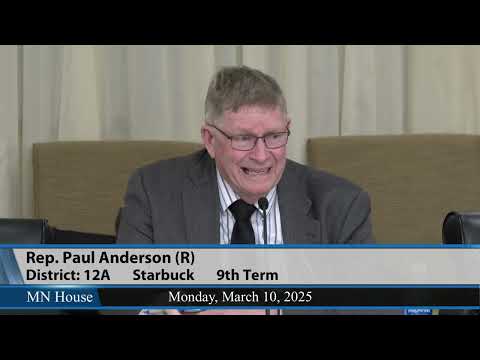
"If all of us on the Ag Committee would maybe agree that we would like to see Ag getting a little bit bigger piece of the overall Minnesota State budget," Representative Gerry Anderson, who moved the DE3 amendment, told the committee in his opening remarks while describing the bill’s scope and priorities.
The amendment also cancels a prior green fertilizer appropriation, reduces some pass‑through grants, and includes transfers such as $1,500,000 from the general fund to the agriculture emergency account in FY 2025. Sabry walked members through dozens of line items and riders; nonpartisan House Research staffer Megan Mullenbach reviewed the draft language and cross‑referenced provisions to earlier bills the committee had heard this year (for example, provisions tied to previously heard House files involving depredation payments and biofuel infrastructure grants).
Why it matters
The bill packages operating increases and one‑time investments aimed at meat and poultry inspection, livestock processing, agro‑innovation and emergency response in agriculture at a moment when several testifiers and the MDA warned about uncertainty in federal funding. Stakeholders said targeted investments could shore up local processing capacity, compensate livestock and crop producers for depredation and help emerging farmers access land and technical support. At the same time, several interest groups and committee members objected to process and to a broadband installer provision placed in the ag package.
Key testimony and disagreements
Tom Peterson, commissioner of the Minnesota Department of Agriculture, thanked lawmakers for their work and described programmatic needs including operating adjustments, meat inspection and depredation payments, but said the department’s position at the time was to support the governor’s budget “until we have like a global target situation that’s agreed to.”
Cameron Henning, a commercial agronomist for Pivot Bio, testified about Section 11, the biofertilizer innovation and efficiency program. Discussing the types of products farmers might use to qualify, he said, “Biological products are growing rapidly throughout agriculture with dozens of companies offering new products and solutions all the time.” Henning described biological nitrogen sources as microbes applied to seed that “spoon feed” plants and, he said, “do not leach and do not volatilize and therefore do not contribute to high nitrate in the water or nitrous oxide in the air.”
County agriculture inspectors urged support for a new appropriation. Bob Dunning, Stearns County agricultural inspector, said county inspectors enforce Minnesota’s noxious weed law, run biological control programs and provide technical assistance; he told the committee that funding for those duties has been “very limited and sporadic.”
Advocacy groups including Minnesota Farm Bureau, Minnesota Farmers Union and Land Stewardship Project expressed support for many provisions—farm business management funding, meat processing investments, and farm safety and wellness grants—while flagging cuts they opposed (for example, a $3,000,000 reduction to a green fertilizer production facility incentive originally funded in 2023).
Broadband installer language drew sustained, cross‑sector testimony. Melissa Wolf, executive director of the Minnesota Cable Operations Association, and Tom Hanson of the Minnesota Telecom Alliance said last year’s new telecom installer training and certification law created an impossible July 1, 2025 deadline for thousands of existing broadband workers to complete 40 hours of new training and pass a state test. Wolf said the DE3 language would not repeal safety standards but “provides additional time, flexibility and clarity to get the new safety program up and running so the new certification program is done right.”
Utility and labor witnesses took opposing positions. Jamie Fitzke, director of government affairs for CenterPoint Energy, told the committee that telecom excavator damages to gas infrastructure rose 60% in 2023–24, and that excavators were found at fault in 75% of those incidents; Fitzke urged robust training that included best practices and dig‑law education. Labor representatives and LiUNA expressed concern that the DE3 language would roll back safety training and urged the committee to refer the changes to the Labor Committee; LiUNA’s Kevin Prentice said he worried the amendment would “send a green light to the same kind of contractors that thought it was appropriate to patch a gas pipeline leak with duct tape.”
Process and timing criticisms
Several Democratic committee members objected to timing and process, arguing that the amendment included provisions that had not received prior hearings and that the state faces major federal funding uncertainties. Representative Fuey Hansen said, “Just because you can bring this bill doesn’t mean you should,” calling it “not normal” to move the omnibus ahead while questions about budget targets and a pending special election remain. Representative Vang and others echoed concerns that key budget targets and external funding uncertainties were unresolved.
What the committee did
After testimony and discussion, the committee laid HF1704 DE3 over for future consideration. Earlier in the meeting the committee also approved corrected minutes for a prior meeting (a motion to approve the minutes, with a spelling correction for “LiUNA,” passed by voice vote). No final adoption or roll‑call vote on HF1704 DE3 occurred at the March 10 meeting.
Provisions to watch and next steps
The amendment includes several items with immediate or near‑term impact if enacted: a transfer into the ag emergency account for FY 2025, supplemental depredation payments referenced to earlier House files, a biofertilizer incentive program that requires rulemaking and minimum enrollment and documentation standards for participants, and changes to AGRI allocations that convert some earlier explicit appropriations into “allowable spending” designations. Committee members said they expect additional amendments and negotiations before a final bill vote.
Members scheduled the committee’s next meeting for Wednesday, March 12, 2025. The H1704 DE3 amendment remains laid over.