Get Full Government Meeting Transcripts, Videos, & Alerts Forever!
Get email alerts on the Health Non Opioid Directive topic
No spam. Unsubscribe anytime.
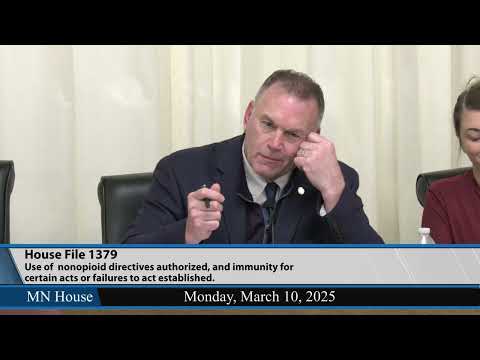
Committee adopts amendment and refers bill creating non‑opioid directive to judiciary committee
Summary
A House committee adopted an A1 amendment and voted to refer House File 1379, which would create a one‑page non‑opioid directive to be stored in electronic health records, to the Committee of Judicial, Finance and Civil Law for further work.
The chair moved adoption of the A1 amendment and the committee then approved a motion to refer House File 1379, creating a one‑page non‑opioid directive for patients to record their preference to avoid opioids, to the Committee of Judicial, Finance and Civil Law.
The bill would direct the Minnesota Department of Health to create and publish a non‑opioid directive form for patients to upload to their electronic health record. Representative Baker said the directive is intended as a communication tool so “the provider or the EMT, whoever has access to their records” can see that a patient has requested to avoid opioids when possible.
Supporters, including Alicia House, executive director of the Steve Rimmler Hope Network, told the committee the form would help people in recovery avoid unintended exposure. “This bill will allow patients the ability to create a non opioid directive, ensuring that they are not prescribed or administered opioids without their expressed consent,” House said, adding the directive would empower patients and support safer, more personalized care.
The bill text includes several clarifications discussed in committee: the form is revocable at any time; providers would not be liable if they cannot feasibly access a patient’s record; and providers retain authority to administer opioids when, in their professional judgment, the medication is medically necessary. Dave Renner of the Minnesota Medical Association said the intent of the emergency exception is to cover situations when clinicians cannot access a patient’s records and must act immediately.
Committee members asked for clearer language about the bill’s exceptions. Representative Liebling said the draft’s current wording on the hospital and emergency exemptions (line 2.3 and related language) is unclear and could be read to exempt all hospital care; Liebling asked that the language be rewritten so the emergency modifier plainly applies when records are inaccessible. Representative Baker and other members said they planned further technical edits in the next committee.
The chair called two voice votes: one to adopt the A1 amendment and a second to refer House File 1379 as amended to the Committee of Judicial, Finance and Civil Law. Both motions passed by voice vote, without a recorded roll‑call tally.
Next steps: the bill is headed to the Committee of Judicial, Finance and Civil Law for further review and drafting changes requested by members, including clearer emergency‑exception language and confirmation of how the form will be made available to dental and other outpatient providers.