Get Full Government Meeting Transcripts, Videos, & Alerts Forever!
Get email alerts on the Rural Ems Funding topic
No spam. Unsubscribe anytime.
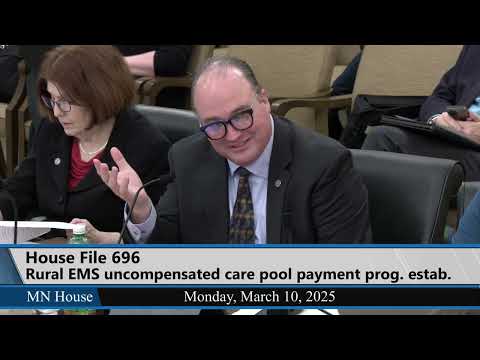
Committee advances bill to reimburse rural EMS for non-transport and "no‑load" calls
Summary
The House Health Finance and Policy Committee laid over House File 696 as amended after testimony that roughly 18–20% of rural EMS runs are non‑transports and go unpaid. The measure would allocate $3 million and use a points formula to send more funds to smaller services.
The House Health Finance and Policy Committee on March 10 laid over House File 696, as amended, for possible inclusion in an omnibus bill after testimony about financial pressures on rural emergency medical services.
House File 696, introduced by Representative Tim Backer, would create a $3 million pool administered by the state Office of Emergency Medical Services to reimburse eligible ambulance services for certain "no‑load" responses — runs that do not result in patient transport and currently generate no payment for many rural providers. The bill includes a points formula that awards more points to smaller services and yields higher per‑point value for low‑volume providers.
The measure aims to address volunteer and municipally run ambulance services that report significant unpaid responses. "About the last 90 days, I've had 68 responses in the last 98 days that are not billable," said John Fox, interim director at Dodge Center Ambulance. "We still had to staff, we still had to go out the door ... that falls well within that 15 to 25 percentage, so 20% or so of our runs are not transports." Fox told the committee those unpaid responses still carry real costs — staff time and supplies — and that modest reimbursement could support training and retention.
Why it matters: Committee members and testifiers framed the proposal as a targeted, modest step toward rural EMS sustainability. Representative Backer said smaller services can run 120–130 calls a year and that roughly 20% being unpaid makes a material difference to budgets and volunteer recruitment. "A little bit of something is a better whole than a lot of nothing," Backer said, describing the bill's intent to funnel support to services with the smallest volumes.
Key details: The bill sets a $3,000,000 appropriation and directs the EMS director to award points based on eligible no‑load responses and service size. Representative Backer described the points scale in committee: responses 1–25 earn 10 points per response, 26–50 earn 5 points, 51–100 earn 3 points, and 101–200 earn 1 point. Backer and others said the formula is designed to push more funding to the smallest services. A fiscal note provided to the committee indicated about $2,500 in administrative costs that the Office of EMS can absorb.
Questions and concerns: Committee members sought more information about the program design and the $3 million figure. Representative Tina Liebling asked why $3 million was chosen; Backer responded that the amount follows a precedent of testing smaller programs and that the figure was intended to be substantial but not excessive. Members also pressed how the payments would affect recruitment, training and whether metropolitan services were excluded intentionally; Backer said the bill targets Greater Minnesota because many metro services are hospital based and have much higher call volumes.
Representative Hewitt asked whether reimbursement for non‑transport calls would let services hire more full‑time staff or mainly cover training and readiness costs. Backer and Mr. Fox said the funds were expected to be used largely for training and readiness — for example, to cover training costs for personnel and modest increases in call‑time compensation that help keep rigs staffed.
Action taken: The committee adopted an author's A1 amendment by voice vote and the chair laid House File 696, as amended, over for possible inclusion in an omnibus bill.
What remains: The bill's point calculation and the exclusion of metropolitan counties drew questions that committee members said would be refined in follow‑up drafting. Committee members also asked for more detailed projections of individual award sizes under the formula; Representative Backer said precise award amounts would vary year to year and were not calculated on the record.
Provenance: Testimony and discussion on the bill began when Chair Backer introduced House File 696 and moved the A1 amendment (transcript excerpt: "House file 6 96... I will move 6 96 before the committee, with the chairs intent to lay the bill over..." ) and concluded when the chair laid the bill over as amended for possible inclusion (transcript excerpt: "The chair lays over house file 6 96 as amended for possible inclusion in an omnibus bill.").