Get Full Government Meeting Transcripts, Videos, & Alerts Forever!
Get email alerts on the Road Funding Gap topic
No spam. Unsubscribe anytime.
MnDOT: highway user tax revenues rising in nominal terms but a nearly $1.9 billion shortfall remains
Summary
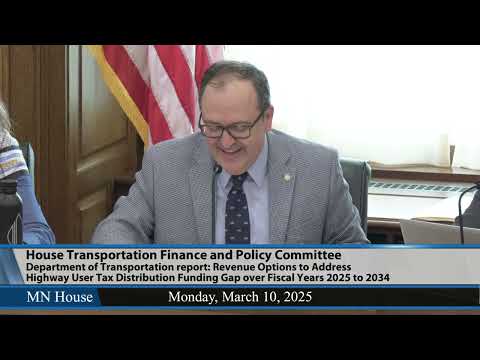
MnDOT Chief Financial Officer Josh Kannatter Heubinger told the House Transportation Committee the Highway User Tax Distribution fund generated about $2.7 billion in fiscal 2024 but that projected needs across state, county and city systems create a funding gap of roughly $1.9 billion per year.
Mnesota Department of Transportation Chief Financial Officer Josh Kannatter Heubinger told the House Transportation Committee on March 19 that Minnesota’s Highway User Tax Distribution (HUTD) fund generated just under $2.7 billion in fiscal 2024 but projected needs for the trunk highway, county and municipal systems create about a $1.9 billion annual shortfall.
Heubinger said the HUTD fund’s three primary revenue sources are the state gas tax, motor vehicle registration taxes and 60 percent of the motor vehicle sales tax, and that registration taxes overtook gas taxes as the single largest contributor in 2024.
The report required by statute asked MnDOT to estimate needs over a 10-year horizon and propose options to narrow the gap. Heubinger said the department used its 20-year trunk-highway plan as the baseline, which previously showed a roughly $890 million-per-year shortfall for MnDOT’s trunk-highway share; when MnDOT constructed comparable need estimates for counties and cities the combined HUTD shortfall came to about $1.9 billion per year, roughly an 80 percent increase over current revenues.
Why it matters: committee members said they wanted clear context for state transportation planning as lawmakers consider competing priorities. Members pressed MnDOT on how much of the gap pays for maintaining existing roads versus expansion, whether recent legislative changes reduced the gap and what internal efficiencies the department has identified.
Key details from MnDOT’s presentation
- FY2024 HUTD receipts: about $2.7 billion (all sources combined). Heubinger said the HUTD’s three primary sources are the gas tax, registration taxes (tabs) and 60% of motor vehicle sales tax. Smaller vehicle-related sales taxes also feed the fund.
- Gas tax: MnDOT said the state gas tax is 31.8¢ per gallon and was indexed on Jan. 1, with a 3.3¢ increase tied to MnDOT’s construction cost index; future inflation indexing is capped at 3 percent per year. The presentation noted a debt-surcharge component remains in the gas tax to repay bonds passed in 2008 for bridges, and that surcharge will phase out as bonds are repaid.
- Registration taxes: the department described the current registration schedule as roughly 1.575% of a vehicle’s sticker price in year 1 and declining over 10 years to a $30 annual fee in year 11; MnDOT said registration revenue now exceeds gas tax revenue.
- Historical gap and the effect of 2023 legislation: MnDOT described earlier analyses showing a trunk-highway gap rising from roughly $600 million per year (2013 estimate) to $1.15 billion (2023 estimate). The department said 2023 legislation closed roughly $5 billion of the previously estimated 20-year trunk-highway shortfall, but a substantive residual gap remained. After adjusting for trunk-highway, county and city needs, MnDOT estimated an HUTD gap of about $1.9 billion annually.
- Needs mix: MnDOT told the committee that roughly 70 percent of the identified needs are for maintaining the existing system, less than 5 percent for expansion and the remainder for safety and other program delivery.
- Efficiencies: MnDOT said a 2018 statutory requirement directs the agency to identify efficiencies equal to at least 15 percent of new money; that 15 percent figure would amount to roughly $350 million over the period described, and Heubinger said MnDOT has identified roughly double that amount in efficiencies so far and has been directing savings back into the program.
Committee questions and follow-up items
Members questioned whether Minnesota’s roadway mileage is “too large,” and Heubinger described the state as having one of the largest roadway systems in the nation and said turnback programs exist to realign jurisdiction where appropriate but removing pavement is difficult in practice. Several members pressed MnDOT for more detail on the efficiency savings — what was achieved, whether savings are transferable or fungible, and whether statutory or regulatory changes by the Legislature could reduce costs. Heubinger said MnDOT can provide more granular documentation of the project-level and administrative efficiencies and the agency’s annual major-highway-projects report itemizes those savings.
On revenue options, MnDOT presented a menu of 22 possibilities grouped into statewide (for example, further gas-tax or registration-tax changes, potential road-user charging), local (local-option sales taxes, county real estate levies) and program-specific financing (expanded tolling/E-ZPass, federal TIFIA loans). Heubinger emphasized the report’s conclusion that no single option will close the gap and that a mix of measures would likely be needed.
On performance: MnDOT said pavement condition and bridges are in relatively good shape against the agency’s current performance targets for most categories, but that projected deterioration will outpace revenues if the gap is not addressed.
What the committee recorded as next steps
Members asked MnDOT to provide the committee with: a) the detailed list of efficiencies and how those savings have been reinvested, b) an explanation of what the 2023 legislative changes included and precisely how much they reduced the trunk-highway gap, and c) any available comparable “transit funding gap” analysis the department or Legislature may have. Heubinger said he would follow up with additional materials, including the detailed major-highway-projects report.
Ending note
Members acknowledged the size and urgency of the long-term maintenance shortfall and agreed the committee will continue to examine revenue and efficiency options as budget decisions are considered.
Speakers cited: Josh Kannatter Heubinger (Chief Financial Officer, MnDOT); Chair (committee chair, identified in the record); Vice Chair Meyers; Representatives Sensory Muir, Scribe, Tapke, Jones, Kraft, Cagle, Murphy, Olson and others who questioned or commented during the presentation.