Get Full Government Meeting Transcripts, Videos, & Alerts Forever!
Get email alerts on the Cannabis Regulation topic
No spam. Unsubscribe anytime.
Office of Cannabis Regulation: registry live, Metrc contract signed; cultivation licensing first step
Summary
The Office of Cannabis Regulation told a legislative committee that its rules are final, the public registry is live, and a seed‑to‑sale contract with Metrc is signed; OCR plans to open cultivation license applications first while it finalizes lab RFPs and a licensing portal.
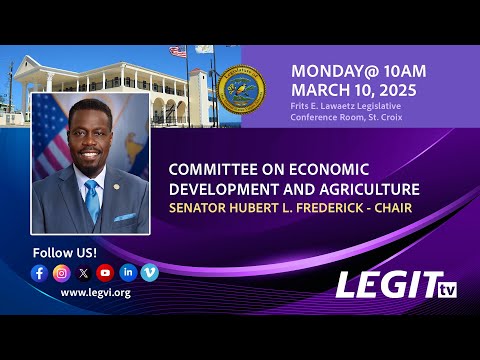
The Office of Cannabis Regulation (OCR) reported to the Committee on Economic Development and Agriculture on March 10 that it has completed key regulatory and technical foundations for a licensed cannabis industry and is preparing to open business licensing in phases.
Rules, registry and Metrc OCR Executive Director Joanne Moorehead said the agency adopted final rules and regulations in April 2024 to implement the Virgin Islands Cannabis Use Act (Act 86‑80) and that the digital registry for practitioners, patients, designated caregivers, sacramental organizations and sacramental users is operational. “All 5 of these online application systems are now live,” Moorehead told senators.
The OCR also confirmed it executed a contract with Metrc in January 2025 for the seed‑to‑sale tracking system. Moorehead described Metrc as an experienced provider used by multiple U.S. agencies and said OCR staff met with Metrc in a multi‑day kickoff to begin fit/gap analysis and implementation planning.
Licensing rollout and prioritization Moorehead said OCR will begin licensing with cultivation licenses and micro‑cultivation permits and will issue a Department of Property and Procurement request for proposals for certified laboratory testing facilities required by statute. OCR plans to open cultivation and micro‑cultivation applications in the coming weeks; lab RFPs are expected concurrently. The agency is designing an intermediary application process to allow the first licensing round to proceed while a longer‑term software integration with the registry portal is developed (that full integration could take up to a year).
Enforcement, staffing and interagency work OCR has expanded from a tiny office to a six‑person team across districts: an executive director, deputy, a lead agent with territorial responsibilities, two enforcement agents and an administrative staffer. Moorehead said enforcement officers have prior peace‑officer experience, are receiving OCR‑specific training and are coordinating work with DLCA, VIPD, DOH and other agencies. She said the enforcement unit will support other law‑enforcement partners with trainings and jurisdictional coordination.
Banking, collections and policy signals The committee pressed OCR about financial processing and how the government will collect taxes and license fees given cannabis’s federal status. Moorehead said OCR and the governor’s office are actively exploring solutions and courting vendors and institutions, but that banking and cannabis‑related financial services remain challenging across jurisdictions. She stressed OCR will coordinate with the Bureau of Internal Revenue to ensure taxes and fees are accounted for; OCR also confirmed a cannabis fund has been established within Department of Finance for OCR receipts.
Public education and outreach Moorehead said outreach and public education will be a continuing, multiyear campaign targeted to distinct audiences — youth, medical patients, sacramental users, employers and visitors — and that messaging must be sustained rather than a short advertising burst. The agency is planning communications tied to upcoming milestones, including opening the first licensing windows.
Bottom line OCR will open cultivation and micro‑cultivation licensing first and simultaneously seek certified testing labs; the Metrc contract and the digital registry are key near‑term milestones. Banking, tax collection processes and interagency enforcement protocols remain work in progress and were the most frequently raised questions by lawmakers.