Get Full Government Meeting Transcripts, Videos, & Alerts Forever!
Get email alerts on the Higher Education Dei topic
No spam. Unsubscribe anytime.
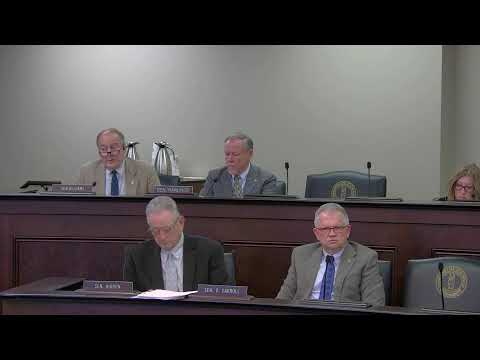
Senate education committee approves bill limiting DEI programs at public colleges
Summary
The Senate standing committee on education voted to give House Bill 4 a favorable report, advancing a bill that would limit the use of state resources for diversity, equity and inclusion (DEI) programs and activities at Kentucky’s public colleges and universities.
The Senate standing committee on education voted to give House Bill 4 a favorable report, advancing a bill that would limit the use of state resources for diversity, equity and inclusion (DEI) programs and activities at Kentucky’s public colleges and universities.
Representative Jennifer Decker (R), the bill’s sponsor, told the committee the measure is aimed at “dismantl[ing] the failed and misguided DEI bureaucracy” and at ensuring public institutions do not engage in “unconstitutional differential treatment based on religion, race, color, [sex], and national origin.” She cited the U.S. Supreme Court’s 2023 Students for Fair Admission v. Harvard decision and said state law must align with the Fourteenth Amendment and Title VI of the Civil Rights Act.
Supporters and opponents framed the bill differently. Gerald Neal, state senator for the 30th District, and a coalition of faculty, students and civic groups opposed HB 4 in committee testimony, saying its language is vague, risks unintended consequences for scholarships and accreditation, and could reduce programs that serve first-generation, low-income, veteran and disabled students. "There is no unconstitutionality per se as it relates to using race as a factor," said Dr. Ray Horton of United Campus Workers, arguing the bill misunderstands existing law on race-conscious considerations.
Students and faculty described concrete campus impacts they expect if the bill becomes law. Bradley Price, a student at the University of Louisville, said campus events and programs that help students “see reflections of my own experience” would be curtailed. Noah Cameron, also a UofL student, said orientation programs that “put inclusion on stage” would be forced to cut skits and activities that help first-year students feel welcomed.
University-affiliated witnesses and professional groups raised concerns beyond campus programming. Dr. Eric Russ, executive director of the Kentucky Psychological Association, cautioned that licensure-related language inserted in earlier drafts could limit boards' ability to sanction practitioners and thereby weaken public protections. Janie Lindell of the League of Women Voters of Kentucky warned that the bill’s process has limited public involvement and could undermine state educational attainment goals.
Representative Decker and supporters said the bill specifically exempts veteran services, student support programs (including programs for Pell recipients, first-generation students and students with disabilities), and privately funded scholarships that are grandfathered; the sponsor also told the committee that she is not asserting DEI is the sole cause of enrollment declines but that some DEI practices risk legal exposure to institutions.
After debate and public testimony the committee voted on a committee substitute that would have narrowed potential collateral impacts; senators rejected that substitute and then took up the bill. The final vote in committee was recorded after a series of member explanations; the clerk announced, "House Bill 4 passes with favorable expression." The bill now moves to the full Senate for further consideration.
Committee members who spoke in favor argued the measure protects equal protection principles and prevents state monies from being used for race- or religion-based preferences. Opponents argued the bill is overbroad, risks harming accreditation-dependent programs (nursing, business, social work and others), could jeopardize scholarship administration, and would chill campus speech and programs that help underrepresented students succeed.
The committee’s consideration included public testimony from more than a dozen students, faculty and civic groups. Several witnesses urged the panel to revise the text to add clearer definitions, carve out program- and donor-restricted funds, and explicitly preserve program-level accreditation requirements.
The committee did not adopt the suggested substitute amendments. With the favorable committee report, House Bill 4 proceeds to the Senate calendar; further amendments and floor debate remain possible.