Get Full Government Meeting Transcripts, Videos, & Alerts Forever!
Get email alerts on the Municipal Water Budget topic
No spam. Unsubscribe anytime.
Santa Rosa Water proposes multi‑year rate increases and restores capital spending in FY25‑26 plan
Summary
At a budget subcommittee meeting, Santa Rosa Water staff outlined a FY25‑26 budget that includes proposed multi‑year rate increases for water and sewer, a return to planned capital improvement program (CIP) funding, and adjustments to reserves and assessments.
Deputy Director Nick Harvey presented Santa Rosa Water’s fiscal year 2025–26 budget overview to the Budget Subcommittee, proposing multi‑year rate increases for both water and sewer enterprises and a restoration of previously reduced capital spending.
Harvey told the subcommittee the department will recommend “three years of 6% rate increases followed by two years of 7% for the water enterprise and five years of 5% increases for the sewer enterprise,” and that the proposal increases both fixed and usage charges. He said the recommendation will be presented at a public hearing on April 1 and that the subcommittee will be asked to formally recommend the full budget to City Council on April 17; City Council is scheduled to hold budget study sessions in May and a public hearing for adoption on June 17.
The nut graf: the proposal is intended to restore capital projects the department cut last year to balance budgets and to address rising costs, including higher wholesale water charges and insurance, while remaining subject to Proposition 218 constraints on how utility revenues and assessments may be used.
Harvey summarized revenues and spending across Santa Rosa Water’s four enterprises. For the year ended June 30, 2024, he said the Water Fund generated about $47.3 million in rate revenues from roughly 54,000 customer accounts and about $12.2 million in demand and miscellaneous fees; the local sewer enterprise generated roughly $72.1 million in rate revenues across about 50,000 accounts and about $16.9 million in other charges. He described the regional enterprise as governed by a subregional agreement allocating operating costs by prorated flows, CIP shares by the agreement’s percentages and debt service by the benefit derived under each issuance.
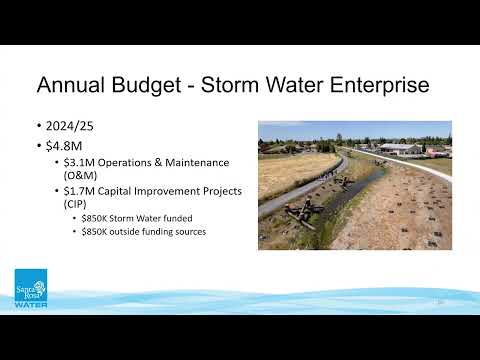
Harvey said the department’s current fiscal year budget across core enterprises is about $156 million, including approximately $104 million in operations and maintenance, $24 million in CIP appropriations and $28 million in debt service, with most debt service in the regional enterprise. The stormwater and creeks enterprise budget for the current year is about $4.8 million, split into $3.1 million for operations and maintenance and $1.7 million for CIP appropriations; about half of the stormwater CIP is funded by special revenue funds.
On assessments and legal limits, Harvey said, “All of Santa Rosa Water’s enterprises are governed by Proposition 218. This means that funds between enterprises cannot be commingled,” and that rate changes require a public hearing and must have a cost nexus. He noted the stormwater assessment is placed on Sonoma County property tax rolls and is calculated by equivalent residential units (ERUs); ERUs were $41.34 for FY24‑25 and will be assessed at $42.46 for FY25‑26. He added that a vote would be required to increase the annual stormwater assessment beyond the CPI adjustment.
Staff discussed assumptions driving the draft FY25‑26 budget: a 1.1% revenue growth assumption tied to development stability; a tentative 8.68% Sonoma Water wholesale rate increase affecting water purchase costs; an upward adjustment to interest earnings; and budgeting guidance that includes a 9% salary increase assumption that reflects a 4% MOU increase plus up to a 5% equity adjustment. “Per finance department guidance, we’re budgeting for 9% salary increases across the board,” Harvey said.
Harvey described some cost pressures and line‑item changes: a spike in property and liability insurance set by Risk; higher electricity costs tied in part to bringing a new well online; and apparent increases in software‑as‑a‑service spending that reflect reclassification of existing contracts rather than pure price growth.
On reserves and CIP, Harvey said the department added to undesignated fund balances in the year ending June 30, 2024, noting approximate increases: about $470,000 added to water undesignated reserves (bringing it to just under $15.4 million), just over $1 million added to wastewater undesignated reserves (to just over $14.7 million), and $5.9 million added to the regional enterprise refund reserve (totaling about $8.8 million). He said the department plans to increase catastrophic reserves under a new policy tied to the proposed rates to improve resiliency, which would reduce undesignated balances.
Staff said last year’s CIP reductions of roughly $5 million for water and nearly $10 million for sewer were required to balance budgets; under the proposed rates, planned CIP appropriations would return to the department’s targets: about $15.5 million for water and $14.3 million for sewer, with a continued $1 million per year cash‑funded CIP increase for the regional enterprise. Harvey said finance staff are seeking bond support contracts to fund a planned electrical infrastructure replacement at the regional plant and that about $12 million in regional CIP is expected to come from bonds, with the resulting principal and interest appearing in future debt service budgets.
Committee members asked about the utility impact fee (UIF) calculation and credits. Staff said UIF credits for prior local work will reduce the local UIF this year and estimated net UIF payments at roughly $2.5 million for water and $2.4 million for wastewater for the current cycle, noting the calculation is complex and includes CPI escalators and crediting for work already paid toward CIP projects.
On stormwater funding, committee members asked whether the existing assessment and general fund support are sufficient for needed infrastructure. Staff said the assessment was structured when placed on the rolls in the 1990s (and later changed under Proposition 218 rules) and that the assessment has always been expected to be supplemented by the general fund for capital investment. Staff said they are exploring other options, including an additional assessment or a utility rate approach, while noting legal and litigation risks associated with changing funding approaches.
No formal motions or votes were taken at the meeting. Staff said they will return with a more detailed FY25‑26 budget and CIP timeline, and with additional modeling about reserve use and planned projects at future meetings.
The subcommittee accepted the presentation and asked staff to bring detailed budget figures and CIP project‑level information at the next meeting.