Get Full Government Meeting Transcripts, Videos, & Alerts Forever!
Get email alerts on the Code Enforcement topic
No spam. Unsubscribe anytime.
Code enforcement reports 552 cases in 2024; new programs to target property maintenance and sidewalk vending
Summary
Code enforcement reported 552 case openings in 2024, a 79% closure rate, targeted sidewalk‑vending enforcement that issued 130 notices and seven impounds, use of CPTED consulting, and two 2025 initiatives: a neighborhood improvement task force and a community preservation volunteer program with nonprofit Trellis.
LAKE FOREST — The city’s code enforcement supervisor on March 6 provided a year‑end summary that outlined caseloads, enforcement results on unpermitted sidewalk vending and a set of initiatives planned for 2025.
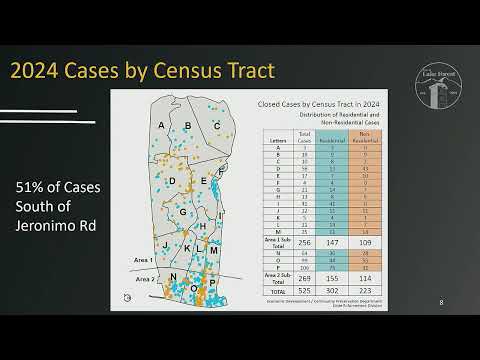
Winston Nkuruga, acting code enforcement supervisor, told the Planning Commission that staff opened 552 cases in 2024 and closed 525, leaving 36 active at year‑end and representing a roughly 79% case‑closure rate. He said staffing constraints and a rise in unpermitted sidewalk vending contributed to a slightly lower closure rate than 2023.
Nkuruga said the department carried over 65 cases into the second half of 2024, opened 280 new cases in that period and closed 309. He described public nuisance complaints and property‑maintenance matters (graffiti, substandard housing, landscaping) as the largest categories and said older housing stock concentrated south of Geronimo accounted for a disproportionate share of complaints; staff said the average home age in Lake Forest is about 40 years.
On sidewalk vending, Nkuruga said state law has allowed sidewalk vending since 2018 and the city took three administrative steps in mid‑2024 to address local impacts: (1) a new ordinance authorizing impoundment of vendor equipment if vendors refuse to cease within 30 minutes; (2) hiring a private security contractor to deter vending at hot spots; and (3) hiring two evening/weekend code officers (named in the presentation as Damien and Ricky) to patrol and educate vendors. Between September and December 2024 staff issued more than 130 minute notices, conducted seven impounds and averaged about 1.5 vendor contacts per day; hot spots included the Trabuco and El Toro intersection but staff said incidents were citywide.
Nkuruga also described the city’s use of CPTED (crime prevention through environmental design) consulting (Trebuco Consultation) to reduce loitering and graffiti at problem sites, citing landscape changes, improved lighting and fencing near the Aldi site as measures that reduced complaints.
Looking ahead, staff previewed two strategic initiatives for 2025: a Neighborhood Improvement Task Force (NITF) that will focus door‑to‑door surveying and a pop‑up event in a southwest neighborhood in May; and a Community Preservation Volunteer Program in partnership with Trellis, a nonprofit that will recruit volunteers to help with small maintenance tasks for residents in need. Staff said Trellis and the city will work to publicize referral pathways for residents seeking assistance.
Nkuruga said staff also updated notice formats and adopted a city property maintenance code and public nuisance revisions in 2024 that staff expect will aid compliance and enforcement.