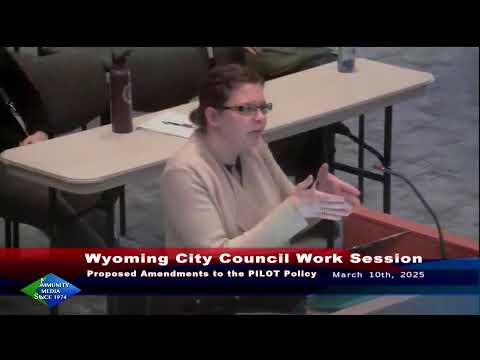
Council discusses housing TIF and pilot policy to encourage affordable housing; favors middle-ground approach
Loading...
Summary
City staff briefed the Wyoming City Council on new state-authorized housing tax increment financing (housing TIF) and proposed updates to the city's pilot (payment in lieu of taxes) policy. Council gave preliminary guidance favoring a blended approach (limits on duration and capture) and asked staff and the Wyoming Brownfield Redevelopment
Wyoming City Council discussed the city's options for using a newly expanded housing tax increment financing (housing TIF) tool and revisions to the municipal pilot (payment-in-lieu-of-tax) policy at the March 10 work session.
Nicole, staff member, told the council the 2023 statutory change allows certain housing projects to qualify for brownfield-style tax increment reimbursement for eligible housing-related costs and that the Michigan State Housing Development Authority (MSHDA) will review housing TIF plans. "It prioritizes bringing affordable housing to the market," Nicole said, noting housing TIF may support rental and owner-occupied housing at or below 120% of area median income (AMI) and can apply to greenfield parcels as well as contaminated sites under specific conditions.
How the tool works and what it can cover: Staff explained that housing TIF captures new tax increment (the increase in property tax revenue after development) and returns that increment to the developer under an approved work plan to reimburse eligible costs such as remediation, infrastructure and some housing-construction-related expenses. Staff used Site 36 and previous brownfield cases as examples of how capture and reimbursement are scheduled and reported to the Michigan Economic Development Corporation (MEDC) and other state reviewers.
Pilots and municipal services agreements (MSAs): For projects using low-income housing tax credit (LIHTC) financing, staff noted a pilot is typically required, and housing TIF can capture pilot or MSA revenue as the increment if included in the plan. Nicole said those revenues can be captured on a case-by-case basis and noted that some taxing jurisdictions' millages (for example, certain debt millages or portions of state education tax) may be limited in eligibility for capture.
Council's policy options and preferences: Staff presented three high-level policy approaches for the Brownfield Redevelopment Authority to consider: a softer approach (allow housing TIF but limit reimbursements to traditional brownfield activities), a blended approach (expand reimbursements with specific caps on years or percent capture) and an expansive approach (use the statute's full allowance). Several council members expressed preference for a blended or middle-ground approach. Councilmember Sheldon said he favored the middle approach and suggested a 20-year cap as a personal maximum. Another councilmember suggested limiting capture to a maximum percent (one councilmember proposed an 80% cap on capture) and keeping some revenue flowing to the city. The council also discussed prioritizing brownfield sites over greenfields and making limited greenfield use contingent on strong home-ownership components or additional restrictions.
Other policy details and implementation questions: Council asked about distance and concentration limits for pilots (staff presented a draft that would limit the city to no more than two active pilot projects within a half mile radius, with possible exceptions). Councilmembers discussed using zoning changes (smaller lot sizes, different setbacks) and other non-tax tools to encourage affordable housing rather than relying solely on incentives. Staff said neighboring municipalities (including Plainfield and Grand Rapids) have adopted or are developing comparable policies; staff will use those as references in drafting a Wyoming policy. Nicole said staff will bring a draft policy to the Wyoming Brownfield Redevelopment Authority and return to council for review; several council members asked staff to craft clear criteria, to limit plan length and percent capture, and to prioritize catalytic brownfield redevelopment while allowing limited greenfield owner-occupied incentives.
Next steps: Staff said it will work with the Wyoming Brownfield Redevelopment Authority to draft a housing TIF policy and will return to council with recommended parameters (including options for year limits, capture percentage and corridor/area prioritization). The staff also asked whether the council wanted staff to advance the proposed pilot ordinance revisions; multiple council members encouraged returning a written policy that balances incentives with municipal revenue protections.
Speakers quoted or referenced in this article are identified in the speaker list below and correspond to the transcript excerpts provided by staff.