Council advances personnel, fee and capital plan items; retail water, sewer rates proposed
Loading...
Summary
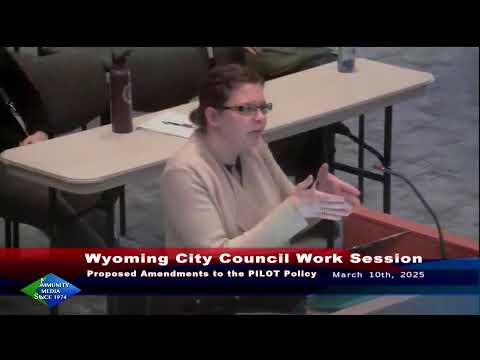
The Wyoming City Council on March 10 reviewed key budget drivers for fiscal 2026, including personnel assumptions, fee schedule changes, a proposed capital improvement plan and proposed retail water and sewer rate increases.
The Wyoming City Council on March 10 reviewed key budget drivers for fiscal 2026, including personnel assumptions, fee schedule changes, a proposed capital improvement plan and proposed retail water and sewer rate increases.
Staff said council decisions at the work session are needed to finalize a draft budget to be circulated at the end of next week and to shape the operating budget presented in April and adopted in May. "We're busy compiling all their operating budgets, which are the last piece of it," said Jody, staff member, as the presentation opened.
The personnel plan and fleet staffing: Staff explained the city builds personnel costs from currently approved positions, contract increases, employer taxes and assumed full family benefits at top pay steps for vacant positions. The only personnel change requested for 2026 was converting a 0.5 full-time-equivalent position in Motor Pool/Fleet Services to a full 1.0 FTE senior technician. That change, staff said, would allow the city to reduce outsourced vehicle repairs, restore the fleet shop to four full-time technicians and still leave Motor Pool's projected fiscal 2026 budget about $120,000 below fiscal 2025 after estimated savings.
Council members asked whether the technician position is easy to fill; staff said fleet technicians are difficult to recruit. After discussion, council signaled it was "comfortable moving this position up to full time for the budget," and staff said it would use that staffing assumption in the draft budget.
Fee schedule updates and industrial sewer penalties: Staff proposed multiple fee schedule edits, including removing a duplicative treasurer fee and updating utility penalty rates. For sewer penalties, staff described changes to the industrial pretreatment program (IPP). "These penalties are designed to work as a disincentive," said a staff member who manages IPP compliance, explaining the penalty structure aims to prevent industrial discharges that could harm the wastewater treatment plant biological process. Staff said typical annual revenue from such penalties is modest ("between $8,000 and $12,000" in a typical year) but that penalties had been out of date and enforcement must be credible to avoid state enforcement and protect the treatment plant and river outfall.
Water and sewer retail rates: Staff reviewed a Stantec model used to set retail water and sewer rates and said water projects represent a large share of capital needs. The model produced a proposed 9% retail water increase and a 10% retail sewer increase. Staff estimated the average single-family household would see about a $15 increase per quarterly bill (roughly $5 per month). Wholesale customers, staff said, have contract formulas and may have different adjustments; those contracts are under review.
Capital improvement plan (CIP) and project highlights: The council was shown a six-year CIP in new ClearGov software; the first-year (fiscal 2026) projects total just under $60,000,000, staff said. The CIP document distributed to council totaled roughly 502 pages. Staff said some projects in later years are placeholders without firm cost estimates (for example, a head-of-line note on a public works building renovation) and that only projects with an attached budget would be incorporated into the operating budget for the coming fiscal year. Council asked about specific CIP items, including a proposed expansion or replacement of the police/pistol range (discussion placed major range work around FY2028–2030) and fleet replacements. Staff said the CIP will remain a living document that departments can update after council approval.
Fire apparatus timing: Fire Department staff asked whether the council would support accelerating replacement of a high-mileage engine if a suitable stock or demo unit became available, to avoid pending new emissions-related costs and tariffs that could add roughly $100,000 or more to a custom build. Council members expressed interest in allowing staff to pursue timely procurement if savings could be realized, while preserving local vendor opportunities.
Next steps and timeline: Staff said the council retreat is scheduled next week, a draft full budget will be delivered by the end of next week, a resolution to establish proposed tax rates and a public hearing date will be presented in April, and the public hearing will occur on May 5 with final budget adoption on May 19. Staff indicated it would move the fee updates and personnel change into the draft budget for council review unless council directed otherwise.
Speakers quoted or referenced in this article are identified in the speaker list below and correspond to the transcript excerpts provided by staff.