Get Full Government Meeting Transcripts, Videos, & Alerts Forever!
Get email alerts on the Stormwater Bylaw topic
No spam. Unsubscribe anytime.
Lakeville discussion centers on stormwater bylaw: authority, enforcement and peer review funding
Summary
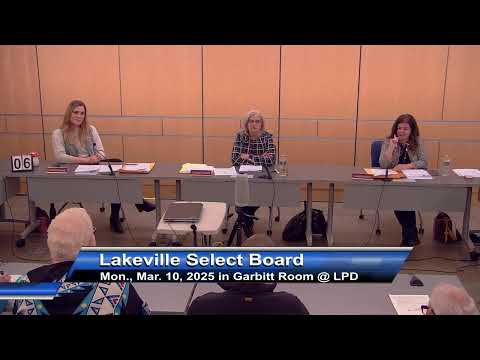
Select Board members, planning and conservation officials and staff reviewed a draft stormwater bylaw that would formalize the town's stormwater authority, authorize outside peer review of stormwater work and set enforcement mechanisms ahead of the town's annual meeting.
Select Board members, planning and conservation officials and staff reviewed a draft stormwater bylaw that would formalize the town's stormwater authority, authorize outside peer review of stormwater work and set enforcement mechanisms ahead of the town's annual meeting.
Board members and staff focused first on who should be the appointing authority for stormwater reviews. Multiple meeting participants said the select board as the appointing authority would be appropriate, with authority to designate an agent (for example, the town administrator or a designated staff member) to sign peer-review contracts so the board would not need to approve routine consultant agreements at every step. Participants also discussed routing administrative work through existing departments—inspectional services, the building inspector's office and the town administrator—to reduce the burden on volunteer boards such as the conservation commission and planning board.
Why this matters: the bylaw would allocate responsibilities that now fall across several volunteer boards and part-time agents, and it could change which staff handle permitting, complaints and contract signings. Participants repeatedly raised concern that the draft could create an unfunded mandate—additional, unspecified staff time and administrative work—unless funding mechanisms are clarified.
Key details discussed
- Funding and 53 g: Several speakers said the draft must explicitly include language referencing "53 g" so the town can establish a revolving/account mechanism to accept and hold peer-review funds (the transcript references the shorthand "53 g"). Meeting participants said inserting that language would allow the town to use outside peer-review consultants without returning repeatedly to the board for contract approval.
- Peer review consultants and management: The group discussed using outside engineering firms (examples mentioned generically in the meeting included well‑known peer‑review firms) and the importance of having the same consultant available to both the planning board and the conservation commission when both boards review the same project. That, speakers said, would streamline coordination and make sure both boards have the same technical information.
- Enforcement and fines: The draft includes a civil penalty of $300 per day (no cap listed in the draft). Participants flagged prior problems enforcing fines in town bylaws and asked for town counsel review to ensure the penalty language is enforceable across related bylaws rather than repeated in each section.
- Exemptions and specific items: Attendees noted an extensive exemptions list in the draft. Concerns were raised about newer commercial practices—specifically power/soft washing that can use detergents and bleach—and whether those activities should be exempted or regulated as illicit discharge to protect areas where storm drains flow to drinking-water sources. Dog waste (or "pet waste") and horse manure were also discussed; participants recommended changing wording to cover "domestic animal/pet waste" rather than only dogs or service animals so the bylaw cannot be narrowly interpreted.
Process, next steps and timing
Planning board staff said a draft will be available to officials by Wednesday evening before the board's next meeting; the planning board's work session was scheduled for a Thursday (referred to in the meeting as the 13th). The planning board will hold required hearings and the intent is to have a bylaw ready for the annual town meeting warrant, pending town counsel review and the planning board's hearings. Participants asked that final language be routed through town counsel to resolve enforcement and account/funding questions.
No formal motions or votes were taken at the meeting. Several participants said they would help in early stages but reiterated that, if administration proved too cumbersome, responsibilities might shift to staff or another designee.
Ending
Board members directed staff to continue drafting and coordinating the bylaw language with the planning board, conservation commission and town counsel; a revised draft, and the schedule for hearings, was expected to be available in the coming weeks ahead of town meeting.