Get Full Government Meeting Transcripts, Videos, & Alerts Forever!
Get email alerts on the Short Term Rentals topic
No spam. Unsubscribe anytime.
Planning director asks commissioners whether to add distance, tax and responsible-agent rules to short-term rental code
Summary
Riley County planning staff presented options for short-term rental regulations — including minimum separation distances, limits on single ownership, responsible-agent requirements and verification of unpaid county fees — and commissioners asked staff to draft code language and additional examples for a future meeting.
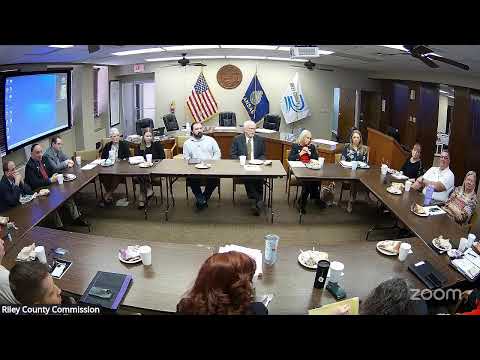
"I'm here to talk more about short term rental regulations," Planning Director Andoweb told commissioners at the March 10 meeting as he reviewed sample code language from other counties and raised several policy options for Riley County.
Staff presented potential regulatory tools that the county could adopt to address density, parking, concurrent occupancy and enforcement. Andoweb said Riley County currently has no separation, ownership limits or density caps in its code and that the department pulled examples from counties (including several in Washington state and some Kansas counties) to show possible approaches. "We don't have any of that in our code right now," he said.
Discussion focused on four areas: - Separation/density: Commissioners asked whether the county should require minimum distances between licensed short-term rentals (examples cited included 200 feet and 500 feet) or a density cap (for example, limiting the number of rentals per block or per an identified subarea). - Responsible agent and local contact: Staff noted the existing code requires a designated "responsible agent" with contact information who must "respond to complaints within an hour," and commissioners asked whether the agent should be required to reside in Riley County to ensure timely on-site response. - Utility bills, taxes and fees: Planning staff suggested conditioning issuance or renewal of an STR license on the owner being current on county utility bills and other fees, and said many sample codes require being current on property taxes or county fees; commissioners agreed this is feasible to verify with Public Works and Finance. - Enforcement: Commissioners and staff discussed limitations of enforcement while state law remains unchanged; county legal and law enforcement staff said local civil options exist, but criminal enforcement authority would be strengthened if a state statute were passed to make STR license violations enforceable by police.
Planning staff closed by saying they would draft proposed code language for the responsible agent requirement and current-tax/fees conditions, and would return with more examples for separation distances and density caps. Commissioners asked staff to include draft language and additional county examples at the next work session.
All quotes and policy summaries are drawn from the transcript of the Planning Director's presentation and the commissioners' follow-up questions.