Get Full Government Meeting Transcripts, Videos, & Alerts Forever!
Get email alerts on the Finance topic
No spam. Unsubscribe anytime.
City reviews law‑enforcement impact‑fee study; commissioners direct workshop with consultant
Summary
City staff presented a consultant study that calculates a per‑resident law enforcement impact fee; commissioners generally supported moving to a public workshop and asked staff to present revenue scenarios and the consultant’s rationale before any adoption.
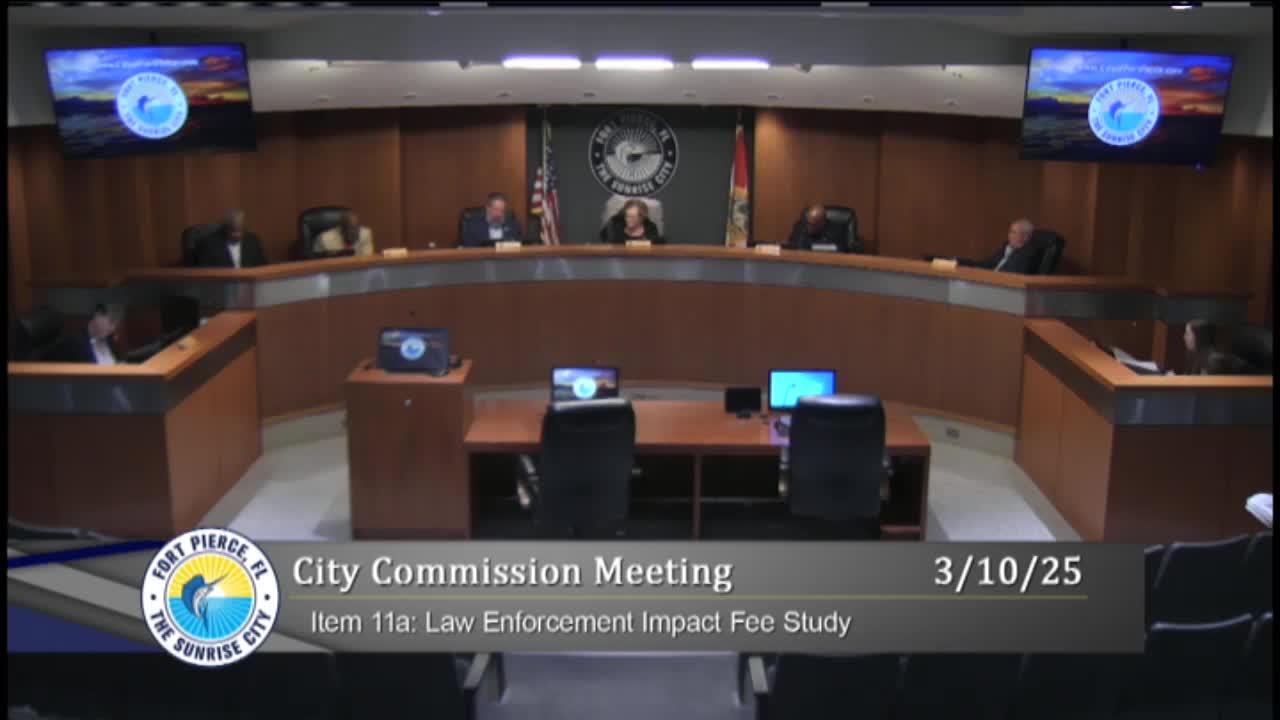
City staff presented a consultant’s law‑enforcement impact‑fee study and asked the Fort Pierce City Commission whether it wants to pursue adoption of a fee that would allocate capital law‑enforcement costs to new development.
Interim director Kevin Freeman summarized the report, saying the study used a consumption‑based methodology required by Florida Statute (cited in presentation) to calculate capital costs per functional resident. The consultant’s calculation produced a net impact cost per functional resident of approximately $296 (the technical study cited an initial $329 figure before adjustments). The report applies use‑specific ratios to produce fee estimates by land‑use category; staff provided examples: roughly $13,000 for 25 single‑family homes and about $74,600 for a 200‑unit multifamily project, depending on the adoption percentage.
Freeman and commissioners discussed statutory requirements, equitable application and the 12‑month window for adopting the study (state rules require recentness). Commissioners raised budget pressures and noted that development brings increased demand for police facilities, vehicles and equipment; several commissioners favored moving the study forward to a workshop with the consultant present. Commissioner Broderick urged collecting fees from new development rather than drawing on the general fund; Commissioner Taylor and others said they favor a user‑pay approach and requested more detail on how a fee would offset future capital needs. Several commissioners asked staff for modeled revenue scenarios showing potential revenue at different adoption rates and to clarify how an impact‑fee waiver or CRA policies would interact with a new fee.
Freeman said staff will schedule a workshop, invite the consultant to present details and return with revenue forecasts and suggested fee percentages for consideration.