Get Full Government Meeting Transcripts, Videos, & Alerts Forever!
Get email alerts on the Legislative Update Homelessness topic
No spam. Unsubscribe anytime.
County staff warn draft state bill could obligate large counties to run homelessness services without funding
Summary
Deputy County Administrator Russell Schoepner told commissioners that a draft bill could require counties meeting a population threshold to coordinate homelessness services — a change likely to impose multimillion‑dollar costs without accompanying state funding — and staff will monitor the bills and propose a local legislative strategy.
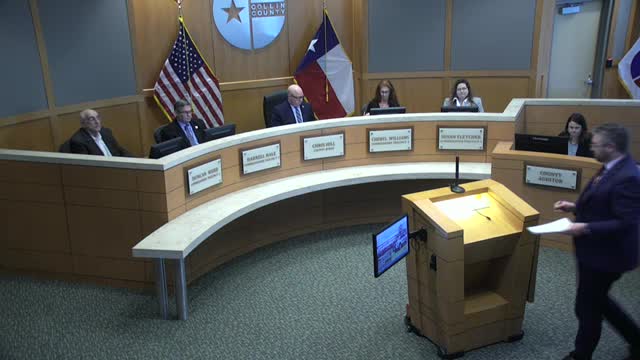
Collin County staff briefed Commissioners Court on proposed state legislation that could require counties above a specified population threshold to coordinate comprehensive homeless services, potentially imposing substantial new costs on counties if the drafts remain unfunded.
Russell Schoepner, deputy county administrator, told the court the county's current estimated population for the decade is 1,064,465. Schoepner said drafts circulating would apply a new county responsibility threshold at 1.3 million residents; Collin County is below that mark now but could grow into the bracket by the next census cycle.
"The draft that I've seen would include us being responsible for crisis management services, housing including temporary and permanent housing, mental health services, [and] case management services," Schoepner said. He added the bills he had reviewed did not include state funding for those responsibilities. "There is no funding associated with this bill in either the senate version or the house version," Schoepner said.
Schoepner identified Senate Bill 1557 and Representative Shaheen's House companion, HB 3187, as measures to watch. He also called attention to SB 985 and HB 342, which would correct a voting‑precinct combining rule and was described as a technical fix that would allow precinct consolidations as long as a combined precinct did not exceed 10,000 individuals or voters.
Commissioners and staff discussed the county's rapid growth and the budgetary implications if the county were placed in a higher population bracket. Judge Hill noted projections that Collin County could reach about 1.5 million residents at current growth rates before the next ten‑year adjustment. Schoepner said county staff will follow bill filings, bring forward items as needed for a local legislative strategy and continue to update the court during the session.
Schoepner said the complex nature of the homelessness proposal and the potential fiscal impact make the bill's passage uncertain in this session; he estimated the measure had less than a 50 percent chance of passing in its current form. Court members asked staff to monitor the bills and coordinate with neighboring counties as appropriate.