Get Full Government Meeting Transcripts, Videos, & Alerts Forever!
Get email alerts on the State Legislation topic
No spam. Unsubscribe anytime.
Deputy administrator warns draft bill could require large Texas counties to manage homelessness without state funding
Summary
Russell Schoepner, Collin County deputy administrator, updated the court on a draft bill that might require counties above a population threshold to coordinate homelessness services. He warned Collin County, currently at 1,064,465, could grow into the bracket and that the draft contained no dedicated state funding.
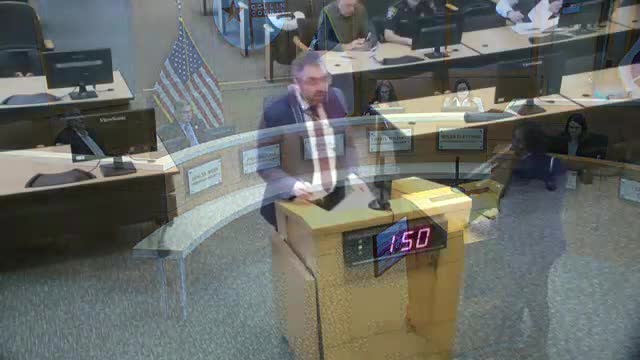
Russell Schoepner, Collin County deputy county administrator, briefed Commissioners Court on a set of legislative items and highlighted a draft bill that would make counties above a population threshold responsible for coordinating homelessness services.
Why it matters: If enacted as drafted, Schoepner said the bill would require counties above the threshold — described in the briefing as 1.3 million residents — to manage a wide range of homelessness functions, including crisis management, temporary and permanent housing, mental‑health services and case management, with no direct state funding attached.
Schoepner told the court that Collin County's population for the decade is 1,064,465 and that while the county is below a 1.3 million bracket now, continued rapid growth could place it into the higher tier in future census adjustments. "The draft that I've seen would include us being responsible for crisis management ... housing including temporary housing and looking towards permanent housing and creating plans associated with those components," Schoepner said.
Commissioners and the judge expressed concern that the draft bill would impose significant new, ongoing costs on counties without accompanying federal or state resources. Judge Hill noted that adding a multimillion‑dollar program without funding would likely require higher property taxes or other revenue changes. Schoepner and the court discussed coordination issues because cities commonly receive federal Community Development Block Grant (CDBG) and HOME funds for homelessness programs; the draft bill as described could create overlapping responsibilities.
Schoepner also flagged several other bills and technical fixes: SB 1557 and the companion HB 3187 (related to transit/sales tax rebate calculations raised by some cities in DART service areas) and SB 985/HB 342, which he described as a technical correction to voting precinct combination rules tied to a prior session amendment.
Outcome and next steps: Schoepner said county staff will monitor bill filings and bring potential bills forward for the court's legislative strategy. Commissioners asked staff to watch the homelessness measure closely and to coordinate with neighboring counties where appropriate. Schoepner judged the initial chance of passage for the homelessness draft to be below 50 percent given its breadth and complexity but advised planning for future sessions because policy changes of this size often take multiple legislative cycles.