Get Full Government Meeting Transcripts, Videos, & Alerts Forever!
Get email alerts on the Financial Regulation topic
No spam. Unsubscribe anytime.
Committee extends Department of Financial Institutions’ sunset to 2029; commissioner outlines oversight of nonbank lenders
Summary
House Bill 242 received a positive recommendation to extend the Department of Financial Institutions’ statutory sunset to 2029. Commissioner Gonzales described the agency’s risk‑based oversight of payday and short‑term lenders and explained how examinations are targeted toward higher‑risk firms.
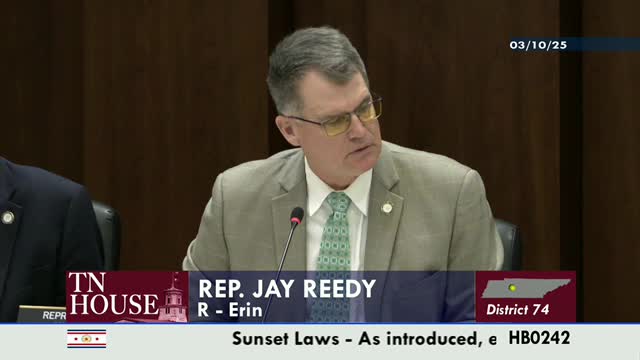
The House Government Operations Committee on March 10 voted to advance House Bill 242, extending the Department of Financial Institutions’ statutory sunset to June 30, 2029. The committee recorded a vote of 12 ayes and 0 no's.
Chairman Lafferty introduced HB 242 as a routine sunset extension and invited Commissioner Gonzales of the Department of Financial Institutions to summarize day‑to‑day operations for new committee members. Gonzales described the agency as small but responsible for the safety and soundness of Tennessee’s banking system and for regulation of hundreds of nonbank institutions, including payday and short‑term lenders and money transmitters.
Gonzales said the department applies a risk‑based approach when supervising nonbank firms, classifying companies as low, moderate or high risk. High‑risk firms receive at least annual examinations and closer oversight; lower‑risk firms may receive exams less frequently. Factors the department examines include interest rates and fees, operational risk including turnover and staff training, management experience and compliance systems.
Committee members questioned whether state banks and institutions are subject to federal reporting rules such as the Bank Secrecy Act; Gonzales confirmed that state‑chartered banks are subject to Treasury/BSA reporting. Members also asked how exam frequency and regulatory scrutiny are adjusted based on industry risk profiles.
The committee voted unanimously to advance HB 242 to calendar and rules; the bill was presented as an extension of the agency’s statutory authority rather than a policy change.
Votes and next steps: HB 242 passed the committee 12–0 and will proceed to calendar and rules.