Get Full Government Meeting Transcripts, Videos, & Alerts Forever!
Get email alerts on the Education Finance Distribution topic
No spam. Unsubscribe anytime.
Committee probes how outcome bonuses, grade-A incentives and fast-growth stipends are calculated and distributed
Summary
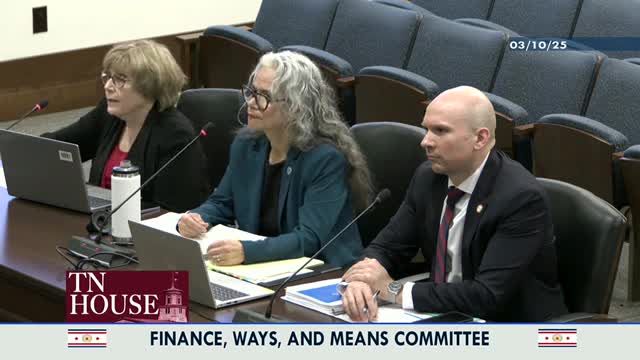
Members pressed the Department of Education on how outcome bonuses and new grade-A and fast-growth payments are calculated, whether payments go to districts or schools, and how carryforward TISA money funded prior-year outcomes.
Committee members asked detailed questions about how the department calculates and distributes three different categories of K-12 payments: outcome bonuses tied to student achievement, $17 million in grade-A LEA incentives enacted in the special session, and fast-growth student and infrastructure stipends.
Jack Powers, assistant commissioner of policy and legislative affairs, said outcome bonuses are determined by specific criteria at the elementary, middle and high school levels and are paid as a percentage of the base TISA funding (typically 10% or 20% of the base per eligible student). "The funds that were not used in the prior year are designated to be used for outcomes in the following year," Mary Ann Dursky noted, explaining how last year's carryforward funded outcomes this year.
Committee members repeatedly asked whether the department sends these dollars directly to individual schools or to districts for local distribution. The department said outcome bonus and grade-A incentive payments are passed to the LEA and are not restricted at the state level on how the district allocates them. "They go straight to the district, and they're not restricted by how they use the funds," Powers said.
On the grade-A incentive structure, Powers explained qualifying LEAs must have 50% or more graded schools receiving an A. He said about 15 LEAs qualified on 2023-24 letter grades and described a tiered payment matrix tied to the number of graded schools in a district (e.g., 0-5 schools = $500,000; 31+ schools = $4,000,000). The department said the payments are one-time distributions and that districts may distribute funds within the district at their discretion.
Fast-growth stipends prompted several questions about funds exhausted, eligibility, and whether growth was trending down. The department said it paid out the full $35,000,000 appropriated in a prior cycle (noting that actual fast-growth liabilities exceeded the appropriation and were prorated), and that it has paid about $8,400,000 so far in the current year with roughly 17 LEAs identified so far for new fast-growth awards. The FY26 request included an additional $5,000,000 recurring and $20,000,000 nonrecurring to avoid prorations and to fund infrastructure stipends.
Committee members pressed for follow-up lists and district-level breakout data; the department said it would provide those figures and additional clarifications.