Get Full Government Meeting Transcripts, Videos, & Alerts Forever!
Get email alerts on the Tbi Wastewater Testing topic
No spam. Unsubscribe anytime.
Committee advances TBI sunset bill; Director describes wastewater‑testing pilot to detect emerging drugs
Summary
The committee gave House Bill 266 a positive recommendation to extend the Tennessee Bureau of Investigation’s sunset to 2029 and heard a detailed briefing on a one‑year wastewater testing pilot in East Tennessee aimed at earlier detection of emerging substances.
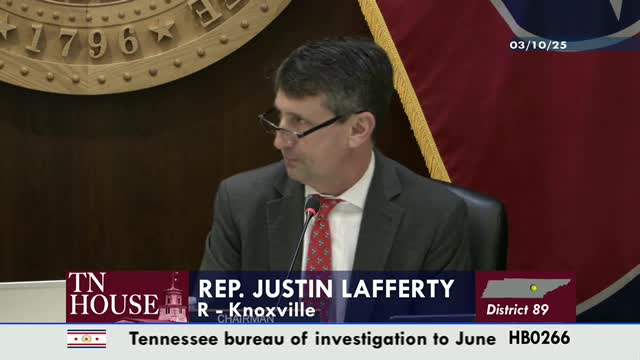
The House Government Operations Committee advanced House Bill 266 on March 10, sending the Tennessee Bureau of Investigation (TBI) sunset extension to calendar and rules after a committee discussion and a 9–0 recorded vote.
TBI Director David Rausch and Patrick Power, TBI policy director, briefed the committee on the agency’s work and outlined a proposed one‑year wastewater testing pilot in Knoxville. Rausch described wastewater testing as a prevention tool that identifies drugs flowing through a community’s sewage system and provides an early indicator of emerging substances. “The purpose for us is…to see the viability of it for prevention,” he said, explaining that the approach would allow health and substance‑abuse partners to target education, prevention and treatment resources where they are most needed.
The TBI witnesses said the technique can identify trends and give local partners advance notice about new or dangerous substances—examples cited included earlier detection of substances such as xylazine and other emerging compounds. Patrick Power told the committee the program could show new drugs in wastewater before deaths or autopsy results arrive, enabling a faster public‑health response.
Panelists stressed that the approach is primarily for prevention; a narrow enforcement application exists but would require additional legal process in most circumstances. Rausch said the one‑year pilot would be funded from opioid‑abatement monies identified for prevention, not general funds. The committee also received briefing data showing improvements in forensic turnaround times: the agency reported reductions in backlogs for DNA and evidence testing since additional positions and funding were added.
Several members raised civil‑liberty and oversight questions, including whether local law enforcement could already identify problem areas without such a program. Directors replied that wastewater testing offers earlier, more actionable data than existing reporting systems and that the Knoxville pilot was selected because of documented local need and overdose data.
The committee voted to advance HB 266 to calendar and rules with a 9–0 tally; the bill extends the TBI’s statutory sunset to 2029 and the pilot will be evaluated after one year, according to testimony.
Votes and next steps: House Bill 266 passed the committee by voice/roll call, 9 ayes and 0 no's, and was forwarded to calendar and rules.