Get Full Government Meeting Transcripts, Videos, & Alerts Forever!
Get email alerts on the Health And Human Services topic
No spam. Unsubscribe anytime.
Ways and Means advances bill to restore $4 million a year for pregnancy resource centers and maternity homes
Summary
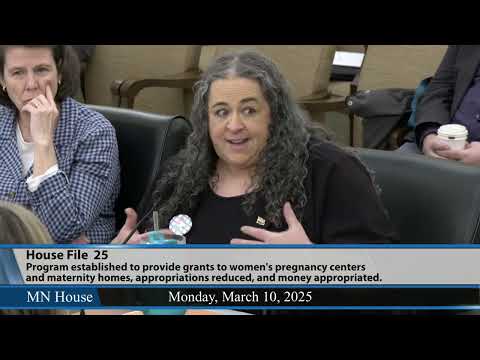
The House Ways and Means Committee advanced House File 25, a bill to restore $4 million annually to "positive alternative" grants for pregnancy resource centers and maternity homes, and heard detailed questions about medical oversight, privacy and grant auditing.
The House Ways and Means Committee advanced House File 25 on a voice vote after a morning presentation by the bill’s author.
Representative Zalesnikar, the bill’s sponsor, told the committee the measure “restores the $4,000,000 per year as positive alternative grants with $3,000,000 for pregnancy resource centers and $1,000,000 for maternity homes.” She described the proposal as restoring funding that she said had existed for 17 years before being ended in 2023.
Committee members asked detailed questions about how grant recipients are staffed, how medical issues would be handled and how the grants would be audited and monitored.
Representative Bierman asked what a crisis pregnancy center (CPC) would do if a woman presented with symptoms of an ectopic pregnancy. Representative Zalesnikar answered that a provider “would give the information that they know, and refer them if they wanted to go to the hospital or for further evaluation.”
Representative Gomez pressed the author on whether the grants would pay for physicians working at CPCs. Representative Zalesnikar said the grants “are established and given out like they have been for 17 years” and that recipients include pregnancy resource centers and maternity homes; she said some physicians who work with centers are volunteers and that “they are credentialed.”
Several members raised concerns about oversight, privacy and fraud prevention. Representative Kotyza-Witthuhn said she was “curious” why the bill had not been routed through the Office of Grants Management or a fraud oversight committee and said the proposal appeared to leave enforcement and penalties unspecified. Representative Zalesnikar replied that third-party audits and program evaluations had been used in prior grant cycles and cited past evaluations performed by organizations such as the Wilder Foundation.
Representative Barrack directed the committee to the bill’s privacy provisions and cited the Minnesota Health Records Act. He said the bill contains privacy and chapter 13 protections and urged members to read the language that requires referrals to medical care when a woman’s life is in danger.
Supporters emphasized the services provided by the centers beyond counseling, including parenting education, car seats, and short-term housing services at maternity homes. Representative Lozakar said the grants could fund programs for fathers, nutrition education, parenting classes and material assistance.
Committee action and clarification The committee’s chair moved House File 25 to the general register and the motion was approved by voice vote; the bill was advanced from the committee. The committee did not record a roll-call tally in committee for that motion in the transcript.
Why it matters The bill addresses state funding for pregnancy resource centers and maternity homes and focuses committee attention on how state grant dollars are spent, what oversight is required for providers that are not licensed medical clinics, and what protections exist for privacy and medical emergencies. Members on both sides raised questions about the scope of services the grants would support and whether the state’s existing grant-management practices are sufficient.
What the transcript shows and what it does not Committee discussion focused on programmatic oversight, medical referral protocols and third-party auditing. Committee members repeatedly pressed for detail about whether grants would support paid medical staff, whether centers would be required to have licensed clinicians present, and how the Department of Health or an outside auditor would monitor grant recipients. The transcript does not record an implementation plan or specific language changes beyond the sponsorship statements; it does not show a final, enacted statute or department guidance.