Get Full Government Meeting Transcripts, Videos, & Alerts Forever!
Get email alerts on the Extreme Heat Response topic
No spam. Unsubscribe anytime.
Maricopa County officials cite decline in heat deaths after ARPA-funded cooling effort but warn funding gaps remain
Summary
County health, human services and medical examiner officials told the Board of Supervisors that a coordinated 2024 response — funded largely with ARPA dollars and using cooling centers, transportation and HVAC repairs — coincided with a decline in heat-related deaths, but program budgets and 2-1-1 funding face shortfalls for 2025.
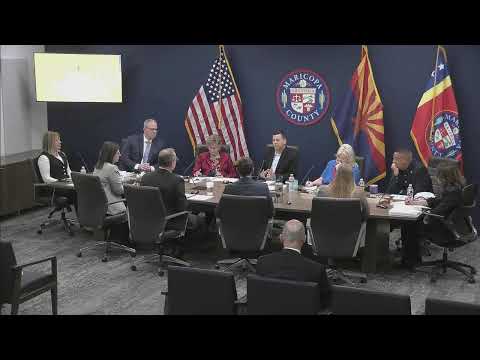
Maricopa County public health and human services officials told the Board of Supervisors on a recent morning that coordinated, ARPA-funded heat-response efforts in 2024 coincided with a drop in heat-related deaths but that many programs face funding cliffs ahead of the 2025 season.
Janine Fowler, director for Maricopa County Public Health, said county agencies worked with cities, the Maricopa Association of Governments and nonprofits last year after ARPA money became available. "Heat toll in Maricopa County takes several hundred lives every year," Fowler said, and county departments used ARPA dollars to expand cooling access and partner services.
The county framed the 2024 work as operationalizing years of surveillance and planning. Fowler said the county’s standardized heat-related death surveillance system — built in partnership with the Office of the Medical Examiner in 2006 — provided the data that guided contracting and site placement.
Jason Matthews, interim director of the Human Services Department, described three core programs tied to the county’s response: an emergency HVAC repair-and-replacement program, utility-assistance support, and targeted assistance to special populations (including the "Hand in Hand" homelessness-prevention outreach and senior in-home case management). Matthews said the HVAC program served about 345 single-family households last fiscal year (311 of those were HVAC-specific) and a total of about 791 clients through related services. He said the county spent about $4,900,000 on the HVAC program in fiscal year 2024 and that $1,900,000 remained to carry the program through the summer target date of Aug. 31, 2025. The presentation listed an average job cost of about $14,239 for HVAC work in 2024.
Matthews said the HVAC program verifies client income and visits homes both before and after work to confirm systems function and to perform spot checks on vendors. He said eligibility is currently set at 80% of area median income (approximately $57,600 in the Phoenix area by his calculation) and that the county is considering lowering eligibility to stretch limited funds.
Matthews and Fowler described the county’s utility-assistance work (including use of LIHEAP and partnerships with APS and SRP) and an "Hand in Hand" program that uses emergency flex funds to avert homelessness for people near crisis. Matthews said in fiscal year 2024 the county performed about 3,200 outreach activities and helped just over 1,000 unique individuals through outreach and shelter contracts; the emergency shelter grants supported bed nights totaling about 8,500 in fiscal 2024 (the presentation noted that bed-night counts include duplicates).
Nick Stobbe, the county’s chief medical officer and incident commander for the 2024 heat response, said the county’s data show 2024 was the first year since 2014 to record a decline in heat-related deaths. "2024 was our first year, since 02/2014 where we saw a decline in the number of heat related deaths," Stobbe said, adding that the decline occurred despite a longer and hotter season in 2024. Stobbe credited expanded respite and cooling-center hours, transportation to cooling sites (arranged through Solari 2-1-1 using Lyft), and stronger coordination with city operators.
Stobbe and Fowler emphasized the role of Solari 2-1-1 as a backbone for transportation and referrals: the county purchased Lyft rides and coordinated with APS and SRP and other partners to get people to cooling centers. Public comment from supervisors and staff noted Solari had curtailed hours to stretch funds and warned that if 2-1-1 funding declines the system’s capacity would be jeopardized.
Dr. Jeff Johnston, chief medical examiner, told the board his office faces recurring July surges in decedents and limited storage capacity. He said the office must identify decedents, notify next of kin and release remains to funeral homes promptly; surge conditions compress normal processing timelines and create operational strain.
Supervisors pressed staff on sustainability and targeting: several asked whether asset tests should be added to eligibility rules so limited HVAC funds reach the lowest-income residents; whether program costs could be reduced through lower-cost cooling options such as evaporative "swamp" coolers where appropriate; and how hospitals and health plans might be engaged as long-term funders. Staff said they have applied for additional grants, including an EPA grant, are pursuing academic partnerships to quantify program costs versus health-system savings, and are working with intergovernmental relations and the legislature to seek state support.
Officials described other measures the county used in 2024: public signage for cooling centers, heat kits (cooling towels, hats, sunscreen and basic wound-care items), pet supports so people could bring animals to respite sites, and partnerships to distribute bottled water when needed. The presentation said about 4,700 individual users used the Lyft rides arranged through Solari/2-1-1 in 2024.
Board members and staff discussed communications and outreach: supervisors proposed printed wallet cards, stickers at transit stops and light-rail stations and more billboard and transit advertising to raise awareness of 2-1-1 and cooling sites. Staff said paper and plasticized 2-1-1 cards were produced in 2024 and were distributed through hospitals, shelters and cooling centers.
The presenters repeatedly highlighted the distinction between discussion, direction and formal action: the board received the briefing and supervisors asked staff to return with program eligibility adjustments and cost-breakdowns; no ordinance, budget appropriation or vote was recorded during the session.
Outlook: presenters said some ARPA funds that paid for 2024 expansions are expiring, leaving an estimated $1.9 million for the HVAC program and uncertain funding for 2-1-1 and partner services. County staff said they will continue to pursue grants, private partners and legislative support and recommended continued emphasis on the heat relief network, data-driven site placement and funding for 2-1-1 to sustain transportation and referral services.