Get Full Government Meeting Transcripts, Videos, & Alerts Forever!
Get email alerts on the Agriculture topic
No spam. Unsubscribe anytime.
Senate Agriculture Committee approves rewrite of grain-buyers law, sends SB 461 to appropriations
Summary
The Senate Agriculture Committee adopted an amendment and voted 8-0 (1 excused) to advance Senate Bill 461, which rewrites Indiana's grain buyers statute to tighten agency procedures, add license-related fees, formalize notice and revocation steps and change governance of the Grain Indemnity Fund.
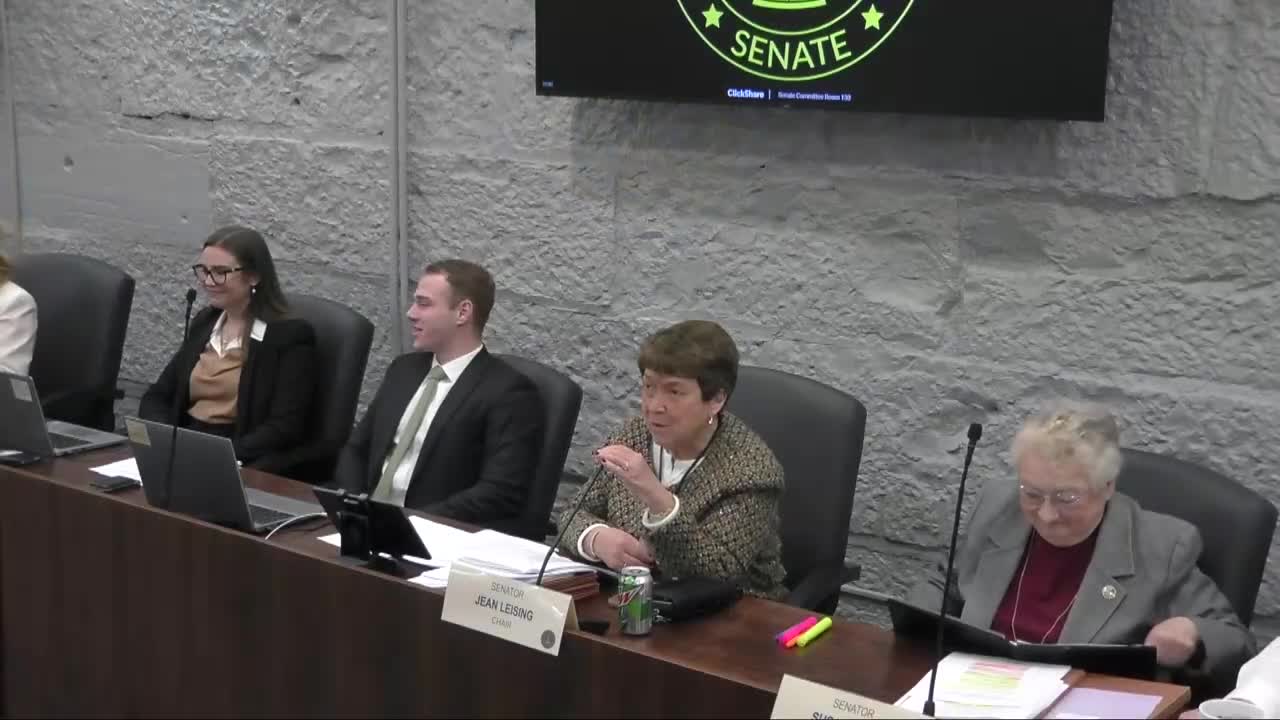
Senator Leising, chair of the Senate Agriculture Committee, opened a lengthy hearing on Senate Bill 461, saying the measure fixes a drafting omission and revises the state's grain buyers and indemnity statutes. The committee adopted Senate Amendment No. 1 by consent and voted to advance the amended bill to the Senate Appropriations Committee by a roll call of 8 yeas, 0 nays, 1 excused.
The bill rewrites the grain buyers statute to replace a loosely defined "failure" regime with a clearer, tiered process that triggers required agency action, witnesses said. "This process now ... trigger[s] action by the agency once a licensed entity's performance falls below the thresholds," said Josh Trenary of the Indiana Pork Producers Association, who described the months-long stakeholder working group that produced the draft.
Why it matters: The changes are intended to reduce uncertainty after a 2020 license surrender and a subsequent Huntington Superior Court decision that, witnesses said, found the agency's earlier practice gave too much unfettered discretion. Supporters told the committee the rewrite aims to protect farmers who store or deliver deferred-price grain to licensed dealers while giving the licensing agency explicit timelines and thresholds for notices of deficiency, hearings and possible license revocation.
Key provisions and debate
- Revocation-based procedure and risk triggers: Under the proposal, three financial risk factors (current ratio, minimum positive net worth and adequacy of unencumbered assets) remain central. If a licensee falls below a statutory threshold but is within 85% of that threshold, the agency must issue a notice of deficiency; continued deterioration can trigger a hearing and possible revocation within a 15-month corrective window, supporters said. Trenary described the shift as replacing a complex, five-factor "failure" test with a clearer revocation pathway.
- Audits, reporting and application fees: The bill requires licensees to file audited or review-level financial statements and an annual report and sets application fees for certain licenses that had been omitted in prior drafting. Katie Nelson, deputy director at the Indiana State Department of Agriculture, told the committee ISDA participated in the stakeholder process and supports the changes.
- Grain Indemnity Fund governance: The measure also changes how the Indiana Grain Indemnity Corporation (the board that manages the indemnity fund) operates, increasing separation between the agency and the fund board and allowing the board to hire outside resources, update quorum and officer rules, and increase penalties for confidentiality breaches, Joe Miller of Roseacre Farms said.
Support and opposition
Representatives of producer and agribusiness groups supported the bill. Bruce Kettler, president and CEO of the Agribusiness Council of Indiana, said the measure "provides more certainty" for businesses and farmers by clarifying timelines and tightening financial-review requirements. Steve Howe of the Corn Growers Association and Caitlin Smith of the Indiana Farm Bureau also testified in support.
Several individual farmers and producers urged stronger enforcement or higher financial standards. Jay (Jace) Skiger, a producer from Markle, said he opposed "how certain sections of Senate Bill 461 are written" and wanted more assurance the new rules would be enforced. Leslie Douglas and Dean Kratzer, farmers who said they were affected by past dealer failures, told the committee they were worried that some thresholds and enforcement mechanisms would not adequately protect farmers and called for standardized, third-party audits and faster enforcement when deficiencies appear.
Votes at a glance
- SB 461 (as amended): Advance to Senate Appropriations Committee. Motion passed by roll call: 8 yeas, 0 nays, 1 excused. The committee recorded the measure as "passed as amended" and recommitted to appropriations.
What the committee recorded and next steps
Senators recorded an 8-0 roll call to advance the bill; the committee adopted the amendment by consent earlier in the hearing. Committee members and stakeholders repeatedly said the bill is the product of months of negotiation; sponsors and supporters said further amendments are possible during the Senate's second reading and later in the process. If the bill advances from appropriations and both chambers pass it, changes to licensing, audit standards and fund governance would take effect as the enacted language specifies.
Ending
Sponsors and agency staff said they will continue stakeholder outreach as the bill proceeds. Senator Leising told farmers in the room that passage from this committee does not fix final language; the bill will be subject to amendment on the Senate floor and in the House if it advances. "We will keep the process moving because we need something fixed to protect farmers," she said.