
Olympia School Board member urges state to fully fund basic education, cites McCleary ruling
Get AI-powered insights, summaries, and transcripts
Sign Up Free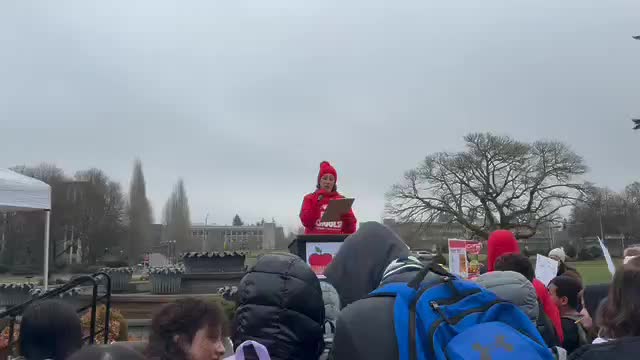
Summary
Maria Flores, an Olympia School Board member, told an audience that Washington has failed to fully fund basic education for decades, highlighted disparities affecting students of color, students in poverty and those with disabilities, and cited the McCleary decision and the 1975 Miller report in calling for legislative action.
Maria Flores, an Olympia School Board member, told students and others at a public meeting that Washington state has not fully funded basic education and urged legislators to act, citing the state Supreme Court's McCleary decision and longstanding reports dating to 1975.
Flores said she left classroom teaching to focus on education policy after working in under-resourced schools, including on the Navajo Nation and in Bureau of Indian Education schools. "I could only control what was in the 4 walls of my classroom, but I could not control how systemically broken my students' education system was," she said.
Flores asked the audience to participate in a series of prompts to illustrate inequities, telling students that efforts to fully fund basic education have been studied for decades: "If you guessed 50 years, you're correct," she said, referring to the length of the debate since the 1975 Miller report.
She highlighted racial and economic disparities, saying students of color and students who live in poverty "are gonna be more likely to attend a school with less resources just because of who you are." Flores also raised special education funding as an example of incomplete state support, saying, "We have a special education cap that says for students that qualify for special education, the state ... will only pay a certain percentage of it, and everything else is not paid for."
Flores invoked the Washington Supreme Court's McCleary decision to frame her call to action. She said the court described public education in the state constitution as a "positive constitutional right" and quoted the court: "where the court is concerned not whether the state has done too much, but whether the state has done enough." She added, "Positive constitutional rights do not restrain government action. They require it."
In closing remarks, Flores encouraged students to tell legislators about the experience of unequal schooling and the importance of fully funding public education. Her remarks were part of her presentation to the meeting audience and did not include a formal motion or vote.