Get Full Government Meeting Transcripts, Videos, & Alerts Forever!
Get email alerts on the Commission Strategy Year End Report topic
No spam. Unsubscribe anytime.
Homelessness Oversight Commission to draft year-end report, form working group for 2025 strategic plan
Summary
San Franciscos Homelessness Oversight Commission agreed to form a working group to develop a year-end report and help shape a 2025 strategic plan, after commissioners reflected on the panels role, limits of authority and priorities including budget transparency, PSH vacancies, eviction disparities and youth homelessness.
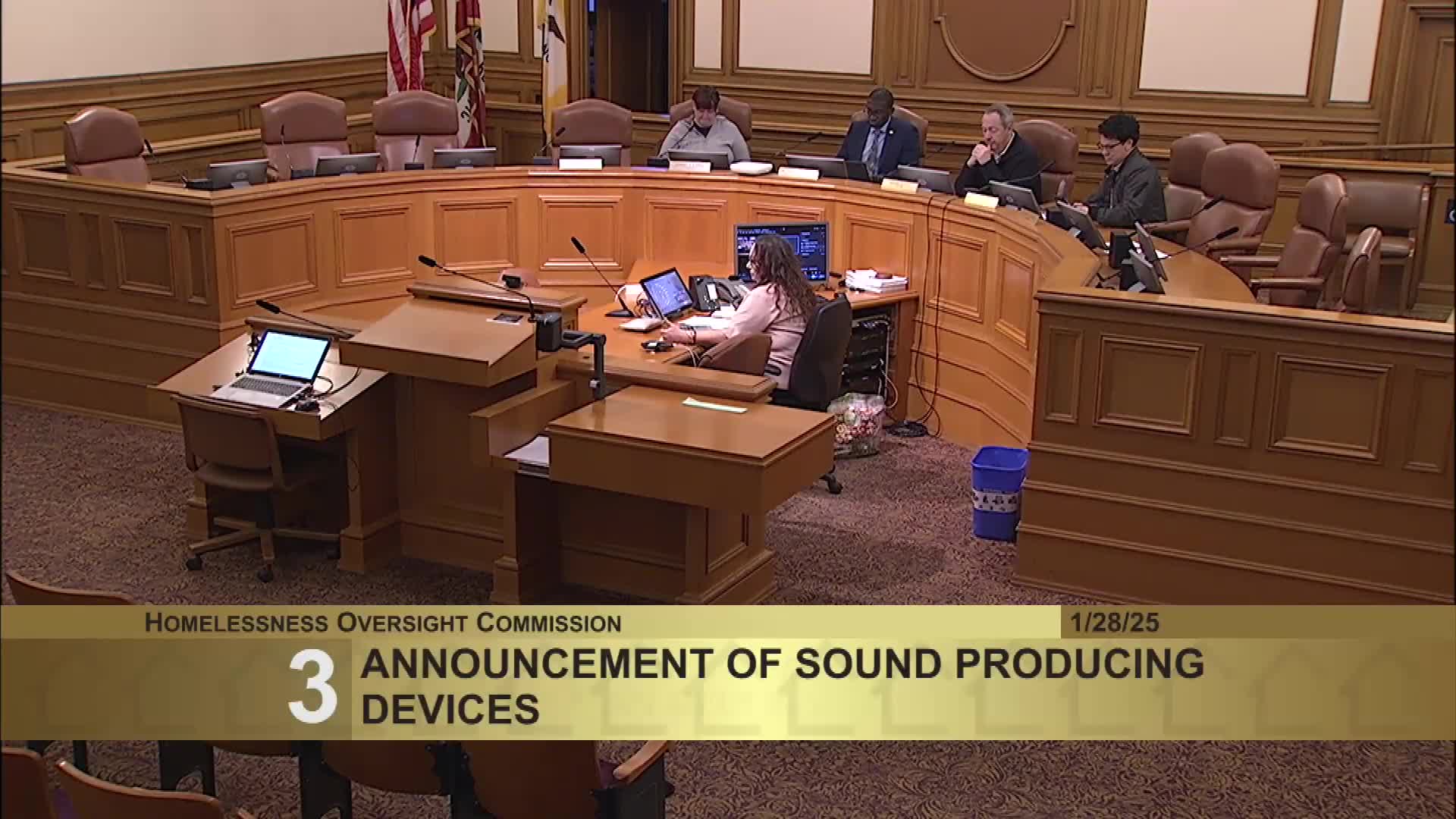
The San Francisco Homelessness Oversight Commission agreed to form a working group to draft a year-end report and develop material for a 2025 strategic plan, commissioners said during a special meeting held in Room 416 of City Hall.
Chair Jonathan Butler said the groups immediate task is to "prepare for our year end report summarizing our accomplishments from last year and also to establish a working group tasked with developing our 2025 HLC strategic plan." The chair and other commissioners described the work as a combination of public education, oversight and clearer engagement with city departments.
The commissions year-end review will be organized around the powers laid out in the ordinance that created the body, commissioners said, and is intended to document what the commission has done, where it has influenced departmental practice and where its statutory powers are limited. Commissioner Katie Albright said she wants the commission to keep accessible materials and public-facing data tools central to its work: "I would love to continue just to center that practice and I think you did a really good job of that."
Nut graf: Commissioners described the new document as both an accountability tool and a public-education piece, designed to show the commissions activities, summarize hearings and data work over the past year and indicate areas for future oversight. The group emphasized that some statutory authorities are more symbolic on paper than they are operationally, and said the report should clarify the commissions actual levers of influence.
In the meeting commissioners reviewed several recurring issues the commission has taken up in the past two years and said those topics should be highlighted in the report: budget transparency and context for contract sizes; persistent vacancies in permanent supportive housing (PSH) programs; racial disparities in eviction-related data; shelter safety and the rate of shelter denials; and gaps in services for transitional-age youth (TAY).
Commissioner Bevan Dufty praised the departments leadership while acknowledging challenges, saying, "Director McFadden has acquitted herself nobly in a very difficult set of circumstances here." Commissioners also urged that the year-end report include specific examples where commission requests for data led to changes in departmental practice, citing a review of eviction data and the departments subsequent steps to address racial disparities.
Several commissioners suggested the report combine numeric tallies with short qualitative summaries. Possible metrics mentioned for inclusion were number of commission meetings (22), hearings on targeted topics, appointments made to advisory bodies (the local homeless coordinating board, shelter monitoring committee and shelter grievance committee) and data-driven findings such as a cited overall shelter exit rate of about 7 percent annually and localized denial-of-service rates as high as 15 percent at some sites.
Commissioners discussed how the commission should interact with the citys budget process. Several members pressed for clearer context so the public can understand whether a given contract or program allocation is relatively large or small in the overall portfolio. One commissioner urged the commission to review long-standing vacant positions in the department as a possible source of funds that might be repurposed to address service gaps.
The commission also agreed to pursue greater clarity on the bodys statutory role. One commissioner read the ordinance creating the commission and listed duties such as approving applicable department budgets, formulating annual and long-term goals consistent with city objectives, establishing departmental performance standards, holding hearings, conducting public education, and performing performance audits; members noted the difference between what the ordinance states and the commissions actual power to enforce or direct departmental operations.
Members proposed steps to improve public engagement and transparency: producing an executive-summary style year-end report alongside a longer document, creating a simple public explainer of the commissions statutory limits, and using SFGTV or other channels to publish short informational pieces on the commissions role and the three appointed committees the commission fills.
Public commenters called for an accessible repository of policy and procedure documents and emphasized the need for strategies that bring additional funding into homelessness services. A commenter recommended a centralized, searchable index of relevant policies; commissioners said compiling links and basic guides would be feasible.
Outcome and next steps: Chair Butler said he will ask Commissioners Kristen Evans, Joaquin Guerrero and himself to form the working group to develop the year-end report and materials to inform the 2025 strategic planning conversation. No formal vote was recorded; commissioners agreed by consensus to proceed. The working group will draft materials for commission review at future meetings, and the commission intends to schedule dedicated time in upcoming agendas to address statutory duties in sequence.
Ending: Commissioners closed by asking staff to prepare a list of suggested report contents for the working group and to present the commissions statutory language and proposed timeline at the next meeting. The commission adjourned after public comment and brief acknowledgements.