Get Full Government Meeting Transcripts, Videos, & Alerts Forever!
Get email alerts on the Budget Process topic
No spam. Unsubscribe anytime.
HSH budget chief warns of large city shortfall; mayor asks departments to plan 15% general-fund reduction
Summary
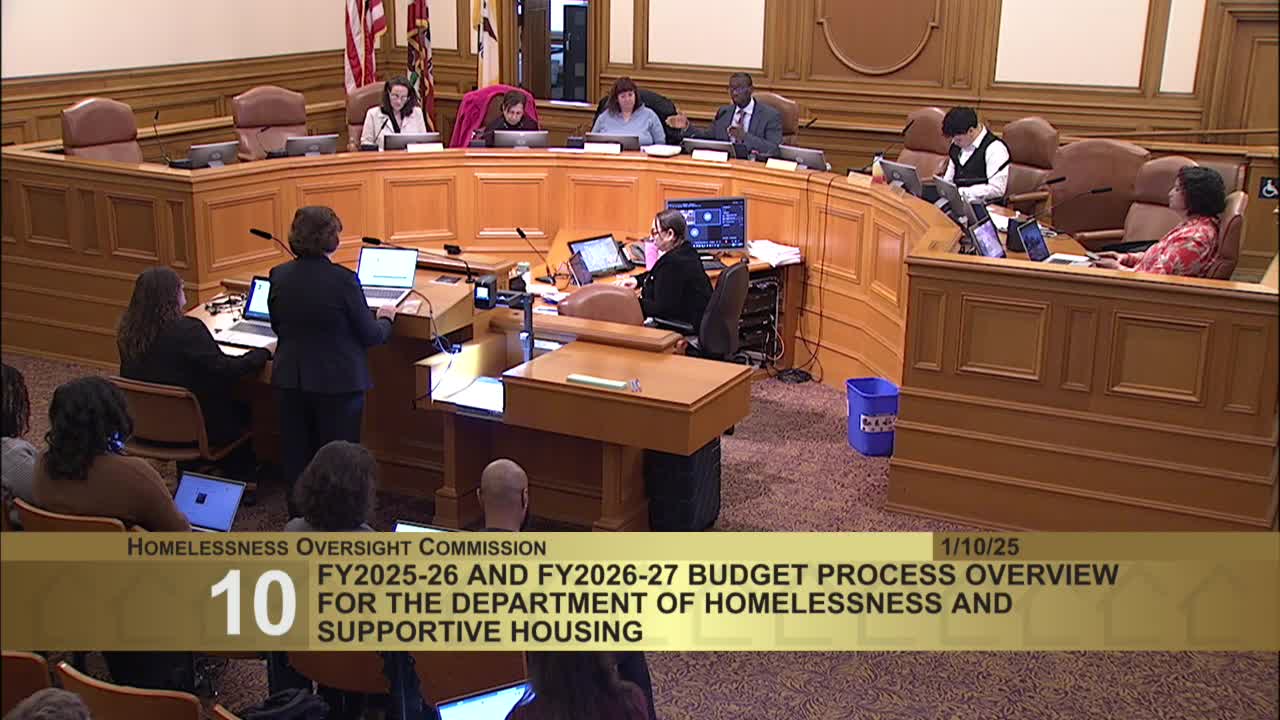
Gigi Whitley, HSH chief of administration and finance, told the Homelessness Oversight Commission on Jan. 10 that San Francisco faces an $876 million two-year general-fund shortfall and that the mayor—s office has instructed departments to prepare options that could include permanent reductions, program consolidations and new revenue strategies.
Gigi Whitley, chief of administration and finance for the San Francisco Department of Homelessness and Supportive Housing, told the Homelessness Oversight Commission on Jan. 10 that the city faces a projected two-year general-fund shortfall of about $876 million and has asked departments to prepare for significant permanent reductions.
Whitley summarized the department—s current adopted 2024-25 budget of about $846 million and said a substantial share of HSH—s recent budget relied on one-time state and local infusions. "We currently have an $846,000,000 budget," Whitley said during the presentation, noting that much of the near-term spending is multiyear or one-time funds that will not recur.
Why this matters: The mayor—s guidance to reduce ongoing general-fund spending by up to 15 percent next year — roughly $46 million for HSH in a straight calculation — would force difficult choices because a large portion of HSH—s operations are locally supported and many shelter and housing costs are recurring.
Key points from the presentation:
- Structural picture: Whitley said the department—s budget appears smaller in year-to-year comparisons because one-time grants and carryover inflated the current-year total; many programs now are funded with multiyear or nonrecurring sources.
- Our City Our Home (OCO) volatility: The gross-receipts-funded OCO fund has shown revenue swings and appeals can create large year-to-year differences. The department expects updated OCO revenue projections in January and again in April.
- Cost drivers: Whitley called out rising insurance costs for providers, an expensive meals budget for shelter operations, and lease payments for privately owned sites as recurring pressures.
- Mayor—s instructions and process: The incoming mayor had issued a hiring freeze and asked departments for ideas including new revenue strategies, efficiencies, and a review of contracted provider outcomes. Whitley said the mayor—s office has asked departments not to submit an immediate plan that simply cuts 15 percent but to collaborate on longer-term solutions and potential revenue and efficiency measures.
- Revenue and efficiency ideas: Whitley listed possible approaches: pursuing additional state grants (HAP/encampment resolution funds), aggressive applications for one-time capital grants (Homekey/Prop 1-style funds) to acquire or convert property, leveraging Medicaid waiver and CalAIM funding for supportive services, and reviewing meal-delivery and site-consolidation options to lower recurring costs.
Questions and concerns: Commissioners pressed Whitley about what a 15 percent permanent reduction would mean, how Prop M and appeals affect OCO revenue volatility, and whether the department could provide a clearer line-item view of spending and outcomes tied to units or beds. Whitley said HSH is hampered by data-system limitations but pledged to improve reporting and to present more detailed breakdowns at the Feb. 14 meeting.
Next steps: HSH will refine its departmental proposal for the mayor—s office by the statutory Feb. 21 submission deadline, continue liaison meetings with the OCO oversight committee in February and March, and return to the commission in February with a more detailed budget package.
Ending note: Whitley told commissioners the administration aims to prioritize homelessness but that the department must identify a mix of creative revenue options, efficiencies and programmatic tradeoffs to meet a large projected citywide shortfall.