Get Full Government Meeting Transcripts, Videos, & Alerts Forever!
Get email alerts on the Sf Survey Richmond topic
No spam. Unsubscribe anytime.
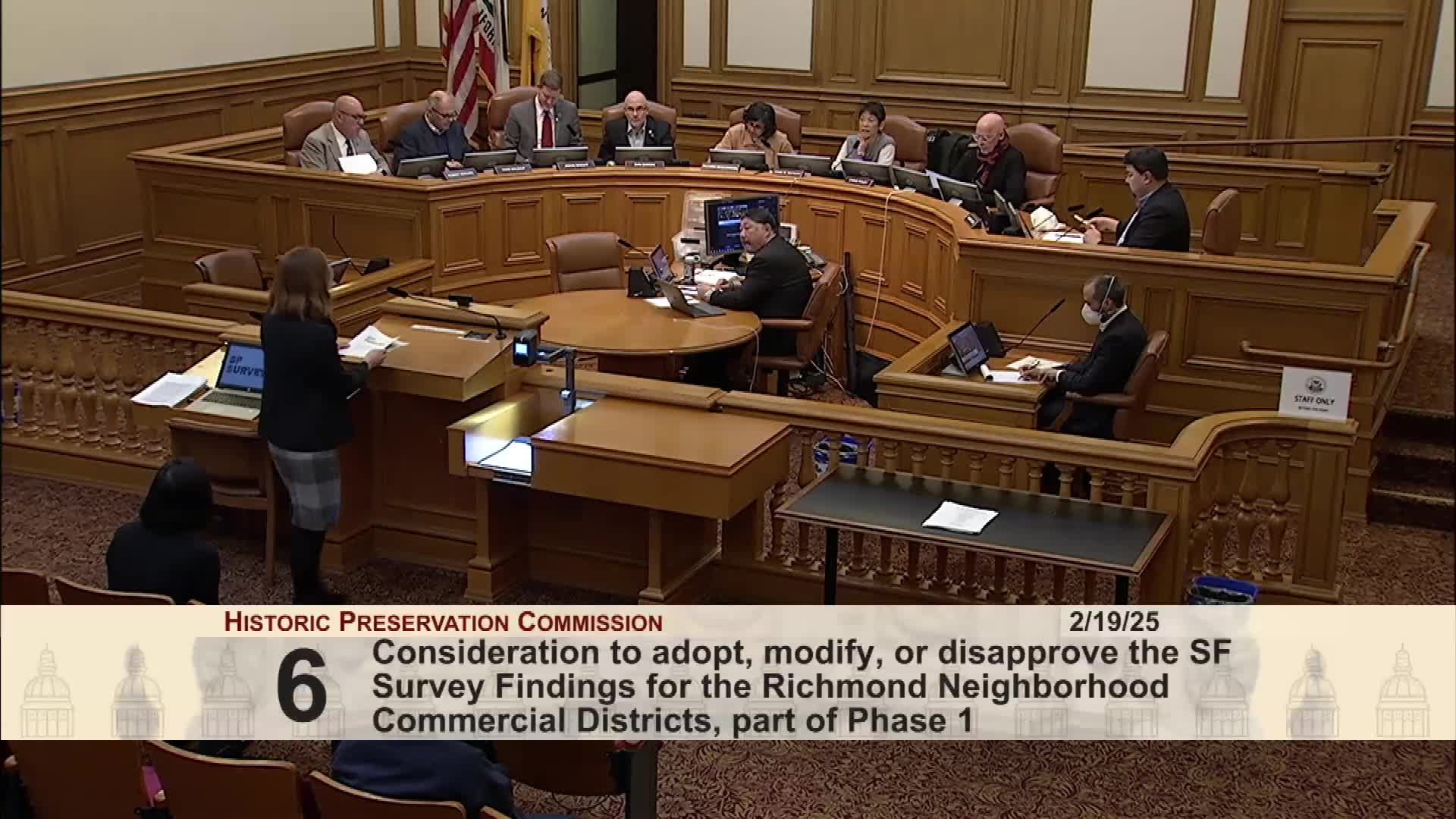
Historic Preservation Commission adopts SF Survey findings for Richmond commercial districts
Summary
The commission adopted SF Survey findings for the Richmond neighborhood commercial districts on Feb. 19, approving staff evaluations identifying 57 historic resources among 979 properties and directing continued community engagement and follow‑up work.
SAN FRANCISCO — The San Francisco Historic Preservation Commission on Feb. 19 adopted the Planning Department’s SF Survey findings for the Richmond neighborhood commercial districts, moving the city’s multi‑year cultural resources effort forward and prompting questions from community members about potential historic districts and intangible cultural heritage.
Planning staff presented results from field work that surveyed 979 properties within the Richmond neighborhood commercial districts and identified 57 properties as historic resources, 730 as not historic resources, 107 as not evaluated because they were not age eligible or not visible, and 85 as pending further historic context statement review. Maggie Smith, the project lead for SF Survey, told the commission the findings are intended as a living document and emphasized broad community engagement during field work.
"Our primary goal is to identify and document places and resources of cultural, historical, and architectural importance to San Francisco and its diverse communities," Smith said. The commission adopted the findings by unanimous roll call, 7–0.
Supervisor Matt Haney Chan (listed in the record as Supervisor Chan) attended and praised staff outreach, telling commissioners, "I really just commend you, and your staff for engaging the community and starting this process." Several public commenters, however, urged the commission and staff to look more expansively for historic districts along Clement Street and other Richmond corridors.
Woody LaBounty of San Francisco Heritage said the survey’s current approach risks missing cohesive commercial districts, telling the commission that walking Inner Clement Street "you see those 2‑story buildings ... there's definitely a historic district there." Neighborhoods United San Francisco echoed concerns about methodology and asked staff to explain how district potential was assessed.
Staff responded that the survey did consider district potential but, given property alterations over time and the current information, did not identify cohesive historic districts in this round. Maggie Smith and other staff said pending context statements — notably Russian American and Chinese American context statements scheduled later this year — could alter findings and lead to district identifications in future rounds.
At the hearing, a building owner who identified themself as the owner of the Forest Theater raised concerns that historic findings can create additional regulatory hurdles for small arts‑oriented projects and described the practical costs of renovating and operating an arts venue. Planning staff and a preservation staff member responded with outreach offers and examples of how staff can work with owners to balance preservation review with reuse and viability.
Commissioners asked staff to continue work on areas the public flagged and to begin the next phases of SF Survey. Staff said field work in residential areas would begin in March and that the project plans to refine boundaries and contributor lists for existing historic districts (192 districts citywide, staff said) during phase two.
The commission’s action adopts the SF Survey findings for the Richmond neighborhood commercial districts as presented and directs staff to continue community outreach and to bring forthcoming historic context statements to the commission for review and possible adoption.
Key numbers
- Properties surveyed: 979 - Properties found historic resources: 57 - Properties not historic resources: 730 - Properties not evaluated (not age‑eligible or not visible): 107 - Properties pending historic context statements: 85
Next steps: staff will continue public engagement, refine findings as context statements are adopted (including Russian American and Chinese American statements), and commence field work in residential areas beginning in March.