Get Full Government Meeting Transcripts, Videos, & Alerts Forever!
Get email alerts on the Hsh Operations Safety topic
No spam. Unsubscribe anytime.
HSH director reports two shelter shootings, outlines outreach, vacancies and moves into housing
Summary
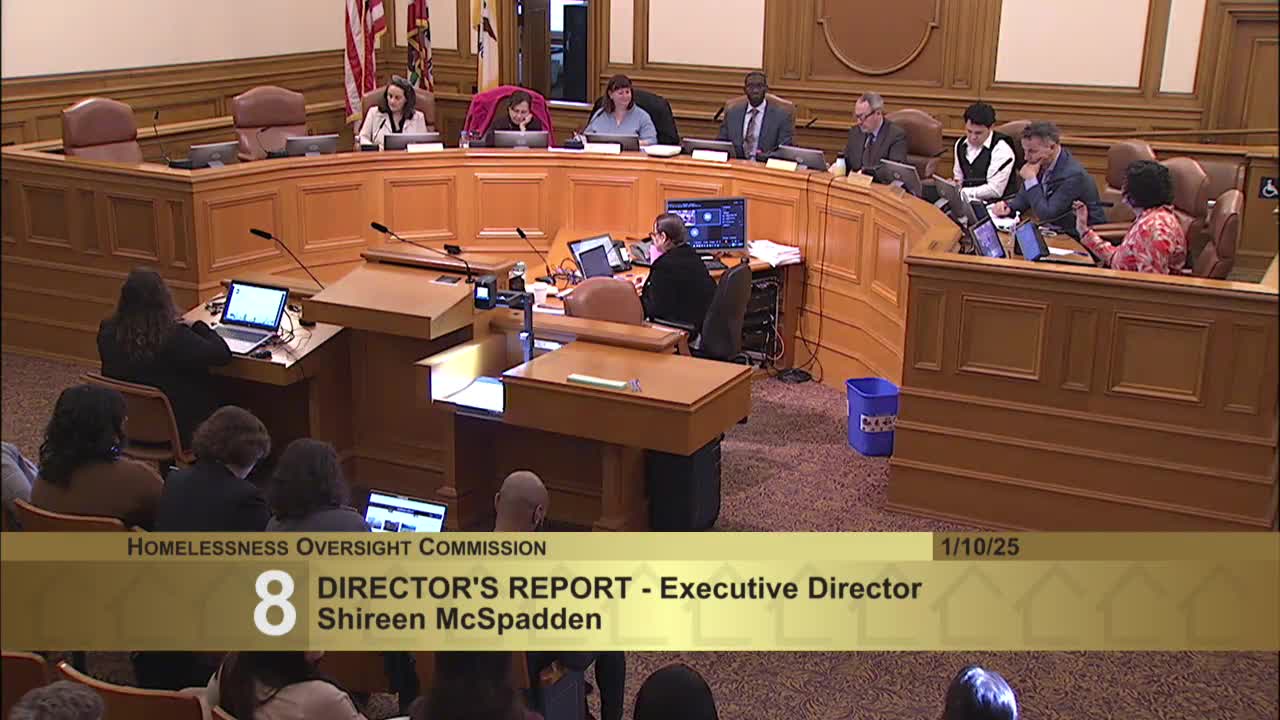
San Francisco Department of Homelessness and Supportive Housing Executive Director Shereen McSpadden told the Homelessness Oversight Commission on Jan. 10 that the department responded to two shootings at sites serving people experiencing homelessness and provided monthly operational updates including outreach totals, housing placements and efforts to bring offline supportive-housing units back into service.
San Francisco Department of Homelessness and Supportive Housing Executive Director Shereen McSpadden told the Homelessness Oversight Commission on Jan. 10 that the department responded to two shootings at sites serving people experiencing homelessness and has been working with providers and public health partners on safety and trauma-response measures.
McSpadden said, “we had 2 shootings at 2 different sites,” and praised on-site staff and community-based partners for their responses and ongoing support to residents and employees at each location.
Why this matters: The incidents underline persistent safety and behavioral-health challenges inside some shelter and supportive-housing sites, and come as HSH tracks occupancy, unit outages and efforts to bring offline units back into service.
McSpadden presented data for November and December 2024 and early January 2025: the city—s homeless outreach team conducted 3,131 engagements and distributed 7,028 items (food, water, hygiene supplies); field teams completed 197 housing assessments, connected 12 households to housing and made 185 placements to shelter; the coordinated entry system completed 976 assessments in November. HSH reported 126 moves into permanent housing in November and 946 so far this fiscal year.
On the supportive-housing portfolio, McSpadden said HSH had a site-based vacancy rate of 8.4 percent. Of 724 vacant units, 319 had move-ins in progress, 332 were offline and 73 were available for referral. HSH required providers with units offline 90 or more days to submit plans; of 147 such units, 106 were brought back online, 18 require rehabilitation and 20 were under instruction to be returned to service by Jan. 15.
Shelter system snapshots: HSH reported 3,698 units of shelter capacity on Dec. 27 with a 92 percent occupancy rate. On Dec. 18, the family shelter wait list held 278 families; 21 families were placed into family shelters in November. The adult wait list stood at 248 people, down from 316 the prior month; 587 people joined the adult wait list in November and the average time on the wait list for adults who accepted placement was 11 days.
Prevention and problem-solving: McSpadden and HSH staff described the San Francisco Emergency Rental Assistance Program (a partnership with the Mayor—s Office of Housing and Community Development) as a key prevention tool. In the month reported, ERAP served 354 households at an average of $4,470 per household; 87 percent of recipients were identified as people of color and 78 percent earned 30 percent or less of area median income. HSH said problem-solving efforts resolved homelessness for 361 unique households over the prior five months with $1,237,572 in direct financial assistance; staff later said the department curtailed some eligible problem-solving uses in November after funds were spent earlier in the fiscal year.
Staffing and operations: HSH told the commission it had 254.65 full-time-equivalent positions and about 333.65 vacancies, with 35 active recruitments; commissioners pressed HSH on how a new mayoral hiring freeze would affect conditional offers and ongoing recruitments.
Commission response and public comment: Commissioners and members of the public raised concerns about shelter training, de-escalation, staff hiring and the condition of some navigation centers. Several public commenters urged better tracking of who exits wait lists without placements and asked for demographic breakdowns (age, seniors, transitional-age youth) for those exits. McSpadden said HSH is working on additional reporting and communications to address those questions.
What—s next: McSpadden said HSH will continue to work with the Department of Public Health and providers on trauma-informed approaches and revised shelter training material, and will report further as corrective actions on offline units and other operational items are completed.
Ending note: Commissioners asked HSH to provide more detailed demographic and cohort data in follow-up reports so the commission and the public can better understand inflow and outflow patterns and which prevention tools are most effective for specific populations.