Get Full Government Meeting Transcripts, Videos, & Alerts Forever!
Get email alerts on the Budget topic
No spam. Unsubscribe anytime.
DOS budget presentation warns of two‑year city shortfall, 15% discretionary cut target for HSA
Summary
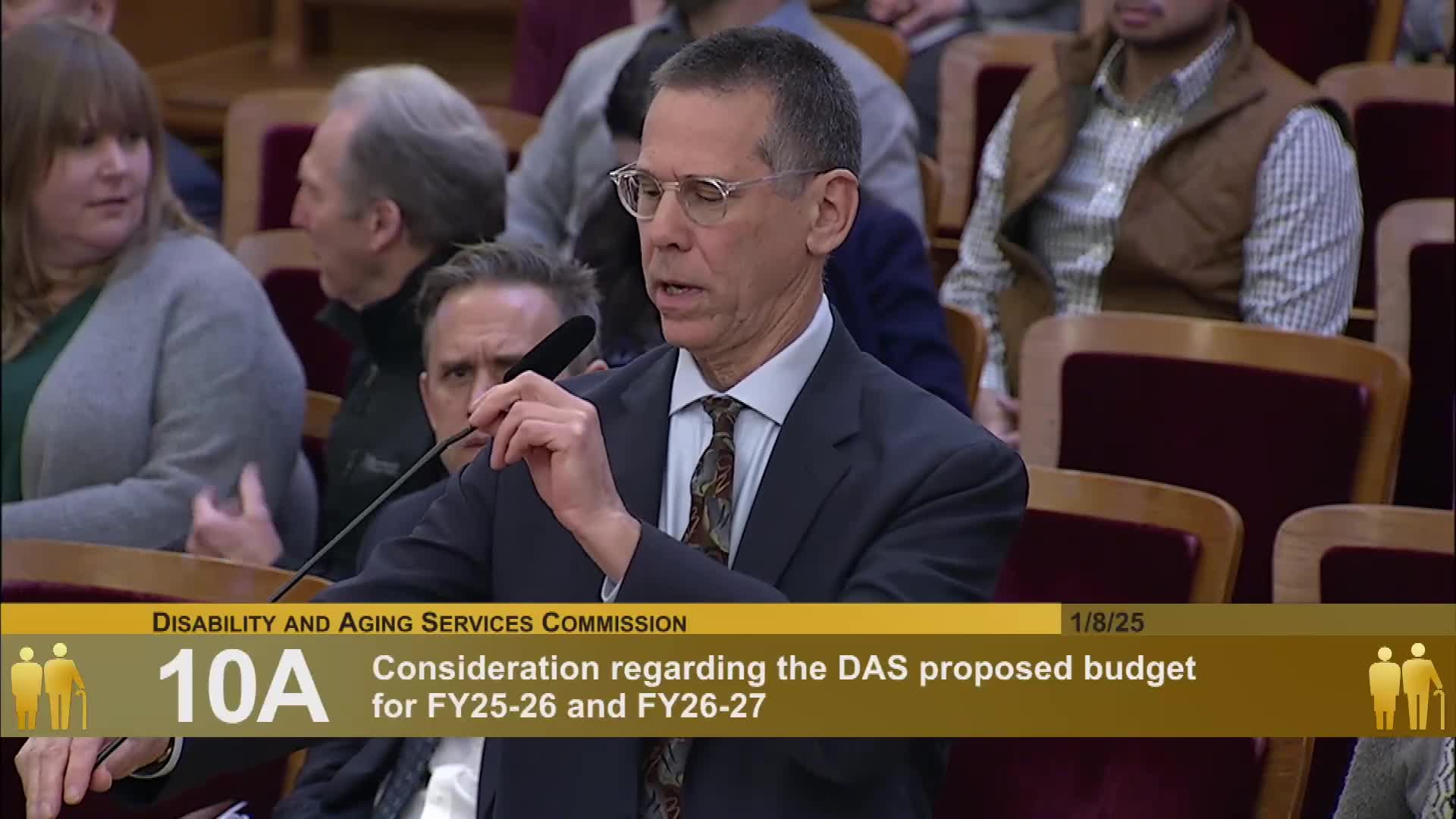
At the Wednesday, Jan. 8 meeting of the San Francisco Department of Disability and Aging Services Commission, HSA budget staff reviewed DOS’s current budget, projected fiscal risks for fiscal years 2025–26 and 2026–27, and a mayoral directive to propose reductions for discretionary general‑fund spending.
At the Wednesday, Jan. 8 meeting of the San Francisco Department of Disability and Aging Services Commission, HSA budget staff reviewed DOS’s current budget, projected fiscal risks for fiscal years 2025–26 and 2026–27, and a mayoral directive to propose reductions for discretionary general‑fund spending.
The Human Services Agency’s deputy director for administration, Dan Kaplan, told commissioners that DOS’s current budget is roughly $510,000,000 and that in typical city practice the agency must review the current year’s spending to build the next biennial submission. Kaplan said in the DOS budget “IHSS represents about 75% of the DAS budget,” and that the local portion carried in DOS does not include the larger state and federal wage dollars for IHSS independent providers, which are run through the state’s payment systems.
The briefing outlined funding sources and pressures. Kaplan said about 23% of DOS funding is federal, 35% state and 42% local; locally supported items include the Dignity Fund and the Community Living Fund. He said the mayor’s office had directed HSA to propose reductions equal to 15% of discretionary general‑fund support, which HSA calculated as an $8.2 million target across HSA divisions.
Why it matters: the budget pressures affect services that serve older adults and adults with disabilities, including in‑home supportive services (IHSS), Adult Protective Services (APS), the Office of Community Partnerships and DOS intake. The commission was not asked to vote on a budget at the meeting; the presentation laid out the department’s forecast and schedule for submission and hearings.
Key details from the presentation
- Program scale and caseloads: Kaplan and Executive Director Kelly Dearman said IHSS is the largest program in the DOS portfolio and that the department’s IHSS program now serves more than 30,000 individuals. DOS integrated intake recorded more than 16,000 intakes in the last year. Adult Protective Services reported a rise in reports after a change in presumptive eligibility from age 65 to 60, with APS reporting a 27% growth in reports over three years. The County Veterans Service Office saw more than 11% growth in clients last year.
- Local versus state/federal money: Kaplan explained the local IHSS MOE (minimum obligation/local share) is what DOS budgets; the greater state and federal dollars that pay independent provider wages flow via the state systems and are not carried in the local DOS operating budget. Under state law, he said, the IHSS MOE grows at 4% per year and will increase further with negotiated wage increases in the current four‑year agreement with SEIU 2015.
- Dignity Fund uncertainty: Kaplan said the Dignity Fund normally grows by $3 million a year unless a city deficit trigger is pulled. He said the forecasted city deficit for the coming fiscal year was about $253 million and the deficit trigger threshold was roughly $249 million; if that forecast holds the Dignity Fund would not grow next year (the base would remain but not increase).
- Citywide outlook and mayoral directive: the city’s November forecast showed a projected two‑year general‑fund deficit of roughly $876 million, with a $253 million shortfall in the coming year. In response, the mayor’s budget instructions asked departments to identify reductions equal to 15% of discretionary general‑fund support; Kaplan said for HSA that equals $8.2 million.
Process and next steps
Dearman and Kaplan told commissioners the department will return with recommended budget adjustments on Feb. 5, submit the agency budget to the mayor’s office Feb. 21, and participate in the mayor‑to‑board review cycle that culminates in a mayoral submission to the Board of Supervisors on June 1. The department emphasized that the mayor’s directives target discretionary general‑fund items (for example agency operations and some general‑fund‑supported staff and services), not statutorily dedicated revenue such as some realignment or Dignity Fund baseline support.
No formal budget actions were taken by the commission at the Jan. 8 meeting; the presentation was informational. Commissioners asked technical questions about timing of potential federal impacts, cost‑of‑doing‑business (CODB) treatment for community‑based organization grants, and whether recent labor agreements would affect the second year of the biennium. DOS staff said CODB treatment is typically resolved at the mayoral submission phase, not at the agency phase.