Get Full Government Meeting Transcripts, Videos, & Alerts Forever!
Get email alerts on the Cost Effectiveness topic
No spam. Unsubscribe anytime.
PSC rulemaking debate focuses on how to define "cost-effective" for Maryland storage program
Summary
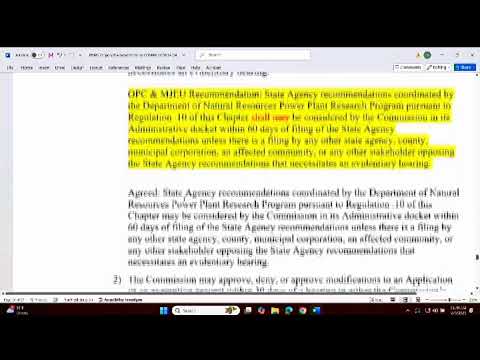
The Office of People's Counsel urged the commission to require traditional benefit‑cost tests in the proposed regulations, while work group staff and several commissioners recommended preserving language that allows consideration of additional factors.
During the RM 85 rulemaking session on the Maryland Energy Storage Program, a central point of debate was how to define the statutory term “cost effective” in the proposed regulations.
Mark Sheebas, speaking for the Office of People's Counsel (OPC), told the commission that the statute (identified on the record as "7 2 16.1") uses the term “cost effective” repeatedly and, in OPC’s view, that phrase should be interpreted in the traditional way: the benefits must exceed the costs. "The benefits must exceed the cost," Sheebas said, arguing that the commission should not adopt an alternative “cost efficiency” approach that would select the lowest-cost alternative among options even if none are net-beneficial in a benefit‑cost analysis.
Mister Borkowski, the work group leader, described the draft regulation as "agnostic to the pricing, meaning we're trying to set up something that could be satisfied for any program," and said pricing and valuation questions would be addressed in the separate procurement proceeding the commission announced to begin in late March.
Several commissioners asked clarifying questions. Commissioner Richard and Commissioner Sutphen raised concerns about whether a strict benefit‑cost test could block otherwise valuable deployments, pointing to uncertain market revenue prospects for storage in the PJM region and to potential system benefits that are difficult to quantify. Borkowski and other participants noted that storage benefits may be large but uncertain and that different use cases (capacity, distribution, transmission deferral, grid services) can compete for the same resource and complicate benefit calculations.
Why it matters: OPC framed its recommendation as a consumer-protection measure because most program funding under the current proposal would come from ratepayers; OPC said a strict benefit‑cost floor is appropriate before approving subsidized programs. Opponents — including commissioners who spoke — cautioned that an overly narrow definition could prevent the program from realizing systemic benefits that are difficult to capture in a conventional benefit‑cost analysis.
Discussion points included: the difference between a traditional benefit‑cost test and a cost‑efficiency selection among alternatives; uncertainty in PJM market revenues for storage; potential for storage to enable additional renewables or avoid large transmission projects; and whether statutory language allows or forecloses broader factor-based evaluation.
No formal change to the draft regulation was made on the record at the meeting; commissioners indicated differing views and staff said the General Assembly could amend statutory language if it intended a different standard.
Ending: The commission voted later in the session to publish the draft regulations for notice; the record shows the cost‑effectiveness question remains a key issue for comment and possible revision during the public notice and procurement processes.