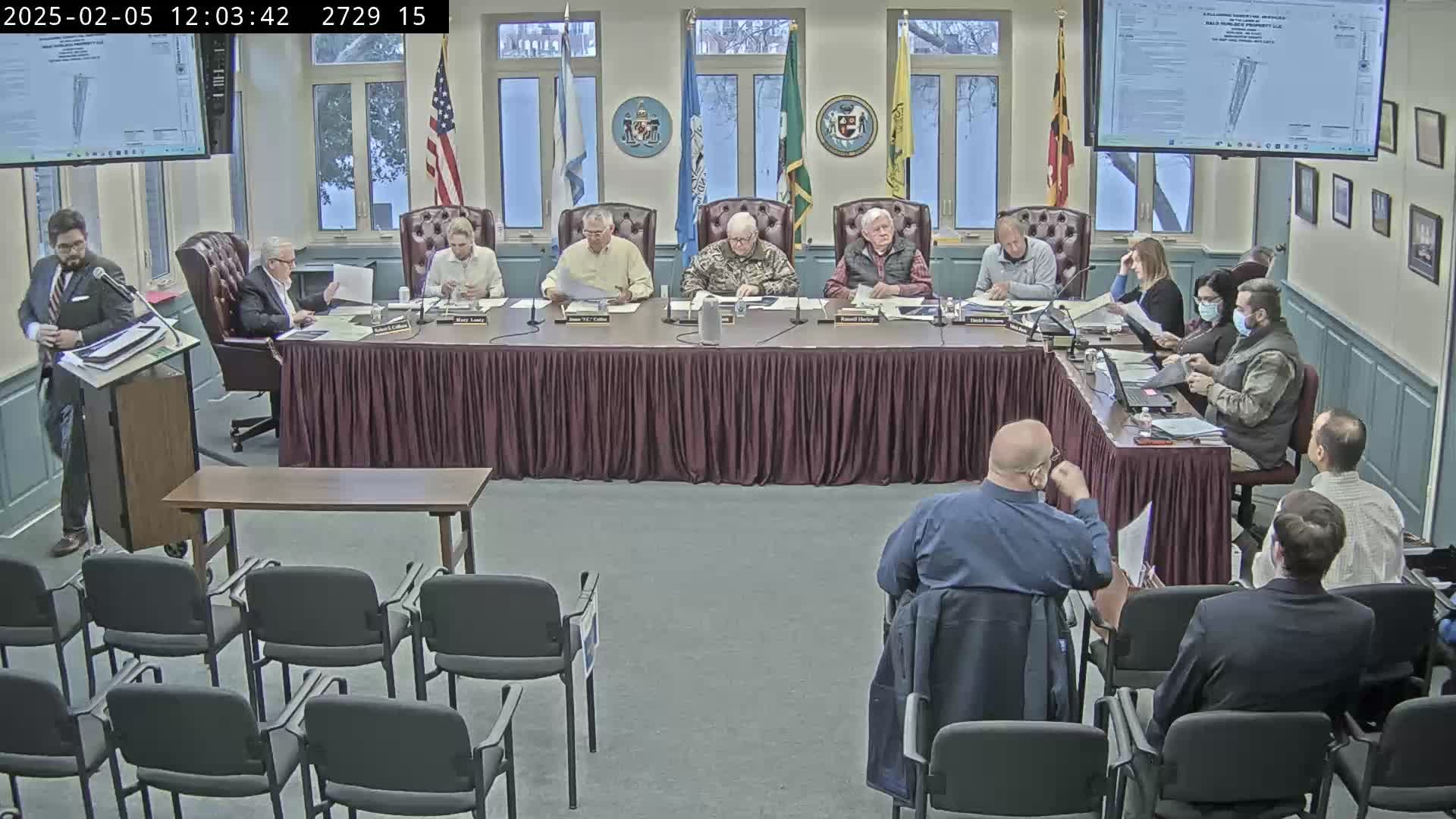
Planning commission recommends Board of Appeals consider variance, special exception for Halo Hurlock community solar project

3225304 · February 5, 2025

Loading...

AI-Generated Content: All content on this page was generated by AI to highlight key points from the meeting. For complete details and context, we recommend watching the full video. so we can fix them.

Summary

Dorchester County planning commissioners gave a favorable recommendation to the Board of Appeals for a proposed 2 MW community solar facility on a 16.33-acre parcel on the south side of Hinson Road, including a request to allow a 7-foot security fence and a modified eastern landscape buffer at the request of an adjacent nursery operator.

The Dorchester County Planning Commission voted to recommend that the Board of Appeals consider a special exception and a variance for a community solar project proposed by Halo Hurlock Property LLC on a 16.33-acre parcel on the south side of Hinson Road.

The developer seeks Board of Appeals approval for a community solar facility not to exceed 2 megawatts alternating current, and a variance to allow a security fence height 1 foot taller than the 6-foot standard included in county practice. The commission’s recommendation is not a final permit; the Board of Appeals will decide on the special exception and variance, and if approved the project will return to the planning commission for final site-plan review.

Developer Brandon Lane of McAllister, DeWald, Wilford & Walker described the proposal as a single-axis tracking community solar installation that would use about 11.88 of the parcel’s 16.33 acres, interconnect to existing Delmarva Power infrastructure along Hinson Road and would not require a new substation. Lane said the project would include standard solar protections: a decommissioning bond revisited every five years, a decommissioning agreement with the county, and planting and maintenance sureties.

Lane also told the commission the project is being treated in the county as a “utility structures and services” use because it is under 2 MW and therefore does not require a state Certificate of Public Convenience and Necessity. He said the developer has designed 50-foot-wide screening buffers on much of the site but is proposing, at the request of an adjacent nursery owner, to leave the majority of the eastern 50-foot buffer in agricultural use so the neighbor can expand nursery operations onto part of the parcel. The adjacent property owner was identified in staff materials as Hubbard Grove Nursery LLC; a neighbor who spoke identified himself as Tristan Glantz of Humber Road Nursery and said he and the developer had been discussing a “living, working buffer” arrangement.

The developer presented estimated fiscal and consumer benefits from the project. He said the subject parcel currently pays about $550 a year in real estate taxes; the developer estimated real estate taxes would rise to about $3,900 annually if developed for solar and estimated total real estate taxes over the life of the project at roughly $156,000 versus about $22,000 if the property remained in agriculture. The developer also told the commission the project would be treated as personal property for Maryland tax purposes and estimated a range of personal property tax benefit to the county (reported in the meeting transcript as a developer estimate between about $600,000 and $700,000). He said the facility could produce enough energy to serve roughly 250 homes and, as a community solar project, would give county residents first opportunity to subscribe; using the developer’s conservative estimate of a 5% reduction in subscriber bills, he estimated roughly $39,184 in subscriber savings in year one and about $1,570,000 over the life of the project.

Tristan Glantz, who identified himself as representing a nearby nursery operation, told the commission he preferred the land remain in agricultural use if possible but said he and the developer had discussed a cooperative approach that would allow nursery expansion on the eastern edge while preserving screening where it fronts the road.

Planning staff recommended the application comply with zoning regulations. After questions from commissioners about interconnection with Delmarva Power and local contracting opportunities, a commissioner moved a favorable recommendation; a second was heard and the motion carried with the commission voting in the affirmative.

The Board of Appeals will hold the hearing on the special exception and variance; if the board approves those requests, the developer must submit a revised final site plan reflecting any change to the eastern buffer before the planning commission takes final action.

Action taken: planning commission recommended referral of the Halo Hurlock community solar application to the Board of Appeals for consideration of the requested special exception and variance.