Get Full Government Meeting Transcripts, Videos, & Alerts Forever!
Get email alerts on the Veterans Education Workforce topic
No spam. Unsubscribe anytime.
Committee advances bill to let National Guard use tuition waiver for certificates and credentials
Summary
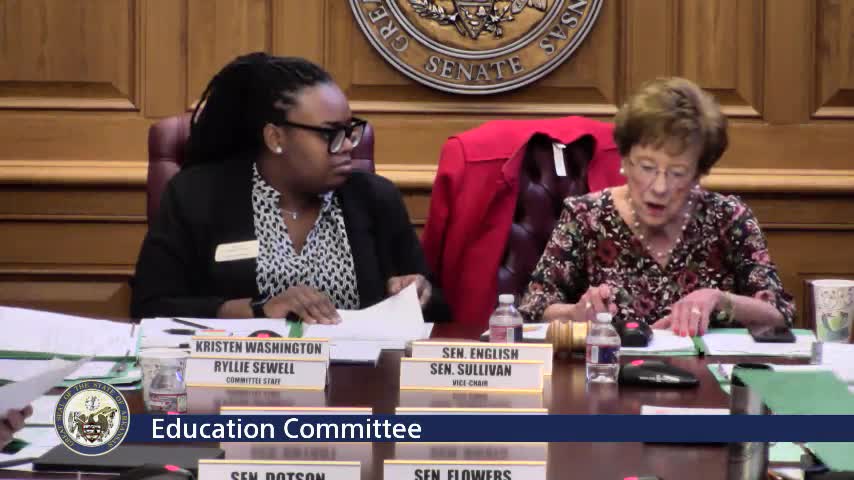
The Senate Education Committee voted to advance House Bill 1005, a bill introduced by Representative David Ray that would allow members of the state National Guard to use the existing tuition waiver to obtain non-degree postsecondary certificates and credentials in addition to degree programs.
The Senate Education Committee voted to advance House Bill 1005, a bill introduced by Representative David Ray that would allow members of the state National Guard to use the existing tuition waiver to obtain non-degree postsecondary certificates and credentials in addition to degree programs.
Representative David Ray (state representative, District 69) told the committee the 2017 tuition waiver program has supported about "400 to 500 guardsmen a year" and that HB 1005 would improve the benefit by letting guardsmen apply it to short-term certificates and workforce credentials—examples he cited included HVAC, EMT, welding, CNC machining and diesel technician training. Ray said the change would better align the benefit with employer demand and workforce needs, and observed the program started in 2017 under a predecessor.
Committee members asked whether the waiver could be used for programs offered outside the state's approved higher education institutions, such as industry-run apprenticeship schools. Senator Bryan asked whether an industry-created certificate, not sanctioned by state higher education controls, could qualify. Jeff Wood, chief of staff at the Department of the Military, said rules for the waiver program are promulgated and that the program is funded through higher education; he said those factors make it unlikely the bill by itself would permit independent private programs to qualify without tying back into the established funding and approval streams.
Representative Ray said the existing program requires National Guard applicants to use federal aid and institutional aid first, with the tuition waiver covering remaining eligible tuition. He and witnesses said partnerships between the Guard, two-year colleges and industry are possible and the promulgation process could clarify eligible providers. Summer De Prote, chancellor at the University of Arkansas Pulaski Technical College, told the committee that employers in the region are "very interested in hiring people with any type of military background" and supported using the benefit to bridge military training and civilian credentials.
Members also discussed fiscal impacts. Ray noted the fiscal estimate had assumed a 20% increase in utilization but said participation has historically been roughly 400–500 participants and that there is a $1.4 million annual appropriation plus a $3 million governor's letter to higher education—amounts witnesses said should cover current utilization. Nick Fuller, assistant commissioner for the division of higher education, said the program has a dedicated appropriation and that recent budgets include the governor's additional $3 million, yielding $4.4 million available for the program.
After discussion on implementation and fiscal capacity, a committee member moved that the committee "do pass." The committee recorded affirmative responses and the chair announced, "Ayes have it." The committee forwarded HB 1005 for further consideration.