Get Full Government Meeting Transcripts, Videos, & Alerts Forever!
Get email alerts on the NAEP Results And State Reforms topic
No spam. Unsubscribe anytime.
Arkansas NAEP scores prompt state education chief to urge continued LEARNS implementation, teacher supports
Summary
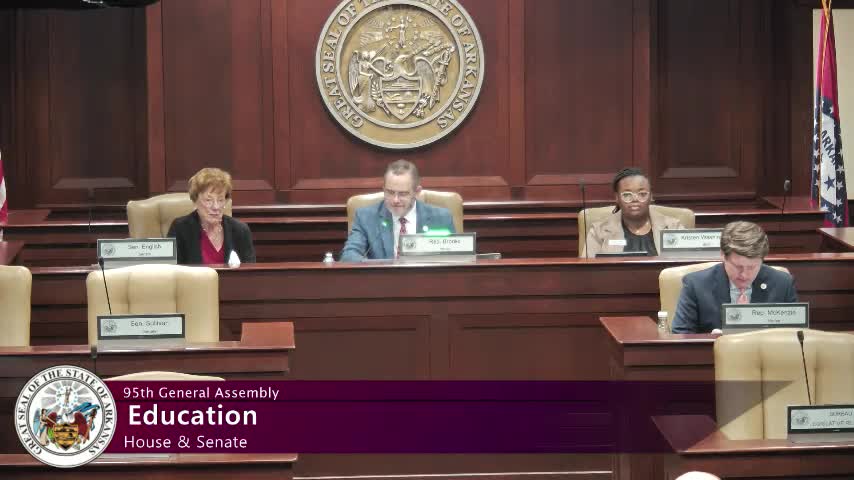
Secretary Jacob Alleva told the Arkansas Education Committee that the federal 2024 National Assessment of Educational Progress (NAEP) results show Arkansas remains below the national average in fourth- and eighth-grade reading and math and that the state must keep implementing the LEARNS reforms to improve outcomes.
Secretary Jacob Alleva told the Arkansas Education Committee that the federal 2024 National Assessment of Educational Progress (NAEP) results show Arkansas remains below the national average in fourth- and eighth-grade reading and math and that the state must keep implementing the LEARNS reforms to improve outcomes.
Alleva, presenting the NAEP “snapshot in time,” said the national assessment samples schools and students deliberately and that Arkansas’ sample for each tested grade and subject included about 90 schools and roughly 1,800 students. He described the results by percentile and said "we have to keep the conversations around access to high quality early learning, deploying the literacy coaches into our most struggling schools, making sure that every student has access to a high quality teacher, and get systematic explicit instruction uninterrupted 5 days a week." He framed the department’s goals through what he called the "3 Es": that policy and practice put students on pathways to be enlisted, enrolled or employed.
Why this matters: Committee members pressed for specifics because the NAEP is widely used for state comparisons and policy planning. Alleva tied the figures to policy choices the state made in the 2013–2015 period — including use of a college-and-career predictor assessment — and said current reforms under LEARNS, started in 2023, are intended to reverse long-term declines.
The department’s findings and priorities
- Performance and sampling: Alleva said Arkansas’ fourth-grade reading and math results place the state in the lower range of the midpack among states; he emphasized the lowest-performing decile of Arkansas students trails the national average by a larger margin than higher-performing Arkansas students. He noted NAEP uses a sample of about 5,000 schools nationally and about 100,000 students overall, and that Arkansas’ sample is designed to reflect the state’s demographics.
- Literacy and the science of reading: Alleva said the state has revised ELA standards, deployed literacy coaches to struggling schools, and is rolling out a unified coordinated progress-monitoring system that embeds early dyslexia screening in K–3. "Teachers know what we expect students to know and learn because we gave them clear and concise language," he said, adding that teachers must have access to grade-level instruction and to training in the science of reading.
- Math and acceleration: The presentation flagged weak fourth-grade math and uneven eighth-grade results. Alleva said Arkansas needs more accelerated math pathways so more students take algebra and geometry in middle school; he reported 17% of students took algebra in eighth grade last year and that about 52% were judged ready for it. He described plans to define what ‘‘advance’’ looks like at each grade so districts can build acceleration paths without sacrificing foundational skills.
- Teacher workforce, pay and preparation: Alleva said the state raised starting teacher pay to a minimum of $50,000 and established a teacher merit-pay program; he reported the state average teacher salary rose from about $53,000 pre-LEARNS to about $59,000 in the most recent data. He also said the department has conducted audits of teacher-preparation programs and partnered with a Teacher Preparation Institute to standardize reviews, adding "we're gonna make sure you're producing high quality candidates." He stated the department has identified 8,433 active waivers in the state’s system and argued for tightening waiver use and strengthening licensure and residency pathways.
Lawmakers’ concerns and questions
Committee members asked about (1) teacher characteristics and preparation, (2) how to help low-performing students without excessive testing, (3) discipline and classroom disruptions, (4) early learning access and kindergarten readiness, (5) the four-day school week, and (6) digital literacy and social-media impacts.
- Teacher characteristics: Senator Sullivan asked whether the report addresses immutable characteristics of teachers. Alleva responded that teacher effectiveness is the strongest predictor of student outcomes, that teachers come from varied backgrounds, and that the state should invest in recruiting and retaining teachers, including grow-your-own programs.
- Testing and instructional practice: Several members worried districts would emphasize testing over daily instruction. Alleva replied that focusing on implementing standards and strong tier‑1 instruction reduces overreliance on repeated formal testing: "A crafted, skilled teacher can monitor student performance without giving a formal test." He said the progress‑monitoring system gives teachers usable, standards‑aligned items and supports.
- Four-day school week: Members raised RAND findings Alleva cited showing long-term use of a four-day schedule can slow academic growth. He said Arkansas districts vary widely in student contact days and that policy should ensure students get the required 178 days of instruction.
- Early learning and kindergarten readiness: Members and Alleva said early intervention is the best investment. The state has consolidated early learning under the Department of Education, created local leads in every county through competitive grants, deployed new early‑learning quality measures focused on teacher–child interactions, and built a portal to track participation and seats.
- Special populations: Alleva said literacy-coach training includes strategies for English learners, students with disabilities and dyslexia, and the department trains coaches with national partners on contextualized instruction.
What the committee did not decide
The session recorded no formal motions or votes. Members posed questions and the secretary described existing and planned departmental actions; there were no committee directives or enacted changes recorded in the transcript.
Clarifying details cited in the briefing
- NAEP Arkansas sample: about 90 schools and ~1,800 students per tested grade/subject (source: Jacob Alleva) - National NAEP sample: roughly 5,000 schools and ~100,000 students (source: Jacob Alleva) - Arkansas waivers in state system: 8,433 (source: Jacob Alleva) - Reported minimum starting teacher salary established by the state: ~$50,000 (source: Jacob Alleva) - Reported average teacher salary: rose from about $53,000 pre-LEARNS to about $59,000 (source: Jacob Alleva) - Eighth-grade algebra participation: 17% of students took algebra in eighth grade last year; readiness rate ~52% (source: Jacob Alleva) - Number of middle-school students taking geometry in middle school: fewer than 100 (source: Jacob Alleva) - State education workforce pre-COVID: ~77,000 employed in education; student enrollment referenced ~493,000 (source: Jacob Alleva)
Speakers quoted in this article are listed in the meeting roster below; all quotes are attributed to those speakers when used.
Ending
Secretary Alleva urged lawmakers to "stay the course" on LEARNS reforms while continuing to prioritize early literacy, teacher preparation and clearer acceleration pathways in math. Committee members expressed support for several of the department’s priorities and raised follow-up questions about waiver use, the four-day school week and access to early learning; the committee adjourned with no formal votes recorded.