Get Full Government Meeting Transcripts, Videos, & Alerts Forever!
Get email alerts on the Urban Forestry topic
No spam. Unsubscribe anytime.
Metro seeks canopy gains with Root Nashville, tree planting and revised tree credits
Summary
Metro Water Services described urban forestry programs tied to stormwater goals: Root Nashville target, public‑private partnerships, tree bank funds and new tree credits intended to preserve existing canopy on infill projects.
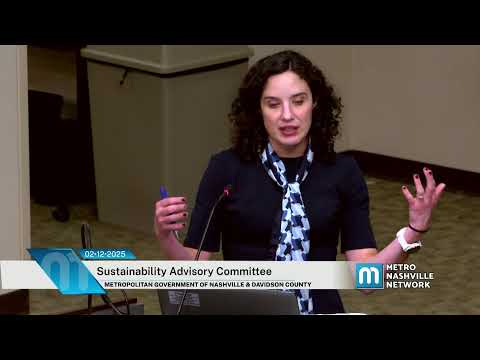
Metro Water Services staff on Feb. 26 described a multi‑pronged urban forestry effort that Metro leaders and partners say supports stormwater management, heat mitigation and neighborhood greening.
Rebecca Doan (Metro Water Services) outlined the department’s urban forestry work, the citywide Root Nashville campaign, the TreeBank fund for developer tree mitigation payments and several regulatory and program changes intended to protect and expand canopy.
Key points
- Root Nashville and plantings: Metro is participating in Root Nashville, a public‑private effort with the Common River Compact and other partners to plant large numbers of trees across the city. Staff said the program has planted about 50,000 trees in recent campaigns and has an aspirational target to plant 500,000 trees by 2050. Metro Water Services told the committee it aims to plant roughly 3,200 trees in the current year and continues to coordinate public‑private plantings on buyout parcels, parks and rights of way.
- Canopy and distribution: Metro staff said the city’s overall tree canopy is roughly 52 percent but noted the number masks variation: nine of 14 planning subareas are not meeting canopy goals. Many canopy shortfalls occur in neighborhoods undergoing infill development or with limited public space for planting.
- TreeBank and developer compliance: Metro manages a TreeBank fund into which developers can pay when they cannot meet tree density requirements on site. Staff said the TreeBank has collected about $1.7 million since the program’s inception; those funds are earmarked for plantings on public properties and nonprofit projects.
- Policy, maintenance and credits: The presentation referenced an administrative direction and codified Metro tree policy that treats the urban canopy as a public utility to be managed as an asset. Metro applies higher planting requirements for city projects than for private development, maintains inventories of street trees in dense areas, and has an urban tree canopy study that the department updates periodically. Staff also said they are revising a “tree credit” in the stormwater manual to give development projects a clearer mechanism to preserve large existing trees and reduce some stormwater control requirements when appropriate.
Why it matters
Metro’s urban forestry work is presented as both a stormwater best management practice (trees intercept and evapotranspire water) and a public‑health/heat mitigation strategy. Staff said tree plantings on public parcels, rights of way and buyout sites create co‑benefits for stormwater, recreation and urban heat reduction.
Public questions and operational details
Committee members and staff discussed canopy mapping, how the TreeBank is used, why some residents decline right‑of‑way plantings, nursery sourcing and the limits of planting on private property (roughly 94 percent of land in Metro is private). Rebecca Doan noted program partners such as the Common River Compact and said the department is working to shift some planting funding into the stormwater budget for long‑term stability.
Ending: next steps
Metro staff said they will continue to plant in the right of way, use TreeBank funds on public and nonprofit plantings, revise the tree credit in the stormwater manual to increase uptake and continue monitoring canopy with periodic urban tree canopy studies. No formal policy action was taken at the committee meeting.