
Attorney General Keith Ellison requests $7.9 million ongoing to bolster prosecutions and Medicaid fraud unit; highlights antitrust and consumer settlements
Get AI-powered insights, summaries, and transcripts
Sign Up Free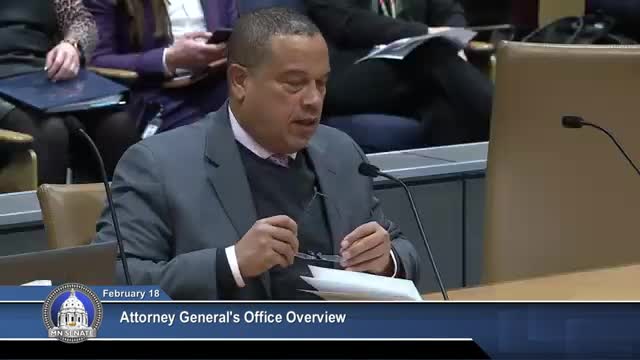
Summary
Attorney General Keith Ellison briefed the committee on the office's recent enforcement results and budget request, highlighting multiyear settlements, returned consumer funds, and a request for ongoing operating increases and staff to strengthen Medicaid fraud investigations.
Attorney General Keith Ellison told the Senate Committee on State and Local Government on Feb. 18 that his office has generated substantial recoveries for the state and consumers and is seeking increased funding to sustain enforcement work and expand capacity for Medicaid fraud prosecutions.
Ellison described the attorney general’s statutory duties and said his office has returned significant money to the state and Minnesotans in recent years, including settlements with opioid manufacturers, tobacco litigation proceeds and recoveries tied to utility and consumer cases. He said the office has contributed “$2,100,000,000 to the bottom line of both the state of Minnesota and Minnesota households” over the past six years and highlighted a $60,000,000 settlement with Jewel and Altria over e‑cigarette marketing.
For fiscal 2026–27, Ellison asked for a one‑time $940,000 request (including a server‑room upgrade) and an ongoing operating increase of $7,900,000 per year to fund salary parity and 26 full‑time equivalent positions across the office. He singled out a request for nine new staff at the Medicaid Fraud Control Unit — one attorney and eight investigators — and said 75% of the cost for that unit would be covered by federal funds, so the state share would be 25% of the total cost for those positions.
Ellison emphasized the public‑interest role of the office’s antitrust and consumer work, citing ongoing litigation involving RealPage, AgriStats and Meta, and singled out cases against insulin manufacturers and HavenBrook Homes as examples of consumer and public‑health enforcement. He told the committee that competitive markets lower prices, increase wages and drive innovation, and framed his antitrust litigation as part of protecting consumers and workers.
When senators asked about capacity to respond to a surge of federal rule changes or litigation originating in Washington, Ellison said his office has coordinated with other states using common‑interest agreements and has sought injunctions and other tools to respond quickly; he described heavy recent workloads and said staff had been working long hours to pursue multiple new matters.
Ending: Ellison said he and his staff were available for follow‑up questions and that the office’s one‑page budget materials provided greater detail on requests; no committee votes were recorded in the hearing transcript.