
Legislative analysts and emergency services leaders say MEMSOF changes boost near‑term funding but long‑term pressures remain
Get AI-powered insights, summaries, and transcripts
Sign Up Free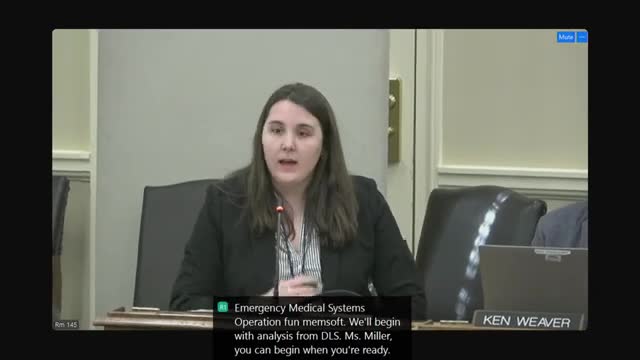
Summary
Madeline Miller, a fiscal analyst at the Department of Legislative Services, presented the DLS forecast for the Maryland Emergency Medical System Operations Fund, describing revenue changes from 2024 legislation and differences between DLS and DBM projections.
Madeline Miller, a fiscal analyst at the Department of Legislative Services, presented the DLS forecast for the Maryland Emergency Medical System Operations Fund (MEMSOF), describing recent statutory changes that altered fund revenue and the divergent DLS and Department of Budget and Management (DBM) projections for the fund's balance through the next decade.
Miller said Chapters 7‑17, 7‑18 and 7‑19 of 2024 changed the fund's main revenue source by increasing the portion of an annual motor‑vehicle registration surcharge available to MEMSOF to as much as $24.50 of a $40 annual surcharge (or $49 if collected biennially). The fiscal 2026 allowance provides about $110.6 million in total MEMSOF expenditures, Miller said, with about 51.7% planned for the Maryland State Police Aviation Command (MSPAC).
Why it matters: MEMSOF supports statewide emergency medical services, including medevac operations, trauma and specialty centers, training and grants for volunteer and career EMS providers. Changes to the fund affect readiness, fleet and personnel costs across Maryland's EMS system.
Analysts and agency leaders described both the immediate budget impacts and the forecasting uncertainty. Miller noted key forecast differences with DBM largely derive from assumptions about motor‑vehicle registration fee income (MDOT forecasts and consumer choices about one‑ vs. two‑year registration) and different expenditure growth assumptions for MEMS, MFRI and MSPAC. With draft registration data through Jan. 9, 2025, DLS estimated fiscal 2025 income to MEMSOF at about $94.2 million while DBM projected about $100.9 million; both estimates exceed actual historic receipts.
Speakers from MEMS, MSPAC, the R. Adams Cowley Shock Trauma Center and the Maryland Fire and Rescue Institute described how MEMSOF funding supports operations. "The backbone of Maryland's EMS system is the 20,000 men and women EMS clinicians...who answer more than 1,000,000 calls for help each year," Dr. Ted Delbridge, executive director of the Maryland Institute for Emergency Medical Services Systems (MEMS), said. Captain Jeffrey Thomas, assistant commander of the Maryland State Police Aviation Command, told the subcommittee MSPAC operates 10 AW139 helicopters and a fixed‑wing aircraft from seven bases and that aviation costs include overtime and higher maintenance and repair expenses.
Christie Snedeker, vice president of the R. Adams Cowley Shock Trauma Center, said the center benefited from the special fund funding, noting local injury‑prevention, training and stop‑the‑bleed high‑school efforts that the center and partners have supported.
Forecast outcomes and risks. DLS projects MEMSOF remains solvent through at least fiscal 2031 with a closing balance of about $20.5 million under DLS assumptions; DBM's more conservative expenditure growth assumptions place potential insolvency earlier. Miller told the subcommittee the largest single uncertainty is registration fee behavior after the surcharge change and the MVA's decisions about one‑, two‑ or future three‑year registration options and installment fees. DLS assumed the full expected revenue growth (about $45.6 million over fiscal 2024 actuals) would be available beginning in fiscal 2026, while noting that fiscal 2025 returns are difficult to predict.
There were no formal votes recorded. Committee members thanked agency representatives and asked for additional detail on projected allocations and any outstanding questions about Shock Trauma's eligibility under the special fund provisions.
Ending: The subcommittee concluded the MEMSOF hearing after hearing testimony from DLS and multiple MEMSOF partners and requested further follow up and clarifications on revenue forecasts and program allocations.