Get Full Government Meeting Transcripts, Videos, & Alerts Forever!
Get email alerts on the Agriculture Climate Land Use topic
No spam. Unsubscribe anytime.
Hughes Center and Farm Bureau tell delegation farmers want localized climate data, flexibility and protections for productive farmland
Summary
The Harry R. Hughes Center presented a Climate Smart Agriculture project summarizing farmers' concerns about changing weather, pests, and the need for fine-scale projections, while Maryland Farm Bureau emphasized private-property rights, ag education and worry about large-scale solar on prime farmland.
Representatives from the Harry R. Hughes Center for Agroecology and the Maryland Farm Bureau told the Eastern Shore delegation that farmers need research, localized climate information, flexibility in mandated best-management practices and protections for productive farmland.
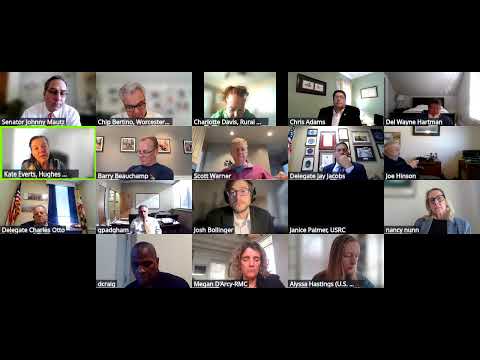
Dr. Kate Evertz (Hughes Center) summarized a multi-institution research and stakeholder-engagement effort commissioned to assess how changing weather and climate affect Maryland farms. She said farmers told the project team they operate on a one-to-five-year business horizon and need fine-scale, locally relevant projections and research-backed guidance about planting dates, new cultivars and pest pressures. "They said what they need is something on a shorter time frame," Evertz said, describing requests for county- or site-level data rather than broad regional forecasts.
Josh Bollinger of the Hughes Center and Nancy Dunn (assistant director) described outreach across the Eastern Shore and noted farmers asked for more interagency coordination so renewable energy goals, tree-planting initiatives and water-quality rules do not work at cross-purposes with preserving productive farmland.
Tyler Huff of the Maryland Farm Bureau said the organisation’s top priorities are private property rights, concern about solar development on prime acres and stronger ag education programs including FFA and 4-H. "We are the ninth largest congressional district in the nation" for some crop measures, Huff said, underlining the region’s production scale and the need to guard prime acreage.
Delegates discussed farmland assessments, estate-tax thresholds and county cost-shifts in the governor’s budget. Several members expressed worry that lower estate exemptions and shifts of state costs to counties would force higher property taxes and squeeze family farms that are "land-rich and cash-poor."
Ending: The Hughes Center said a detailed report with research recommendations will be published; delegates asked for the report and for coordination with state agencies, and the Farm Bureau announced its Maryland Farm Bureau Day in Annapolis on Feb. 5.