Get Full Government Meeting Transcripts, Videos, & Alerts Forever!
Get email alerts on the Training Stormwater Outreach topic
No spam. Unsubscribe anytime.
Planning board receives annual training; stormwater manager briefs board on permit, LID and watershed work; staff summarizes neighborhood feedback
Summary
Assistant solicitor Grace Innes reviewed public‑meeting rules and ethics; stormwater manager Rich May briefed the board on the city's stormwater permit requirements, monitoring and projects; Planning Officer Anya Collette summarized neighborhood outreach and recurring themes for the comprehensive plan and code updates.
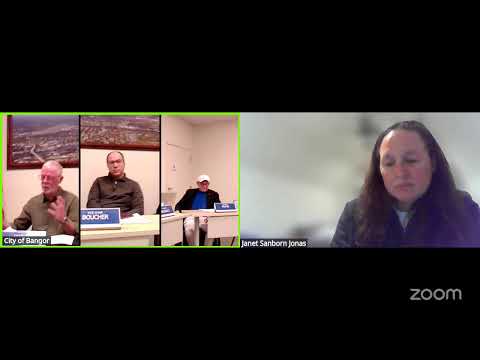
At the Jan. 21 meeting the Bangor City Planning Board received its annual training on open‑meeting and ethics rules from Assistant Solicitor Grace Innes, heard a detailed briefing on the city's stormwater permit and related programs from Stormwater Manager Rich May, and received a summary of neighborhood outreach from Planning Officer Anya Collette.
Innes reviewed due‑process obligations and the Maine Freedom of Access Act, explaining that public records and proceedings are presumptively open to the public and advising board members to avoid using private email for board business. She discussed conflict‑of‑interest procedures (members should announce potential conflicts and, if a conflict is found, leave the room for that application), the prohibition on accepting gifts in exchange for official action, handling of confidential materials (rare and typically limited to marked trade secrets), and social‑media guidance (clarify personal views are not official board positions).
Rich May outlined the city's stormwater (MS4) permit framework administered under Maine Department of Environmental Protection authority and tied to federal EPA requirements. May described the permit's minimum control measures (public education and outreach; public involvement; illicit‑discharge detection and elimination; construction site runoff control; post‑construction stormwater measures; and pollution prevention/good housekeeping). He said the permit is typically renewed on a five‑year cycle (the city expects the next permit cycle target in 2027), noted the last statewide permit round extended longer than five years, and described the city's three conveyance systems: separated storm sewer, sanitary sewer, and combined sewer.
May explained enforcement and monitoring practices. Construction sites disturbing one acre must employ erosion and sediment controls, and sites that create an acre of impervious surface (or half an acre in an impaired watershed) must provide stormwater treatment. City staff conducts systematic outfall testing and chase elevated indicators such as E. coli and optical brighteners to detect possible illicit sewage connections; he gave an example of a historic building tied to a storm sewer where an illicit connection persisted for decades and was corrected after dye testing and follow‑up repairs. May said post‑construction stormwater structures require ongoing maintenance and annual reporting from property owners.
May also described pending and contested policy work: a proposed low‑impact development (LID) ordinance originally scheduled to take effect in mid‑2024 remains under legal challenge and is not yet required; when enacted it would expand LID expectations to sites that disturb an acre even if they do not create an acre of impervious surface. He noted funding constraints for some watershed work, including that Section 319 grant funds used historically for projects are not eligible for permit‑compliance tasks.
Anya Collette presented takeaways from neighborhood meetings, pop‑up events and two online surveys used to supplement outreach. Recurring themes included interest in mixed‑use development and more amenities within walking distance; support for preserving older buildings and adding green space; mixed opinions on allowing multifamily housing (some participants favored single‑family retention, others denser multifamily); interest in design standards for multifamily and so‑called "village" or neighborhood centers outside downtown; and support for complete‑streets design and bike parking requirements. Collette said the consultant preparing draft code changes has received the outreach summary and will use it as input for code writing.
Board members asked clarifying questions about the scope of combined versus separated sewers (May estimated the city remains roughly 60% separated, 40% combined in areas closest to downtown), the number of impaired urban streams (May listed six watersheds in city jurisdiction), recent local stormwater projects (mentioned Montgomery Street, Silver Road separation, Balsam Road ditch work, and a geomorphic improvement design near the I‑95 exit), and whether the city's updated Chapter 500 stormwater rules and the Maine DEP's construction general permit changes would affect local permitting and LID implementation.
Ending: Staff said outreach results will be incorporated into the consultant's draft code updates and that training and stormwater compliance work will continue. Board members were invited to contact staff with follow‑up questions; no formal action was taken on the subjects reported.