Get Full Government Meeting Transcripts, Videos, & Alerts Forever!
Get email alerts on the Mental Health 988 topic
No spam. Unsubscribe anytime.
Northwest Human Services explains 988 crisis hotline operations and local outreach
Summary
A Northwest Human Services manager explained how the national 988 lifeline routes calls, the types of crises centers field, and local outreach challenges in Polk County, including rising call volume and georouting changes.
Maggie Walker, a project manager at Northwest Human Services, told Polk County public safety partners that the 988 national crisis line routes callers to trained crisis counselors across a coordinated Lifeline network and emphasized local outreach to increase use in rural areas.
Walker said the Lifeline network has more than 200 crisis centers in the U.S. and its territories and that callers can reach crisis counselors by calling, texting or using an online chat. "The crisis and information hotline at Northwest Human Services has existed since 1970. We've been in operation 24/7, 365 since then," she said.
Walker said the center joined the Lifeline network in 2018 and that, in 2024, her center fielded more than 6,000 calls routed through 988 in addition to calls to the longer-standing 10‑digit line. She described common call types as suicidal ideation and general mental‑health concerns, loneliness, family and relationship problems, substance use, trauma and stress tied to major world events and elections. She said a spike in text contacts followed a recent presidential election and was concentrated in the LGBTQIA+ youth subnetwork.
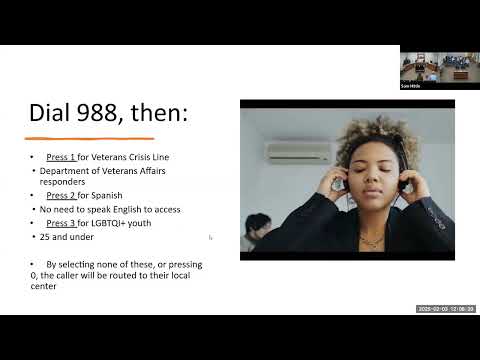
Walker discussed how calls are routed: a caller who dials 988 is connected into the Lifeline network and routed to an appropriate center based on georouting so that counselors can provide local resource referrals. She said the Veterans Crisis Line and Spanish-language services are available through menu options and that there is a youth LGBTQIA+ subnetwork for people under 25. She urged staff and service providers to tell clients to remain on the line if there is a delay so the call can be routed to an available counselor.
Walker said Oregon data show most 988 contacts do not result in an in-person response. "In Oregon, 98.5% of our calls are resolved all over the phone with no in-person response required," she told the group. She added that about 1.5% of calls require an in-person response and that only roughly half of those in-person responses are involuntary. She said involuntary responses are reserved for people who have attempted suicide, are actively attempting suicide, or are judged to be at imminent risk.
Local questions and outreach: When asked whether Polk County–specific data were available, Walker said the Northwest Human Services center serves Marion and Polk counties and that Polk County callers account for an estimated one‑quarter to one‑third of the center's contacts; she said she would follow up with exact monthly numbers. Walker said recruiting and retention of crisis counselors is an ongoing challenge as public awareness of 988 grows and cited a statewide awareness campaign launching in June to increase public knowledge of 988.
Walker highlighted that georouting, implemented nationally after 988 launched, now routes callers to the local call center based on where the caller dials from; the change aims to improve referrals to local services while preserving caller anonymity. She said centers do not have the same geolocation tools as 911 and that callers may block their numbers or decline to provide location and still be served.
The presentation ended with Walker inviting service providers to use 988 as a resource to consult when they are unsure whether a client needs immediate in-person support and to encourage people in crisis to call, text or chat.
Polk County officials in the meeting acknowledged the outreach gaps in rural areas and discussed partnering with schools, community markets and other local institutions to increase awareness.
Looking ahead, Walker said the center is hiring additional crisis counselors to handle rising 988 call volumes and to support upcoming statewide outreach.