Get Full Government Meeting Transcripts, Videos, & Alerts Forever!
Get email alerts on the Disaster Recovery Cdbg Dr topic
No spam. Unsubscribe anytime.
City council approves $159.8 million 'Sunrise St. Pete' CDBG‑DR action plan to fund housing, infrastructure and recovery supports
Summary
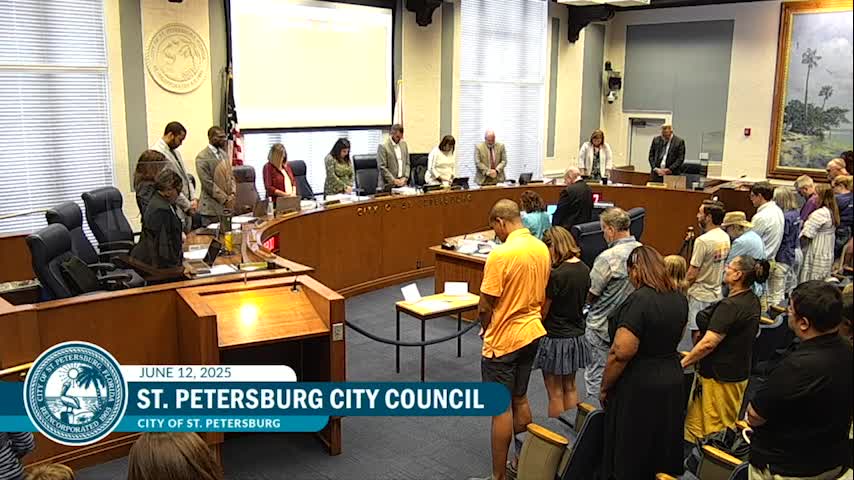
The St. Petersburg City Council unanimously approved the Sunrise St. Pete Community Development Block Grant–Disaster Recovery (CDBG‑DR) action plan on June 12, 2025, authorizing staff to pursue $159,800,000 from HUD to repair storm‑damaged homes, build affordable housing, support nonprofits and fund mitigation projects after Hurricanes Idalia and Helen.
The St. Petersburg City Council unanimously approved the Sunrise St. Pete Community Development Block Grant–Disaster Recovery (CDBG‑DR) action plan on June 12, 2025, authorizing staff to pursue the $159,800,000 federal grant from the U.S. Department of Housing and Urban Development (HUD) to address unmet recovery needs from Hurricanes Idalia and Helen.
City and consultant presenters told council the plan is built around HUD requirements that at least 70% of funds must benefit low‑ and moderate‑income (LMI) households and that a 15% mitigation set‑aside is required. Consultant Ryan Flannery of Horn described the unmet‑needs analysis showing housing as the largest category (about 73% of unmet needs), with infrastructure, the economy and public services making up the remainder. Flannery said HUD requires projects be ‘‘tied back’’ to the designated storms and explained the difference between unmet needs (repair/recovery) and mitigation (forward‑looking resilience).
Why it matters: The plan is the city’s required roadmap to receive and spend federal disaster dollars. It outlines programs to repair and replace storm‑damaged housing, build affordable rental units, reimburse homeowners and provide nonprofit recovery services and mitigation projects to reduce future storm damage.
Key elements and programs - Total award announced by HUD: $159,800,000 (includes a 15% mitigation allocation). - Priority: At least 70% of funds must benefit households at or below 80% of area median income (AMI). - Major program categories presented: residential rehabilitation/reconstruction/elevation; homeowner reimbursement; disaster relief reimbursements (up to $15,000 per household for qualifying hardship); homebuyer assistance; voluntary buyout/acquisition; affordable rental housing (subsidy up to $125,000 per unit requested in plan); nonprofit community support services (mental‑health/trauma support/housing navigation); public infrastructure mitigation; and post‑disaster planning/after‑action work. - Budget highlights shown in the draft: about $35M for residential recovery (rehab/reconstruction/elevation), $12M for homeowner reimbursement, $14M for disaster relief reimbursements, $48M proposed for affordable rental housing, $25M for infrastructure mitigation, $6M for nonprofit support services and nearly $1.9M for planning and after‑action studies.
Consultants from Horn and program leads emphasized that the plan must balance community input and data. Horn’s analysis found the largest remaining dollar gap was in housing; staff said the proposed allocations are roughly proportional to those unmet needs and therefore should meet HUD’s review expectations. Horn’s Ryan Flannery and Tyler Bridges of Horn walked council through the eligibility rules HUD imposes (tie‑back to the storms, income prioritization, limits on mitigation to 15% of the award) and the city’s public‑engagement work.
Public comments: Several residents urged clearer communications and easier application assistance. Sandra Harrison and Gloria Maxwell, among other speakers from South St. Petersburg and inland neighborhoods, said many residents remain displaced or underinsured and do not know how or when to apply. Pinellas Community Foundation’s Rebecca Hughes urged the council to fund trauma‑informed mental health services for residents and nonprofit staff. Jerome King and other canvassers told council that food losses, utility impacts and eviction risk remain urgent in some neighborhoods and asked that outreach focus on the most affected blocks.
Council Q&A and follow‑up commitments Council members pressed administration and Horn experts on several practical points: - How applicant households will access funds and whether the city will require out‑of‑pocket payments first. Administration described a ‘‘no‑wrong‑door’’ intake model with a contracted vendor to case‑manage homeowners through program eligibility and documentation requirements, and outreach teams (including local nonprofits) to help access benefits. - Whether permit fees for rebuilding could be reimbursed or waived; staff said they are seeking HUD clarification and will pursue waiver or reimbursement if allowed. - Whether insured homeowners’ deductibles would be eligible for aid; staff said historically HUD CDBG‑DR has not paid insurance deductibles and that question would require further review. - Use of the mitigation set‑aside: staff said mitigation funds are baked into the infrastructure programs and can also be used for residential mitigation when eligible. - How the city will manage cash flow (reimbursement model) and city administrative capacity: administration noted HUD reimbursement procedures are generally fast, and told council it would present implementation staffing and quarterly reporting to the Budget/Finance committee to track expenditures.
Council action and next steps: Council voted unanimously to approve the draft Sunrise St. Pete action plan and to submit it to HUD; staff said the post‑disaster planning studies (after‑action report and long‑term recovery plan) will begin before full HUD approval because federal rules allow some planning funds to be initiated earlier. Staff also committed to written guidance for applicants, locally‑based outreach partners and periodic updates to council on program roll‑out, eligibility criteria, and the status of HUD clarifications (for example, on permitting and allowable reimbursements).
Ending: The approved plan creates the city’s framework to use HUD CDBG‑DR dollars over a multi‑year recovery period. Council members and speakers repeatedly urged rapid, proactive outreach so the funding reaches displaced and lower‑income residents who have already spent money repairing or replacing damaged homes.