Get Full Government Meeting Transcripts, Videos, & Alerts Forever!
Get email alerts on the Drainage topic
No spam. Unsubscribe anytime.
St. Joseph County drainage board approves outfall permit for IC 3 South Campus, discusses upstream erosion tied to increased pump flow
Summary
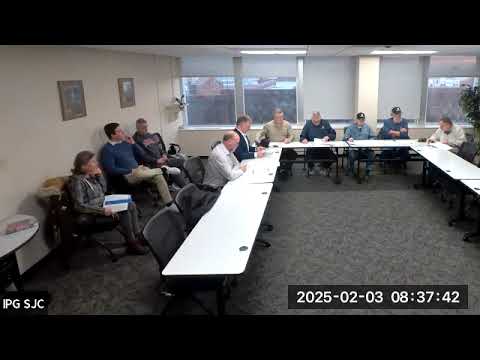
The St. Joseph County Drainage Board voted to approve a developer’s request for two 12-inch outfall pipes for the IC 3 South Campus detention basins, while board members and residents raised concerns that added pump flow from nearby industrial operations has worsened bank erosion in local ditches and farms.
The St. Joseph County Drainage Board on Jan. 25 approved a request to allow two 12‑inch outfall pipes from detention basins at the IC 3 South Campus to discharge into nearby ditches, while members and residents debated who should pay for recurring ditch and crossing repairs caused by increased upstream flows.
Andy Denam, the civil engineer for the IC 3 South Campus project, told the board the campus will rely on two separate detention systems that will each discharge through a single 12‑inch outfall: one to the Rogers Clark Ditch along Horton Road and one to a neighboring ditch on the east side of the site. Denam said the basins are being designed to detain runoff from about 200–230 acres and that, once built, the outfalls would release at roughly 5–6 cubic feet per second per pipe in overflow conditions. He also said the applicant has applied for an individual permit from the U.S. Army Corps of Engineers and does not anticipate installing the pipes before the corps issues that permit, which he said is not expected until the first quarter of 2026 at the earliest.
The board’s decision to approve the outfall request followed extended discussion about localized bank failures and sedimentation attributed by several speakers to increased pumped flow from nearby industrial sites. One board member described four large cottonwood trees that “took the whole bank down” and said the work to remove the trees and stabilize the bank was performed as an emergency and should not have to come from general taxpayer funds. The board also approved payment to contractors for cleanup and pump connections, including an emergency $2,500 payment to a contractor identified on the agenda as Bailey.
Public commenters urged the board to press upstream operators and regional partners to address broader conveyance and maintenance problems. Resident Deborah Durrell, who said she lives on Cotton Road in South Bend, criticized Amazon’s local operations and said, "they're using our water. They're adding traffic to a rural and small community." Another commenter, Dan Caruso, said he had supported development previously but argued Amazon has not acted as a good neighbor, particularly with respect to local hiring and the strain on drainage infrastructure.
Board members and nearby landowners also discussed a failing crossing (currently a 10‑foot “squash” pipe) that several landowners use as a drive. The group considered whether to seek a larger replacement — a 12‑foot squash pipe or a small bridge — and who should bear the cost. Board members noted a quoted price of roughly $19,000 for a 10‑foot squash pipe and said the price for a 12‑foot structure is substantially higher. One board member said developers upstream, including representatives who have previously agreed verbally to improvements, should be pressured to fund a larger replacement because upstream development has increased flows through the system.
Board members discussed coordination with the Four County drainage oversight and the County Line Ditch authority, and several speakers urged the board to press La Porte County/port representatives to complete maintenance and improvements on the downstream County Line Ditch, which residents said is out of alignment and impedes through flow. The board agreed to try to arrange a site meeting with upstream developers and port or county representatives to seek commitments on improvements and maintenance; no financial commitment or assignment of payment responsibility was recorded at the meeting.
The board also tabled consideration of an encroachment/enforcement permit (agenda item noted as tabled when no applicant representative was present) and scheduled follow‑up conversations with developer and county staff. A board member said there was no formal motion on the crossing replacement at this meeting and that further discussion would take place after the planned coordination with upstream parties.
Votes at the meeting included motions to authorize listed contractor payments and to approve the IC 3 South Campus outfall request. Both motions were announced as carried; the transcript does not contain a roll‑call vote tally. The board discussed the practical limits of its authority — several members emphasized the board can approve permits when engineering and county engineering find them acceptable, but that broader conveyance and maintenance problems may require coordinated action with the port, Four County oversight, or other jurisdictions.
The board’s actions leave key implementation steps pending: the project’s installation timeline depends on an individual permit from the U.S. Army Corps of Engineers (anticipated earliest in Q1 2026), and the crossing replacement and larger ditch improvements remain unresolved and dependent on further discussions with developers, landowners and regional drainage authorities.
Ending — The board approved the outfall permit and contractor payments and agreed to pursue a multi‑party meeting to address recurring conveyance and maintenance issues caused, board members said, in part by increased pumped flows from nearby industrial development. The board did not assign construction or replacement costs for a failing private crossing at the meeting and left the encroachment/enforcement permit matter tabled pending applicant representation and further staff follow‑up.