Get Full Government Meeting Transcripts, Videos, & Alerts Forever!
Get email alerts on the Economic Development topic
No spam. Unsubscribe anytime.
Developers propose “Vision 2050” public‑private partnership for California City; residents and council raise feasibility questions
Summary
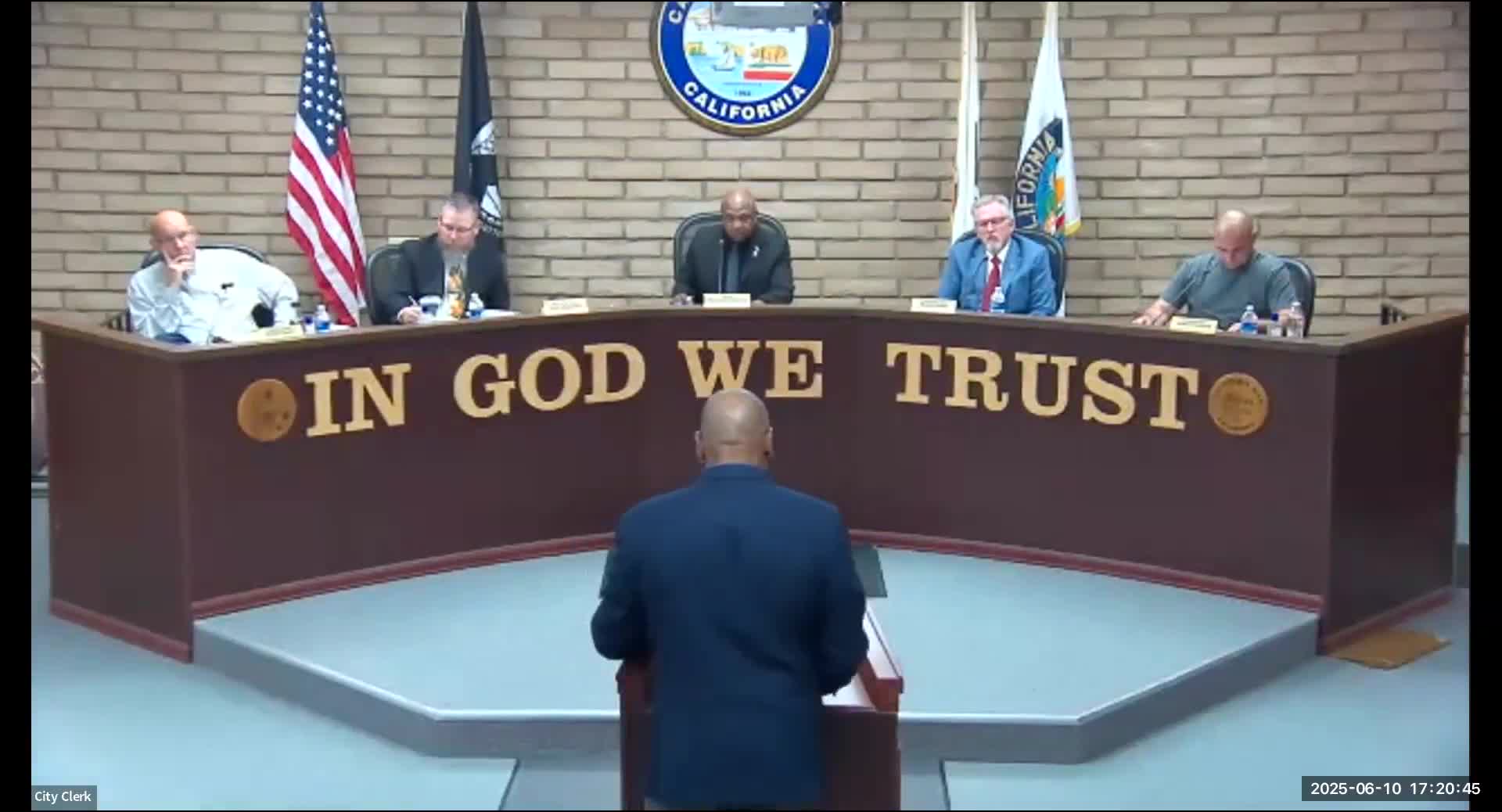
A group of private developers presented a long‑term “Vision 2050” plan to the California City City Council on June 10 that would use public‑private partnerships to finance water, airport and housing projects and spur job creation without initial direct city spending.
A group of private developers presented a long‑term “Vision 2050” plan to the California City City Council on June 10 that would use public‑private partnerships to finance water, airport and housing projects and spur job creation without initial direct city spending.
The presentation was made by Mike Echols, who said he and two colleagues formed the California City Development Association (CCDA), a California nonprofit. Echols said CCDA would lead feasibility studies and recruit private capital and technical partners to repair infrastructure and develop catalytic affordable‑housing and economic projects. "The answer is 0. The answer is absolutely nothing," Echols said, describing CCDA's pitch that initial costs for feasibility and early planning would be borne by private partners and nonprofit funding rather than the city.
Why this matters: CCDA’s proposal targets the city’s most visible assets — the municipal airport, golf course and large undeveloped tracts — and promises infrastructure upgrades, some housing and roughly 1,000 jobs within two to three years of initial work. Council members and residents repeatedly pressed presenters about limits on city authority, the true costs of feasibility work and whether private partners could deliver the needed infrastructure in areas lacking water and electricity.
What the presenters proposed
Echols, joined by Lenny Stanley Sedano and Craig Keyes, described CCDA as a nonprofit organized to assemble investors, technical experts and development partners to pursue cluster industries such as logistics, food processing, biotech and leisure/entertainment. The group said it would begin with feasibility studies — including on water and power — and use pilot catalytic projects to attract larger private capital.
Sedano estimated an initial feasibility effort could last six to 12 months; Echols said some studies could cost about $250,000. CCDA emphasized structures frequently used in infrastructure partnerships, such as build‑lease‑transfer or concession arrangements, and pitched the municipal airport and golf course as immediately monetizable assets.
Council and public questions
Council members asked specific technical and legal questions about water, electricity and timeline. "The first phase is to do feasibility studies. We need to understand what's out there," Sedano told council. Council members asked how CCDA would avoid leaving the city responsible for long‑term liabilities and whether projects would require city‑owned land or exclusivity agreements.
Public comments were mixed. Several residents urged the council to consider the city’s history with failed or unfinished development projects and to be cautious about entering deals that could replicate past losses. Others urged the council to take opportunities to attract capital and jobs. John Fisher, a longtime resident, said he had seen many development proposals fail in California City and said he would remain “very skeptical.” Another resident, Mary Wade, urged the council not to dismiss potential partners simply because previous attempts stalled.
No formal council action or commitment
Presenters said they would invite city representation on CCDA’s executive board and that CCDA would follow with more detailed proposals. The council did not vote on any contract or agreement at the meeting; councilmembers instead asked staff to monitor follow‑up materials and watch for items that should be returned as formal agenda items. Several councilmembers stressed they wanted specifics — engineering reports, property‑owner consents and detailed financial terms — before any commitment.
What comes next
Presenters said they would return with more detailed feasibility costs and a proposed governance relationship. CCDA described its approach as phased and community‑engaged; presenters and the city agreed that detailed studies and formal proposals must come back to council before any city land or funds are committed.
Ending
The CCDA presentation drew a mix of guarded optimism and caution. Council members and residents said they want to see clearer cost estimates, documentation of land availability and detailed feasibility results before considering partnership agreements. The city did not authorize any expenditure or enter into agreements at the June 10 meeting.