Get Full Government Meeting Transcripts, Videos, & Alerts Forever!
Get email alerts on the Artificial Intelligence topic
No spam. Unsubscribe anytime.
Fairfax officials, industry and educators discuss forming AI coalition to speed safe adoption and workforce training
Summary
Fairfax County officials, university leaders and private-sector executives at an Opportunity Committee meeting debated forming an AI coalition to coordinate test beds, workforce training and commercial adoption; no formal action was taken.
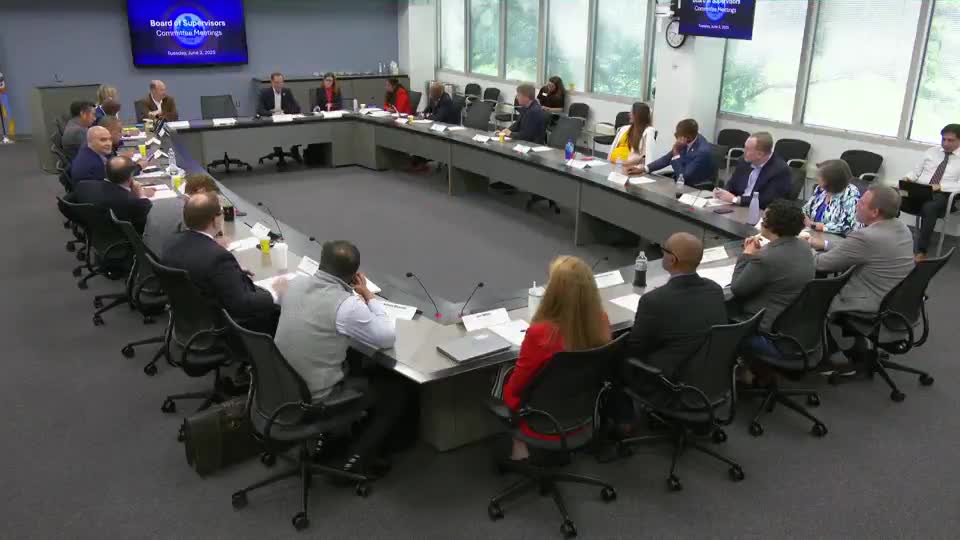
Fairfax County officials and a cross-section of private- and nonprofit-sector leaders on Monday discussed creating an AI coalition to help local businesses and workers adopt practical, governed artificial intelligence tools.
The proposal, put forward by Dan Stork, chair of the Opportunity Committee and the Mount Vernon District supervisor, would aim “to empower every Fairfax County business and their workers to quickly adopt and govern practical and safe AI tools to enhance productivity, creativity, and job efficiency,” Stork said as the meeting opened.
Committee members and invited speakers said the county already has significant assets — federal contractors, research universities and a skilled workforce — but lacks coordinated local leadership to translate AI research and tools into widespread, safe use and workforce training. Speakers recommended a coalition to provide centralized test beds, shared data and standards, and targeted education and apprenticeship pathways beginning in secondary school.
Rebecca Mowdrey, director of the Fairfax County Department of Economic Initiatives, summarized survey findings she said illustrate a gap between leadership and workers: “An Axios survey found 90% of C-suite executives report their firm has an AI strategy, while only 57% of employees say theirs does,” she said, and other surveys show many workers are not receiving organized workplace training on AI.
Private-sector speakers urged an emphasis on applied AI — teaching businesses how to use existing models and tools to solve specific problems rather than attempting to build foundational models locally. Cheryl Menage, president of Tanex (a GovCon information-technology firm), argued a coalition would reduce duplicated effort and provide shared test beds. “Let Fairfax County be the sandbox for safe, explainable and interoperable AI,” Menage said, citing Tanex’s recent work with Texas A&M and FEMA to speed post-storm damage assessments using image data.
Peter Kann, chief executive of Enabled Intelligence, described his company’s work preparing and labeling raw data for AI systems in defense and critical industries and said local focus should be on applications and workforce readiness: “I would love to send 150 to 200 employees somewhere to Nova or GMU for some sort of class that says, here are the basics of applied AI in the workplace. I have no place to send them,” he said.
Representatives from George Mason University outlined existing county-facing capabilities. Andre Marshall, vice president for research, innovation and economic impact, described GMU programs and facilities including the AI Squared Nexus, Patriot AI (a platform GMU says provides secured access to more than 18,000 generative models) and academic offerings such as a planned master’s in AI and a graduate certificate in responsible AI. Marshall also said GMU received a $1,000,000 congressionally directed project to launch a center for small business AI innovation that would support local firms adopting AI tools.
Industry and county officials discussed several themes that a coalition might address: establishing test beds and standards for safe deployment, systematizing workforce upskilling and credentials, supporting small-business adoption, and creating an innovation and startup ecosystem that can retain local talent. Panelists stressed beginning education earlier than college; multiple speakers recommended K–12 exposure, with several calling for programs beginning before ninth grade.
Speakers from health care, construction and higher education noted that many jobs are composed largely of language and clerical tasks that AI can augment or automate; they argued local workforce and education planning should reflect that change. Matt Kaul, chief information and digital officer at Inova Health, said substantial portions of hospital work are language-driven and therefore susceptible to near-term AI implementation.
Several private-sector leaders urged that Fairfax leverage its proximity to federal customers and primes (defense and intelligence agencies, prime contractors such as Leidos and Lockheed) to help startups scale. John Serafini, CEO of Hawkeye 360, and other startup and venture representatives recommended lowering barriers to government contracting for small companies, improving access to facility clearance and to early customer contracts.
The board-level discussion also touched on local policy levers. Supervisors raised zoning, density and housing affordability as factors that affect the county’s ability to attract and retain workers and entrepreneurs. Multiple speakers urged the county to clarify which government roles would support a coalition — for example, by hosting test beds, providing limited funding or facilitating connections between industry, the university and government customers.
No formal motion or vote was offered at the meeting. County staff said they would consolidate comments and proposed next steps for the committee to consider. Rebecca Mowdrey told the group staff would summarize the meeting’s findings and return recommendations on whether to add coalition work to the county program.
Discussion points marked in the meeting included environmental considerations for AI infrastructure, the need for communications and branding for a Fairfax AI effort, and the view that a coalition should be private-sector led with county support on specific roles such as test beds and permitting.
The committee did not adopt a coalition charter or funding plan; participants urged follow-up work to define the coalition’s scope, leadership, one-year and five-year goals, and specific county support or budget needs.