Get Full Government Meeting Transcripts, Videos, & Alerts Forever!
Get email alerts on the Homelessness Shelters Frsp topic
No spam. Unsubscribe anytime.
DHS budget includes major shelter capital spending but pauses some family programs; council seeks clarity on capacity and voucher lease-ups
Summary
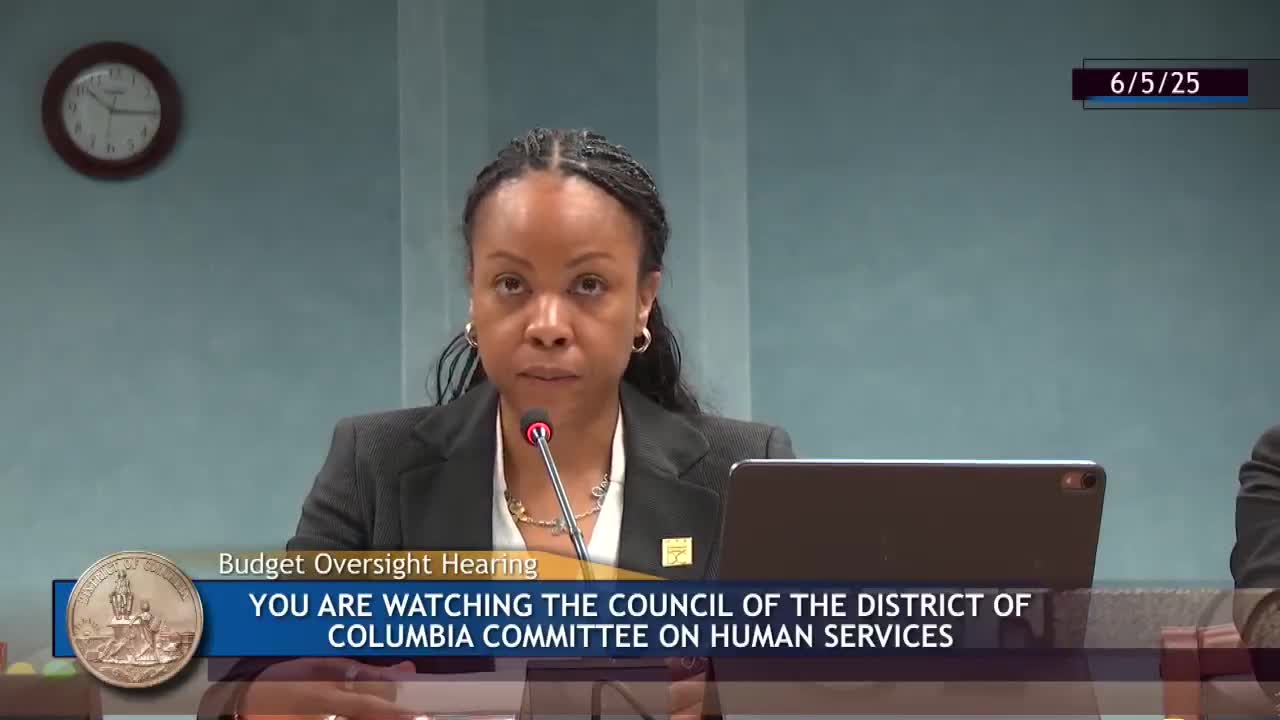
At a June 5 Committee on Human Services hearing, the Department of Human Services outlined multi-million-dollar shelter capital investments and described a temporary pause to new entries in the Family Rehousing Stabilization Program as officials defended proposed budget shifts.
At a June 5 Committee on Human Services hearing, the D.C. Department of Human Services detailed proposed capital spending for the adult homeless system and described operational changes to family homelessness programs that drew sustained questioning from council members.
DHS interim director Rachel Pierre said the FY26 proposed budget includes about $107.5 million in capital investments over five years for the single-adult homeless system, including $57.5 million for redevelopment of the Federal City shelter in partnership with the Community for Creative Nonviolence (CCNV), $43 million to replace the New York Avenue men's shelter, $5 million to renovate the Naylor Road shelter and $2 million for small capital projects. "We are seeing results," Pierre told the committee when summarizing investments across the homeless continuum.
On family homelessness, DHS described a set of policy shifts intended to "diversify exit pathways" from family shelter. The department said it would pause new entries to the Family Rehousing Stabilization Program (FRSP) while it reevaluates program design and that it intends to expand alternative interventions such as DC Flex and homeless prevention programs (HPP). Pierre said the pause aims to avoid pressuring families into unsustainable housing exits to meet a 90-day benchmark and to allow more tailored, longer exits where needed.
Council members expressed concern that a pause, even if temporary, could strain short-term family shelter capacity. Councilmember Nadeau asked about vacancies and capacity; DHS said there were about 144 vacancies in short-term family housing at the time of the hearing and that the agency monitors capacity daily and has additional sites (for example, Rolark and other buildings) it could activate if needed. Pierre said some sites, such as Naylor Road, are currently unoccupied and others would be activated only if necessary.
Vouchers and lease-ups: The committee asked about a multi-agency voucher effort. DHS reported significant activity moving vouchers into people's hands but also sizeable numbers still in process. DHS said roughly 526 of the 1,300 family vouchers provided through a housing authority MOU had leased up; DHS reported about 820 individuals in the singles lease-up pipeline and about 868 families still not yet leased up to vouchers. Pierre said staff meet frequently with the housing authority to accelerate lease-ups and that DHS averages roughly 60 to 80 lease-ups per month across programs, with a goal of increasing that pace.
FRSP appeals and timing: Councilmembers asked how appeals of FRSP exits would be handled if program continuation were limited by the BSA. DHS said families in appeal historically received continuation of benefits during review but that the BSA would change that approach for some exits; DHS said it would continue to process appeals and reinstate benefits and back-pay if appeals are successful. Committee members expressed concern about families who might remain in place while appeals proceed and the financial unpredictability that creates for landlords and households.
Permanent supportive housing and capital timing: Pierre said the Federal City/CCNV replacement would follow a build-first approach (complete the new facility before the old one is closed) and that the New York Avenue replacement would aim for the same sequencing to avoid displacing residents. Naylor Road renovations were characterized as life-safety and ventilation upgrades rather than capacity expansions; DHS said Naylor Road is not currently in use and would not force a displacement.
What's next: DHS said it will continue daily capacity monitoring and can activate additional inventory if needed. Council members requested more precise counts of families who would be affected by program pauses, a timeline for voucher lease-ups, and clearer plans for preventing evictions that could arise from FRSP exits and transitions to vouchers.