Lifetime Citizen Portal Access — AI Briefings, Alerts & Unlimited Follows
Office of Administrative Hearings says FY26 budget leaves agency "beyond capacity," raising backlog and access-to-justice concerns
Loading...
Summary
At a June 6 Committee on Public Works and Operations hearing, Office of Administrative Hearings leaders and legal advocates warned that the mayor's FY26 budget would not provide needed staff or technology funding, risking further delays in resolving enforcement and public-benefits cases.
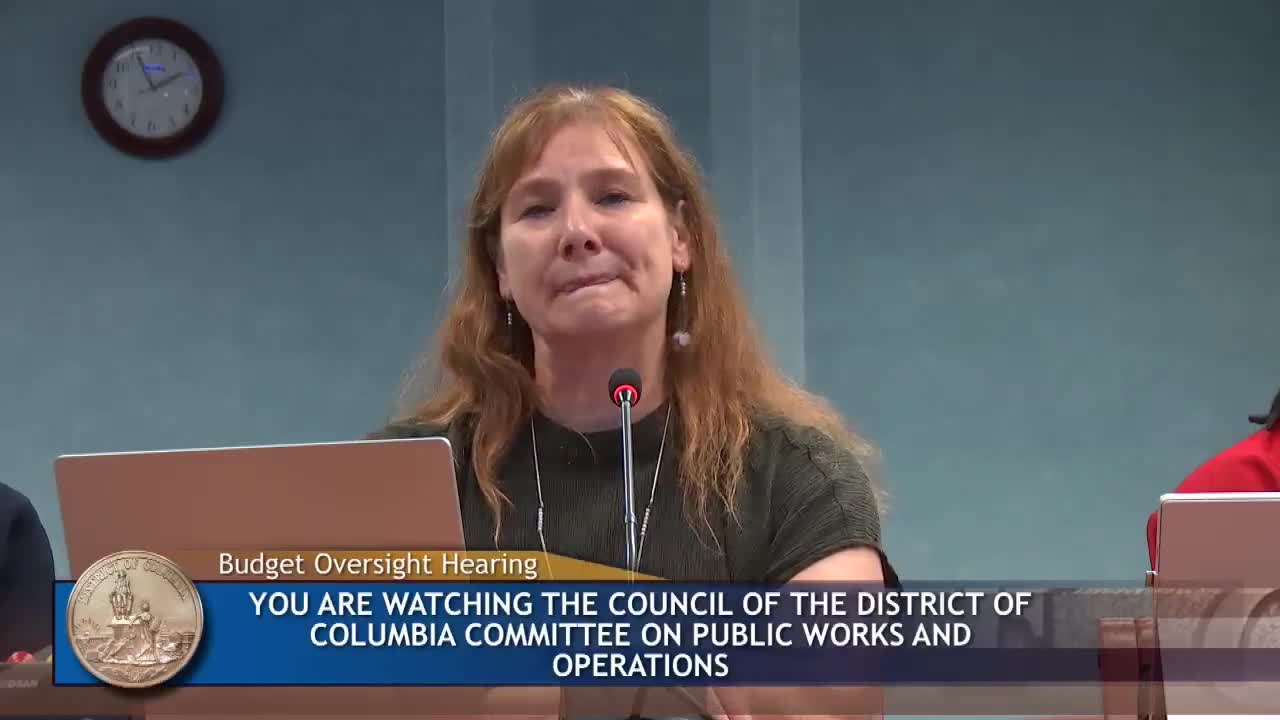
WASHINGTON — At a June 6 budget oversight hearing of the Committee on Public Works and Operations, the Office of Administrative Hearings told the council its proposed fiscal year 2026 budget would leave the agency unable to keep pace with rising caseloads, creating delays that affect both the District’s ability to collect fines and residents’ access to public benefits.
"To put it bluntly, we are simply beyond capacity," M. Colleen Curry, Chief Administrative Law Judge for the Office of Administrative Hearings, told Chair Brianne Nadeau. The agency reported a proposed gross FY26 budget of approximately $12,225,000 and 92 full-time equivalents, with personnel services accounting for roughly 93% of that total.
The budget reduces or eliminates one-time funds the committee provided in FY25, including about $187,000 for contractual temporary staffing and $250,000 for information-technology upgrades. Judge Curry and witnesses from civil legal-service organizations said losing that one-time support will worsen OAH’s ability to process cases quickly.
Why this matters: OAH adjudicates cases across more than 40 District agencies, including enforcement matters (building, public space, vending) and public-benefits disputes (SNAP, TANF, unemployment). Delays in adjudication can slow the collection of fines tied to enforcement cases and postpone benefits for individuals who appeal agency decisions.
Advocates and agency leaders pointed to a staffing shortfall. External witnesses cited a 2023 staffing study by B. McNamee (BMC) that recommended roughly 50 administrative law judges (ALJs) and 85 clerk-office staff to handle recent caseload levels; OAH currently has 36 ALJs and about 39 clerk-office staff working cases. Christina Jackson of the Washington Council of Lawyers noted that filings spiked in FY24: "In FY '24, OAH received the largest number of filings in its 20-year history" and cited a figure of 12,652 filings in the first quarter of FY25 as evidence of rapid growth.
Legal-aid and access-to-justice groups asked the committee to restore the FY25 one-time investments and to press agencies on whether prior appropriations were spent as intended. "OAH must be adequately staffed," Jen Jenkins, policy manager at Legal Aid DC, said, urging the council to reauthorize funds for IT and contractual services and to remove a proposed Budget Support Act subtitle on street-vendor enforcement that she said would add unnecessary burden to OAH.
Agency officials described operational pressures in detail. Judge Curry said FY24 saw 33,745 filings — a 28% increase from FY23 — and a closure rate of about 75%, meaning OAH disposed of only three-quarters of the cases filed that year. The FY26 budget includes a net increase of roughly 1.4% but also assumes vacancy savings equivalent to about 5.87% of personnel services, which the agency said will limit new hiring.
OAH also flagged technology and records access problems. Witnesses and agency staff said the final-order database contains only a fraction of orders issued, lacks robust keyword search and has performance problems; those shortcomings hinder both litigants and attorneys preparing cases. The committee previously appropriated $250,000 in one-time funds for IT in FY25; witnesses asked whether those dollars were spent and requested that, if not, the committee replace them in FY26.
The hearing also addressed a newly proposed vending subtitle in the FY26 Budget Support Act (the Vending Compliance and Modernization Amendment Act of 2025), which would allow expedited hearings and require OAH to hold a hearing within three business days and issue a decision within 10 business days for Department of Licensing and Consumer Protection notices. OAH officials and witnesses told the committee that the agency lacks the resources to meet those timelines without additional funding or staffing adjustments.
Public commenters raised additional concerns. Tiffany Montgomery, a public witness, made allegations about an individual employed previously by District agencies; Montgomery described ongoing inquiries she said involved federal and local authorities. Those statements were presented as allegations and not adjudicated at the hearing.
The committee said it will follow up to determine how FY25 one-time funds were used and whether further appropriations or adjustments are required. Chair Nadeau reminded attendees that the hearing record would remain open through 5:30 p.m. on June 20, 2025, for submission of written testimony.