Get Full Government Meeting Transcripts, Videos, & Alerts Forever!
Get email alerts on the Tanf Reform topic
No spam. Unsubscribe anytime.
D.C. budget plan would reinstate TANF time limits, widen sanctions; council members press for working group
Summary
The Committee on Human Services held a budget oversight hearing June 5 on the Department of Human Services' (DHS) proposed FY2026 budget and the Proposed Budget Support Act (BSA), where DHS officials described a fiscal pressure that they said required changes to the city's locally funded Temporary Assistance for Needy Families program (local TANF).
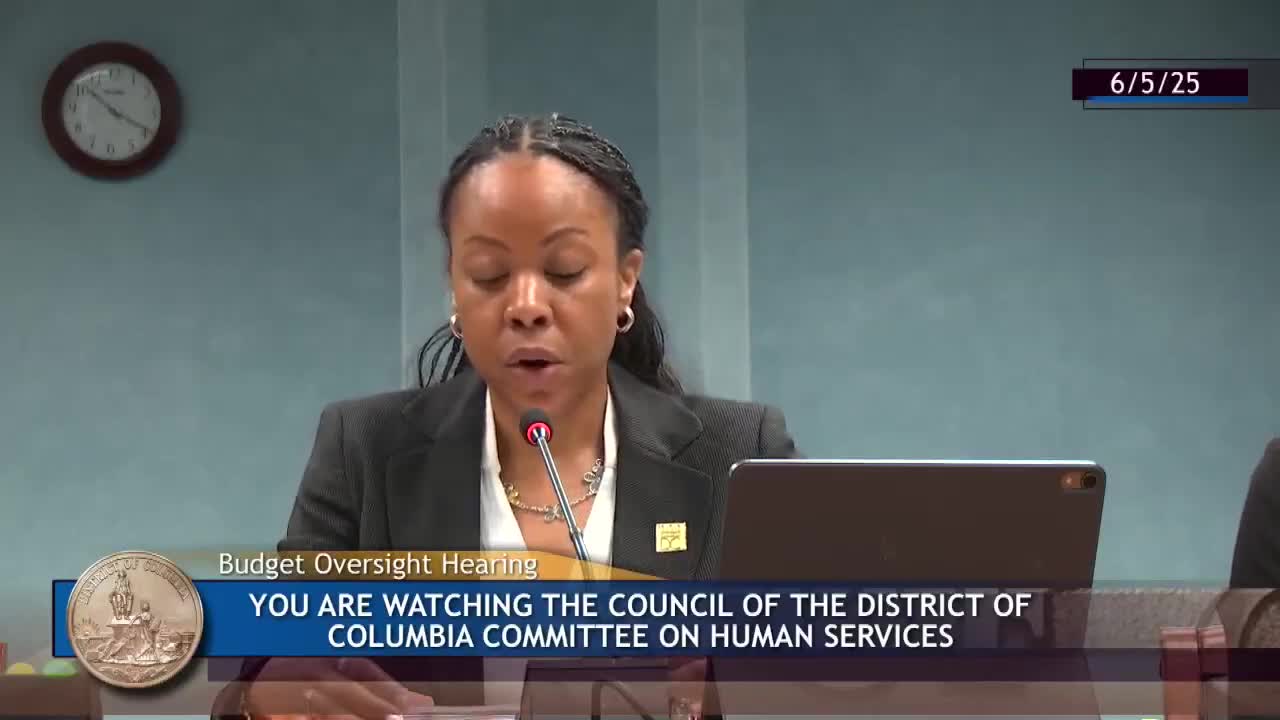
The Committee on Human Services held a budget oversight hearing June 5 on the Department of Human Services' (DHS) proposed FY2026 budget and the Proposed Budget Support Act (BSA), where DHS officials described a fiscal pressure that they said required changes to the city's locally funded Temporary Assistance for Needy Families program (local TANF). The hearing was convened by Councilmember Matt Fruman, Ward 3, chairperson of the committee, in Room 123 of the John A. Wilson Building and online.
DHS interim director Rachel Pierre told the committee the local TANF program is growing at an unsustainable pace and that the BSA would start a phased stepdown for households that have been receiving local TANF for more than 60 months beginning in fiscal 2027. "Our local TANF program is on trajectory to grow by $56,000,000 in the next 4 years, which is just unsustainable," Pierre said. She also described other changes: increasing penalties for noncompliance with engagement requirements and pausing the local cost-of-living adjustment that previously indexed benefits.
Why it matters: TANF provides cash assistance to very low-income families and interacts with other programs (SNAP, housing and workforce services). Council members warned that reversing prior reforms and adding sanctions could push families into deeper hardship unless paired with stronger workforce pathways and hardship protections.
Councilmembers pressed DHS on the substance and timing of the changes. Councilmember Nadeau challenged the move to restore time limits and sanctions, saying the committee's earlier working-group reforms had removed time limits because "they were arbitrary and they were not changing behavior." She added, "The sanctions weren't working. The sanctions didn't work." Councilmember Henderson called for the agency to provide more data and asked how many households would be affected; DHS staff said roughly 6,500 current TANF households had already passed the 60-month benchmark and that figure represented about one-half of enrolled households.
DHS officials emphasized that the BSA language would be accompanied by a working group and a hardship policy. "We will plan on having a working group," Pierre said, and she described planned outreach to consumers, advocates and stakeholders to develop hardship exceptions and implementation details.
Council members also pressed DHS on alternatives to sanctions, and whether the administration had strengthened employment and training pathways before increasing penalties. Pierre pointed to the department's recently restructured "2-gen" TANF model and performance-based contracts for training providers and said the department planned to continue investing in programs such as CareerMap. "We have implemented a 2-gen program that really allows families to have many other opportunities to engage," she said.
What DHS proposed (as described at the hearing): the BSA would suspend the local TANF cost-of-living adjustment in FY26 and ongoing unless revised; begin a phased stepdown of benefits for households beyond 60 months starting in FY27; and increase the reduction in the parent portion of the grant for noncompliance from 6% to 25% (for households not meeting engagement requirements) as part of a package DHS says is intended to make the program financially sustainable while promoting engagement and work.
Questions and next steps: Council members repeatedly urged DHS and the mayor's office to allow the committee and stakeholders time to review and to convene the promised working group before the BSA's provisions are enacted into law. Several members said they would prefer pausing the proposed statutory changes while the working group studies alternatives and ramps up employment and training capacity. DHS said it is prepared to convene that working group and provide additional data on who would be affected and on administrative implementation.
DHS and council members also sought more precise metrics to judge whether increased penalties would improve employment outcomes and how to mitigate benefit cliffs when families increase earnings. Pierre said the department measures employment and vocational participation and will provide more detailed outcome data to the committee in follow-up briefings.
Ending note: Committee members accepted DHS's offer to assemble a working group and a hardship policy, but several members said they would not support changes that cut households without a clearer plan for workforce attachment or other mitigations. The BSA remains proposed; whether the council adopts its TANF provisions will depend in part on the working-group findings and any changes lawmakers make during the budget process.