Get Full Government Meeting Transcripts, Videos, & Alerts Forever!
Get email alerts on the Net Zero Costs Reliability topic
No spam. Unsubscribe anytime.
Mackinac Center presentation warns net‑zero pathway could raise costs and risk outages
Summary
Jason Hayes of the Mackinac Center presented modeling comparing a wind‑solar‑battery pathway and a nuclear‑and‑carbon‑capture pathway, saying the former would be costlier and could produce multi‑day capacity shortfalls while the latter would be cheaper and avoid shortfalls in the model.
Jason Hayes of the Mackinac Center presented the committee with an advance summary of a forthcoming study that modeled two pathways for Michigan to reach statutory clean‑energy targets: a wind/solar/battery (WSB) pathway and a lower‑cost decarbonization (LCD) pathway that relies on carbon capture and expanded nuclear.
"There is no 0, no inexpensive way to meet the CO2 emission reduction targets that Michigan officials have written into legislation," Hayes told the committee, warning that a WSB pathway in the group’s model required extensive overbuild and still produced capacity shortages. Hayes said the WSB scenario carried an estimated construction and system cost of about $360 billion through 2050 and the model produced contiguous capacity shortfalls of as much as 61 hours in January in some runs.
In contrast, Hayes said a LCD scenario that extended existing plant lives with carbon capture and staged construction of new nuclear units reduced modeled costs to about $206 billion through 2050 and produced no modeled capacity shortfalls. Hayes summarized modeled customer bill impacts by scenario: the WSB pathway raised average utility bills by about $230 over the study period, while the LCD pathway rose by about $125, in the modeling results presented to the committee. Hayes also noted his modeling found little measurable change to global temperatures from Michigan's actions alone (he cited a modeled change on the order of 0.0015°C).
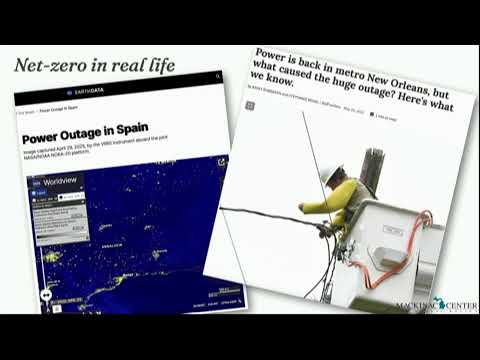
Hayes and the committee referenced grid‑operator analysis and recent events to underscore reliability concerns. He cited statements from the Midcontinent Independent System Operator (MISO), FERC and NERC that increasing shares of weather‑dependent, nondispatchable generation can raise reliability risk; he also pointed to recent rolling outages in other regions as examples. Hayes told lawmakers that MISO’s recent capacity auction price spike — from about $30 per megawatt‑day to roughly $666 per megawatt‑day in his description of the auction results — signals growing need for reliable capacity.
During the Q&A, lawmakers said they shared concerns about cost and reliability but differed on technology preferences. Some members pressed Hayes on whether a middle path of continued wind/solar deployment combined with dispatchable gas and a build‑out of nuclear could be acceptable; Hayes said the LCD scenario was intended to provide flexibility and noted tradeoffs among affordability, reliability and emissions.
Hayes closed by urging the committee to prioritize energy security and consider the economic impacts of the state’s statutory targets as rulemaking and implementation proceed.
Ending: The committee filed the presentation into the record and moved to other business; no committee action was taken on the basis of the presentation.