Get Full Government Meeting Transcripts, Videos, & Alerts Forever!
Get email alerts on the Transportation topic
No spam. Unsubscribe anytime.
Minn. House passes transportation bill after debate over transit cuts and Anoka County footbridge mandate
Summary
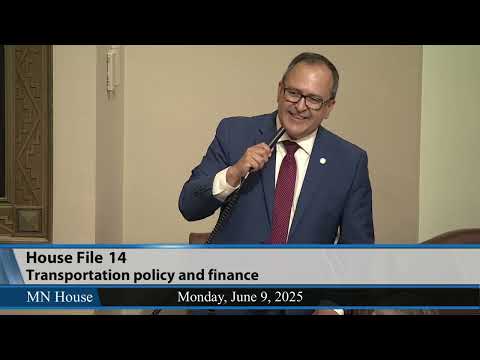
The Minnesota House passed House File 14 on June 6, 2025, by a 78-55 vote after members debated transit funding cuts, protections for the 2024 greenhouse gas mitigation law, changes to EV fees and a failed amendment that would have removed a provision directing Anoka County to use sales-tax revenue for a pedestrian bridge.
The Minnesota House passed House File 14, a transportation budget bill, on June 6, 2025, by a roll-call vote of 78-55 after several hours of debate that included a failed amendment to remove a requirement directing Anoka County to use part of its sales-tax receipts for a footbridge project.
The bill funds a mix of trunk-highway and transit programs, preserves the greenhouse-gas mitigation law enacted in 2024, modifies electric-vehicle fees (tiered by vehicle MSRP), and includes named capital projects and regional allocations. Representative Cagle, the bill author, said the measure "is the result of a broken deal" but defended provisions that preserve operating adjustments and several local projects, including a $10,000,000 appropriation for Duluth Airport and a $40,000,000 earmark for Lakeville.
Supporters and opponents traded sharp critiques over where cuts landed. Representative Cagle said the bill "is balancing the transportation budget on the backs of transit riders," and Representative Jones warned the bill "does not bring us forward" on transit expansion. Advocates for transit stressed the loss of proposed bus-rapid-transit funding and said some of the state's most transit-dependent residents would bear the brunt of reductions.
An amendment coded A2, offered by Representative Niska, would have removed a provision that mandates Anoka County spend a portion of its sales-tax revenue on a pedestrian bridge across the Rum River Dam and that directed the Department of Transportation to disperse a related grant "notwithstanding internal DOT guidelines, policies, or documents related to grant management." Representative Niska described the provision as "a pet project" and said "Anoka County doesn't want this project." Representative Stevenson and other supporters of the provision responded that the language implements a direct appropriation to a government unit and does not constitute misapplication of competitive-grant protections. The amendment failed on a roll-call, 62 ayes to 67 nays.
After debate and several exchanges about the process for finalizing bills, the House adopted the transportation bill. The clerk recorded the final passage as 78 ayes and 55 nays. The motion to suspend the rules earlier in the session to give House File 14 additional readings and place it on final passage was approved by voice vote.
The bill contains multiple line items and localized earmarks that lawmakers described as both protective of 2023 gains and the result of difficult bargaining: Representative Cagle noted a $22,000,000 cut to Greater Minnesota transit for the upcoming biennium while also listing projects funded through an "empowering small communities" program, including $2,700,000 for Crookston. Members also described restored county allocations after negotiations removed a proposed $93,000,000 diversion of county-directed funds.
Speakers on the floor repeatedly raised concerns about process and transparency. Representative Bliss expressed disappointment that leaders' agreement limited amendment options and public input, saying the schedule "limits the transparency" and reduces time for citizen comment. Others framed the bill in the context of larger fiscal constraints: Representative Cosmic (Kosnick) and Representative Quam warned of a multi-billion-dollar structural deficit that requires restraint.
Representative Jones recounted a constituent's commute to underscore gaps in regional connectivity, saying a constituent now pays about $30 per Lyft ride when reliable transit options are unavailable, and cited the long-term maintenance backlog for Minnesota roads as a reason to prioritize different approaches, including transit investment. He concluded with a paraphrased quote about public transportation that he attributed to Bogota's former mayor Enrique Peñalosa: "A developed country is not a place where the poor have cars. It's where the rich use public transportation."
The bill also includes language modifying EV fees tied to vehicle MSRP and establishes a working group to study kilowatt-hour charging. Lawmakers noted continued funding for state trooper academies and trunk-highway maintenance. Multiple members said the bill preserves the 2024 greenhouse-gas mitigation law and resists proposals to repeal it.
Votes at a glance: the A2 amendment (Anoka County pedestrian bridge mandate) failed 62–67; House File 14 passed 78–55. Earlier parliamentary motions included a voice vote to suspend rules and place the bill on final passage.
Lawmakers signaled that additional policy work on transit expansion and project funding will continue in future sessions. The bill now moves to the next stage of the legislative process for enactment procedures not recorded in this floor transcript.