Get Full Government Meeting Transcripts, Videos, & Alerts Forever!
Get email alerts on the Housing Affordability topic
No spam. Unsubscribe anytime.
Public commenters urge Santa Barbara council to commit $5 million annually to local housing trust fund
Summary
Multiple residents and housing advocates at the City Councilstrategic planning workshop urged the council to prioritize a $5 million annual allocation to the local housing trust fund and outlined several potential funding sources and near-term steps.
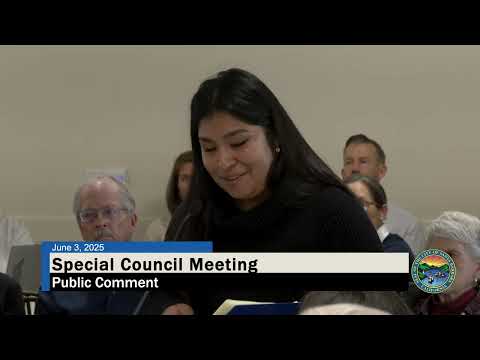
Speakers at a Santa Barbara City Council strategic planning workshop on June 3 pressed the council to approve a regular $5 million annual contribution to the city—s local housing trust fund to accelerate construction and preservation of affordable housing.
Members of local housing advocacy groups, a representative of the Housing Authority and long-time residents described worsening housing affordability and called for the council to use a mix of city reserves, Measure I and Measure C allocations, loan payoffs and other near-term options to reach the $5 million target.
Rob Fredericks, with the Housing Authority of the City of Santa Barbara, told the council that housing is the foundation that other services depend on. "Without affordable places to live, our workforce, seniors, and disabled residents are left behind, and the vitality of our community suffers," Fredericks said.
Larry Severance, speaking on behalf of CLUE Santa Barbara and as a resident, laid out a multi-part proposal the public suggested for raising roughly $5 million. He said city staff had proposed $1.5 million for the local housing trust fund, and he urged reallocating portions of Measure I—s $1.5 million undesignated housing and homeless services allocation, applying an $800,000 projected Measure I surplus for the current year, directing affordable housing loan payoffs to the trust fund (he estimated that could raise up to $1 million), and deferring some Measure C paving projects to free up roughly $1 million. Severance also suggested freezing three police positions identified in Measure I, temporarily lowering the reserve policy, and using a small portion of remaining Measure C funds to close any gap.
"Finding $5,000,000 for the local housing trust fund, an amount that would greatly increase its ability to leverage other sources, remains an elusive goal," Severance said. "You could begin by prioritizing $5,000,000 for the local housing trust fund, and then following up when you finalize the budget next week."
Other public speakers framed the ask in terms of urgent local needs. "You've already shown leadership by adopting a strong housing element last year," Fredericks said. "Beyond Measure I allocations, I urge you to also consider modest amendments to your reserve policy and explore leveraging a portion of your investment portfolio to support and invest locally in 100% deed-restricted affordable housing." Linda Honickman, who described long ties to the community, urged prioritizing local residents and local workers in housing decisions. Angeliza, a community organizer with Cause, said the question is "where our constituents— needs are, especially during these very difficult times."
Speakers requested that council members and staff work with community organizations on a long-term strategic housing plan and identify both near-term funding and structural steps to speed production of deed-restricted units. Several speakers also emphasized the role of matching state funds and local leverage.
Council and staff did not take a formal vote on funding at the workshop; the session was framed as a strategic planning retreat rather than a budget hearing. City staff and the consultant leading the retreat said the workshop is intended to inform a 3- to 5-year strategic framework and further community engagement rather than to make immediate budget allocations at the meeting. Mayor Rausch and staff confirmed the retreat was not the final step on the upcoming budget, which council planned to adopt in mid-June.
The public comments add to an ongoing council-level conversation about how to balance multiple priorities amid projected budget pressures and a multiyear planning horizon. Members of the public said they expect the trust fund ask to be taken up again during the formal budget deliberations and follow-up planning steps.
Ending
Councilmembers and staff acknowledged the public comments and said the priorities raised during public comment would be incorporated into the broader strategic planning process and the next steps for community engagement and budgeting. No formal council action occurred during the workshop on the funding requests; advocates signaled they will return during the budget process to press for the allocations discussed.