Get Full Government Meeting Transcripts, Videos, & Alerts Forever!
Get email alerts on the Property Taxation topic
No spam. Unsubscribe anytime.
Coconino County staff recommend Truth in Taxation notices as levy rises; rate falls under formula
Summary
Coconino County finance staff recommended beginning statutory legal notices and scheduling a Truth in Taxation hearing for June 24 after proposing a 2% general-fund levy increase that, due to higher assessed values, would lower the primary tax rate from $0.49 to $0.48 per $100 of assessed value while increasing levy dollars.
Coconino County finance staff recommended the board begin legal notices and schedule a Truth in Taxation hearing for June 24 after proposing budget assumptions that include a 2% increase to the general fund property tax levy.
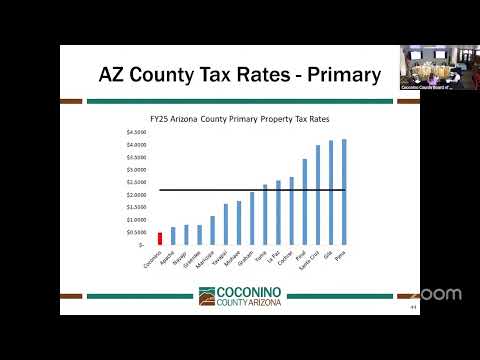
Siri, identified in the meeting as a county finance staff member, told the Board of Supervisors that the county would collect about $11 million in general-fund property tax under current rates and that a full allowable 2% levy increase would raise levy dollars by roughly $368,000 on a roughly $100 million general-fund budget. "It can be used for any county purpose," Siri said, and noted that because limited assessed values rose faster than 2% this year, the primary tax rate would fall from $0.49 to a recommended maximum allowable $0.48 per $100 of assessed value even as the county collects more in levy dollars.
The presentation stressed that Coconino County still has the lowest primary property tax rate of any county in Arizona. Siri warned that the county's historically conservative use of taxing capacity led to a situation where the county is effectively locked into a low rate: "If we do this property tax notice of tax increases... our rate will be 48¢," she said while explaining the arithmetic linking assessed value, tax rate and levy.
Why the rate can fall while the levy rises was a focal point. Siri explained that taxes owed equal taxable (limited) assessed value multiplied by the tax rate. Because limited assessed values on properties already on the roll increased by an average of about 4.4% while the levy increase requested is 2%, the formula produces a lower rate to reach the target levy. Siri summarized: "It's a tax increase. It's a rate decrease." Supervisor Vasquez said he was having difficulty following that result and asked for clearer public-facing language: "We're increasing... and then on the right, it's we're actually decreasing," Vasquez said, calling the outcome counterintuitive.
County staff also recommended keeping the Public Health Services District rate at its statutory maximum of $0.25 per $100 of assessed value. Siri said assessed values' 4.4% increase and a separate new-construction component would produce a combined 5.7% increase in that district's levy — about $326,000 on a roughly $5.7 million levy — and that the median residential impact would be about $2.65. Staff noted the public health levy is restricted to health and human services uses and also receives a general-fund maintenance-of-effort contribution of roughly $3.8 million annually.
Flood-control district staff recommended no change to that district's rate, which is already at a statutory or allowable maximum of $0.50 per $100 of assessed value. Siri said the flood-control levy would increase roughly 5.5% overall (about $578,000) because of valuation changes; the median homeowner impact for the three districts combined was shown in the presentation as about $10.04 (roughly a $10 increase from $329 to $339 annually, about 3%).
Staff and several supervisors flagged communication concerns for taxpayers. Multiple supervisors asked that the Truth in Taxation notices and any supplementary paid explanation language make clear the distinction between a levy increase and a rate change and explain how other taxing jurisdictions (schools, fire districts, the city and community college) appear on the same bill. Siri said the county can supplement the required legal notice with explanatory copy and links; the presentation also noted that other local taxing entities will be issuing similar notices around the same time.
The meeting included a procedural note about next steps: staff signaled they will begin the required statutory notices and publication process and that the actual tax-rate adoption will follow a public Truth in Taxation hearing on June 24. Siri reminded the board that the Truth in Taxation hearing process is a roll-call matter: the board opens the hearing, receives public comment, closes the hearing and then records individual roll-call votes on adoption of each rate or levy.
Board discussion also touched on historical context. Staff said that earlier conservative tax-rate practice contributed to Coconino's low position in the statewide rate comparison and that prior administrative practice had effectively frozen the county at a lower rate when its capacity went unused. Supervisors asked staff to provide a simple, public-facing explanation (one supervisor referenced an approach similar to Schoolhouse Rock) to reduce confusion and incoming constituent calls.
No formal rate changes or final votes occurred at the meeting; the staff recommendation is to begin the statutory notice and hearing process. The board will consider adoption after the public Truth in Taxation hearing on June 24 and associated roll-call votes.