Get Full Government Meeting Transcripts, Videos, & Alerts Forever!
Get email alerts on the Zoning And Planning topic
No spam. Unsubscribe anytime.
Washington County presents recodified planning code; shifts notice, enforcement and technical standards
Summary
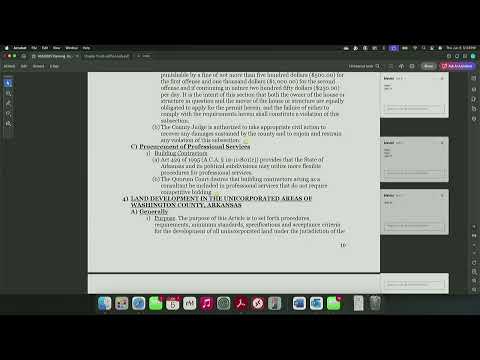
Washington County officials presented a draft recodification of the county's planning and zoning ordinances at a public hearing, saying the update consolidates decades of separate rules and moves online codification to the Arkansas Association of Counties.
Washington County officials presented a draft recodification of the county's planning and zoning ordinances at a public hearing, describing a reorganization of the county's land-use code, updates to technical requirements and a series of procedural changes that officials said will make the code easier to find and enforce.
The county's presenter, identified in the hearing as a representative of the county judge's office, said the change in codification moves the county from Municode to the Arkansas Association of Counties (AAC) for online codification. "State law requires that counties codify their ordinances at least every 5 years," the presenter said, and noted the AAC service is provided to member counties and reduces annual costs compared with Municode. "Municode exists solely to codify municipal, county, and parish codes, around the country and that's what they do," the presenter added, describing why the county had used Municode historically.
Why it matters
County staff said the primary purpose of the work is not to make large new policy changes but to consolidate and clarify decades of separate ordinances into a single, codified land-use code that the AAC can host and index online. Officials emphasized the recodification would make it easier for property owners, surveyors and developers to find definitions, approvals and cross-references that previously were scattered or in hard-to-read formats.
Key changes presented
- Codification platform and scope: The county will use the Arkansas Association of Counties for online codification; the presenter said the quorum court previously passed an ordinance to make that platform change. The presenter said the new codified code lists roughly 105 ordinances with hyperlinks so users can read underlying ordinances when needed.
- Zoning amendment status: The presenter said a previously proposed change to zoning was removed by the quorum court and is not part of the current public hearing.
- Consolidated definitions and organization: Staff consolidated definitions that had been dispersed across multiple sections into a single definitions section and moved several definitions into that section to reduce confusion (examples cited: "accessory buildings and uses," "administrative officer," and notification-area definitions for different project types).
- Removal of a codified anti-displacement plan: The draft removes an "anti-displacement" provision that had been entered by resolution. The presenter said resolutions are not codified and therefore the provision was removed from the codified text even though the underlying resolution remains in effect.
- Notification and application process: The draft shifts legal responsibility for sending neighbor notifications from the county planning office to the applicant or developer, though the planning department will supply a neighbor list and printed labels, and require proof of timely notification as part of the application. The presenter said this change reflects common municipal practice and saves staff time and expense.
- Enforcement and penalties: The recodification adds an explicit violation section and sets out that the planning department will notify the sheriff's office for enforcement; the sheriff's office would issue citations and citations would be adjudicated in district court. "The planning department would be the one that would notify the sheriff's office of a violation, and the sheriff's office would then issue a citation," the presenter said.
- Administrative roles and signatures: The code clarifies the administrative officer role is typically performed by the planning director (or their designee) and updates which county officials sign final plats and approvals, listing the planning director, the county road superintendent and the county judge as signatories when required in practice.
- Fees and fee-setting: The draft proposes that the planning board and planning department work together to set planning fees going forward rather than leaving fee-setting solely to the quorum court. Officials said the county's existing fees had not been updated since about 2016'17 and are lower than neighboring municipalities.
- Technical and procedural updates: The draft updates several technical standards and submission requirements, including accepting a single PDF for plan submission instead of multiple paper copies, revising contour-interval and topography standards (to allow 1-, 2-, 5- or 10-foot intervals depending on technology such as lidar), and adding a plat checklist and signature blocks for clarity.
- Minor subdivisions and plat review: The recodification clarifies when a division of land must be processed as a minor subdivision (for example, certain splits over or under five acres) and reiterates the need for utility and health-department signoffs prior to recording.
- Floodplain and hazardous materials language: The draft incorporates an updated flood prevention ordinance (identified in the hearing as previously adopted, referenced as Ordinance 2024-3) and replaces an unreadable decades-old hazardous-chemical list with a federal reference to current hazardous-chemical definitions.
Questions and clarifications during the hearing
Planning staff member Sam (identified in the hearing as planning department staff) explained some of the clarifications and procedural consolidations in the document. On minor subdivisions, Sam said, "It's just a clarification. It was in it's in our code, like, it's already there, but it's not explained."
Several participants asked whether the county judge retained final decision authority for certain appeals. Presenters pointed to older ordinance language (filed in the early 1990s) that had given the county judge authority to waive appeal requirements in limited contexts for land-use ordinances passed in 1991, and they emphasized the recodification preserved that historical language rather than creating new authority for conditional-use permits. The presenter said conditional-use appeals are handled in the conditional-use section and that the recodification did not change that practice.
What was not decided at the hearing
No formal vote on substantive policy changes was recorded during the presentation. The presenter repeatedly characterized the recodification work as organizational and technical, with "a few minor changes" but not a wholesale rewrite of substantive land-use policy. The quorum court previously made at least one separate decision to move the county's codification to the AAC, and that change was noted in the presentation.
Next steps and availability
County staff said the recodified draft is intended to provide an accessible, consolidated code for residents, surveyors and applicants and to allow the planning board and quorum court to pursue specific substantive amendments in a more orderly fashion going forward. Staff also said they would correct Scrivener's errors noted in the draft and that the planning department will maintain a list of current fees and provide application templates and sample neighbor-notification proofs for applicants.
Ending
The public hearing presented the recodified planning and zoning code primarily as an administrative consolidation with a set of procedural and technical updates; officials said the changes are intended to make the code easier to use and enforce, while leaving substantive policy decisions to future actions by the planning board and quorum court.